
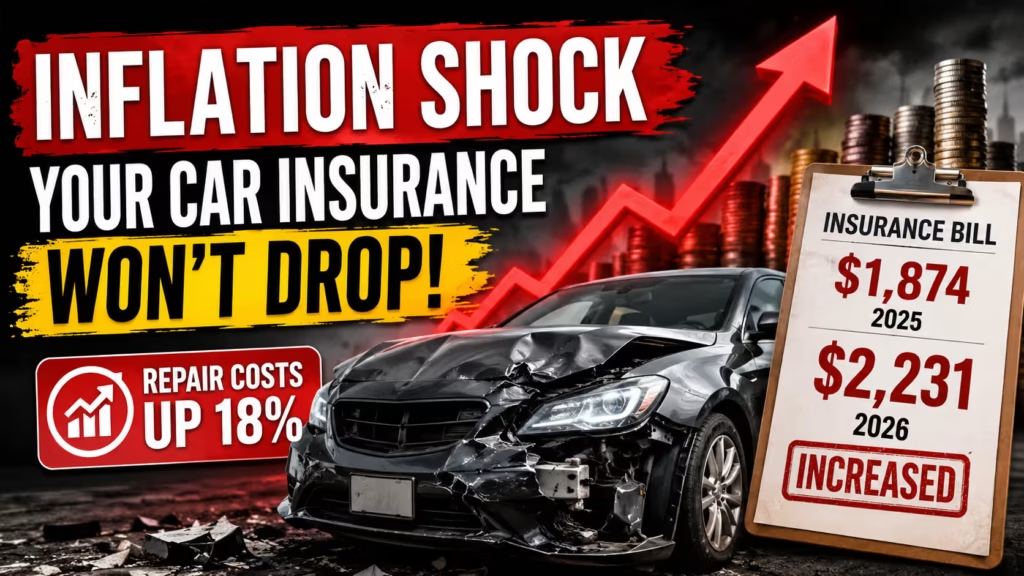
Take a deep breath. You aren’t imagining it. Even though gas prices stabilized and the news says inflation is “cooling,” your car insurance renewal just came in higher. Again. A 2026 fender bender that would have cost $2,100 to fix in 2019 now costs $4,500 or more. And insurers aren’t absorbing that difference — you are. The Insurance Information Institute projects that while the national average premium increase slowed to 1% in 2026 on paper, drivers in 19 states are seeing punishing 6% to 10.46% spikes. This “repair cost inflation trap” has replaced the used-car price surge as the number one driver of your premium.
The Brutal Truth: A car doesn’t have to be in a catastrophic crash to financially destroy your policy’s profitability for the insurer. The rise of Advanced Driver-Assistance Systems (ADAS), $30,000 EV battery packs, and an 18% spike in labor rates means that insurers are now totaling cars at a record rate for seemingly minor damage. Even if you haven’t filed a claim, your neighbor’s $4,500 bumper replacement is why your rate went up.
This guide strips away the macroeconomic jargon and tells you exactly which vehicle technologies are driving this silent surcharge, which cars to avoid buying if you hate paying for insurance, and five hardball negotiation tactics to claw your money back — starting with a quote comparison that takes 30 seconds.
The “Repairability” Crisis: It’s Not the Crash, It’s the Fix
Forget the sticker price of the car. In 2026, the most important number on your vehicle is its repairability score. Insurers use complex algorithms tracking parts availability, labor hours, and sensor recalibration requirements. The result? Cars that were affordable to buy are becoming unaffordable to insure.
- The Sensor Tax: A standard windshield replacement on a 2023 Honda Civic with ADAS requires $800-$1,200 in mandatory camera and radar recalibration, turning a $400 glass job into a $1,500 claim. A broken front radar sensor behind the bumper can cost $2,500 alone.
- Gigacasting & Mega Presses: Tesla and Toyota have pioneered giant cast metal parts to simplify manufacturing. But in a rear-end collision, a damaged Gigacasting part cannot be repaired — it requires a full structural teardown that easily costs $15,000-$20,000, instantly totaling the vehicle.
- Complexity Kills Savings: Cars with matrix LED headlights now have units costing $3,000+ each. While halogen bulbs were a $20 fix, these luxury features have turned simple parking-lot scrapes into loss leaders for insurance companies.
Which Vehicles Are the “Repair Cost Traps” of 2026?
Buying the wrong car in 2026 doesn’t just mean a high car payment — it means a monthly insurance bill that feels like a second car payment. Based on Quadrant Information Services data, these categories are seeing the most aggressive premium inflation:
Why a 1% Average Increase Is a Lie for Your State
National averages hide a violent divide. While some states stabilized, insurance is a local crisis in others. The 2026 forecast maps two very different Americas:
- The “Red Hot” States: New Jersey (+10.46%), Nevada (+6.42%), and Florida (consistently high) are getting hammered by a combination of uninsured drivers, catastrophic weather claims, and dense traffic where ADAS claims pile up.
- The Cooling States: Idaho, Maine, and Ohio are seeing flat or slightly negative premium movement thanks to lower traffic density and stable repair shop networks.
- The “Stealth” Factor: Even in states with a 1% average increase, your specific ZIP code might see a 7% hike if it’s a high-theft area for Kia/Hyundai models or has experienced severe hailstorms recently.
The “Total Loss” Trap: When a $5,000 Fix Totals Your $15,000 Car
Here is the silent killer in 2026. Historically, a car was repaired unless the fix cost exceeded 70-75% of the car’s value. Today, parts delays are so bad that insurers are adding “cost of rental car during repair” to the calculation. If a backordered ADAS sensor means waiting 60 days, the insurer must pay $2,100 for your rental car. Suddenly, a fix that was 65% of the value (economically repairable) jumps to 85% and the car is declared a total loss. This dynamic is flooding salvage yards and raising premiums for everyone.
5 Inflation-Beating Moves to Make Before Your Next Renewal
You can’t control the Federal Reserve, but you can starve off these insurance spikes with aggressive strategy:
- Exploit the “Loyalty Penalty.” Insurers reserve their best rates for new customers. A 2026 internal study by the National Association of Insurance Commissioners (NAIC) confirmed that loyal customers pay an average of 12% more after three years. Action: Ship your policy every 6 months. Use aggregator tools, pick the cheapest A-rated provider, and leave.
- Slash Your Mileage-Based Risk Score. If you’re driving less than 8,000 miles a year, you are overpaying if you aren’t in a telematics program. “Drive Safe & Save” or “Snapshot” can instantly offset 2026 inflation with a 10-25% discount — but only if you let them track you.
- Embrace the High Deductible Era. A $2,000 collision deductible is now a badge of financial intelligence. The premium savings versus a $500 deductible usually pays for the extra risk in 16 months. Given that claims under $2,000 shouldn’t be filed anyway (to avoid rate hikes), you aren’t losing protection — you’re just stopping prepayment of small losses.
- Ditch Physical Damage on “Beaters.” If your car is worth less than $4,000, you are likely giving more money to the insurer in comprehensive and collision premiums than you’d ever get back in a total loss. Cut it. Use the savings to boost your liability limits.
- Buy “Inflation-Proof” Cars. If shopping, check the IIHS “Insurance Loss” data. The Subaru Outback, Honda CR-V, and Toyota RAV4 are engineering benchmarks with high availability of aftermarket and salvage parts, making them statistical money savers against inflation.
Don’t Let Inflation Dictate Your Premium
Insurers change their algorithms daily. The company that was cheap two years ago might be gouging you today. Enter your ZIP code below to instantly pull the hottest 2026 quotes tailored to your car’s specific repairability score.
Get Your 2026 Car Insurance Quotes NowFinal Verdict: Keep Your Head, Cut Your Bill
Inflation in the auto insurance world isn’t a blanket tax — it’s a surgical penalty on those who buy the wrong cars or stay loyal to the wrong companies. The S&P Global 2026 “Repair Cost Index” shows no sign of retreating, meaning premiums will stay sticky. The only lever you have left is aggressive comparison shopping. You can’t fix the supply chain, but you can refuse to pay for its incompetence.
Sources: Quadrant Information Services (2026 Rate Projections), Bureau of Labor Statistics (Auto Repair & Body Shop Labor CPI), Insurance Information Institute (2026 Inflation Impact Report), S&P Global Mobility (Repair Cost Index), National Association of Insurance Commissioners (NAIC 2026 Trends), IIHS (Loss & Repairability Data).