
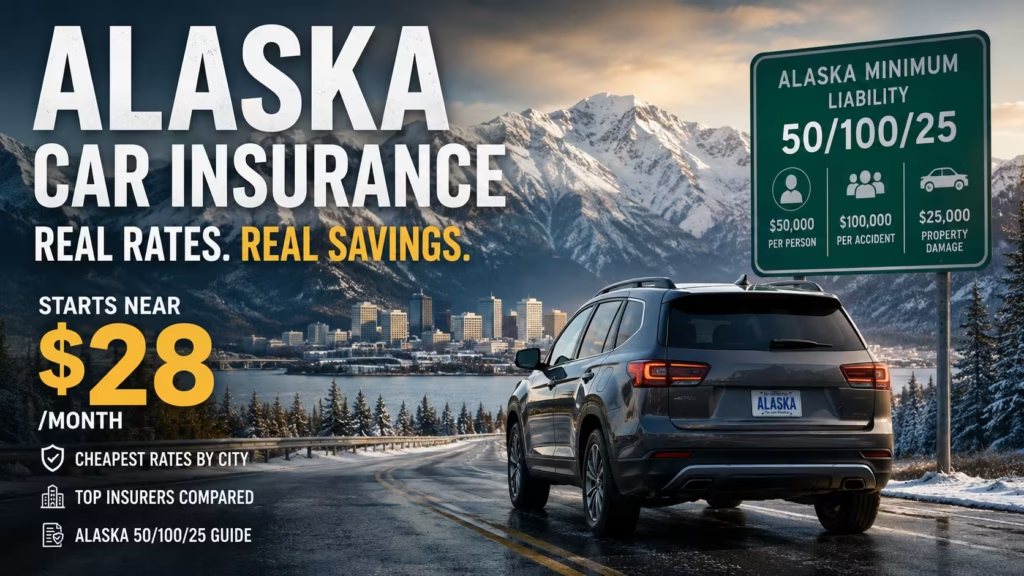
The cheapest car insurance in Alaska starts at the state’s 50/100/25 liability minimum, which averages roughly $33 to $35 a month statewide, with GEICO’s lowest reported rate running closer to $28 a month. Full coverage averages closer to $180 to $185 a month statewide. The carrier that’s actually cheapest changes by city, by ZIP code, and by driver profile — Anchorage, home to roughly 40% of the state’s drivers, consistently prices higher than road-disconnected communities like Juneau or Ketchikan. The fastest way to pay less is comparing several carriers against your own address, not accepting whatever number shows up on a renewal notice.
Key Takeaway: Cheapest car insurance in Alaska means the state’s 50/100/25 liability minimum, averaging around $33 to $35 a month, or full coverage averaging roughly $180 to $185 a month statewide. Rates vary sharply by location — Anchorage and Fairbanks price highest because of traffic density and claim frequency, while Kenai runs below the state average and communities with no road connection to the Alaska highway system, including Juneau, Ketchikan, Sitka, and Kodiak, post the lowest premiums in the state. GEICO, State Farm, and USAA (for military households) repeatedly surface as the cheapest carriers, with Alaska-based Umialik Insurance competitive for drivers who want local underwriting. Real savings comes from comparing carriers at your exact address, not assuming a single company or city average applies to you.
In practice, I see two kinds of Alaska drivers shopping for cheap car insurance: the ones chasing the lowest number on a single quote screen, and the ones who understand that Alaska’s higher-than-average liability minimums exist for a reason — a serious accident here can be just as expensive to settle as one in Seattle or Denver, even with far fewer cars on the road. This guide walks through what “cheapest” actually costs in 2026, which companies and cities price lowest, and where the state’s unique risks, like moose collisions and long distances between repair shops, change the math on coverage.
Navigate This Guide:
- How Much Is the Cheapest Car Insurance in Alaska in 2026?
- What Are Alaska’s Auto Insurance Requirements?
- Which Companies Offer the Best Auto Insurance in Alaska?
- How Much Does Car Insurance Cost in Anchorage, Alaska?
- How Much Does Auto Insurance Cost in Other Alaska Cities?
- How Do You Get Car Insurance Quotes in Alaska?
- What Discounts Lower Auto Insurance Rates in Alaska?
- Is Alaska’s Minimum Car Insurance Actually Enough?
- Why Is Car Insurance Cheaper in Some Alaska Cities?
- How Does a DUI or an Accident Affect Alaska Rates?
- How Can You Get the Cheapest Quote in Alaska?
- Frequently Asked Questions
How Much Is the Cheapest Car Insurance in Alaska in 2026?
For a driver with a clean record, the cheapest car insurance in Alaska at the state-minimum level averages between $33 and $35 a month, while a full-coverage policy averages closer to $180 to $185 a month. Alaska actually ranks among the more affordable states nationally for auto insurance — lower population density and less congested roads than most of the Lower 48 keep base rates down even though the state requires higher liability limits than almost anywhere else. Here’s how the numbers break down:
Average Monthly
Average Monthly
Minimum Quote
Reported Yearly
Those numbers move depending on which rate aggregator ran the study, which is normal — every comparison site pulls from a different mix of ZIP codes, driver ages, and sample carriers. A few 2026 sources report Alaska full coverage as low as $1,455 to $1,692 a year from GEICO alone; others put the statewide full-coverage average closer to $2,200 a year. None of them are wrong. They’re measuring slightly different driver profiles and coverage limits. The number that matters is the one tied to your own address and driving record, not a statewide headline.
What Are Alaska’s Auto Insurance Requirements?
Alaska’s car insurance requirements are set out under the Alaska Mandatory Motor Vehicle Insurance Law, AS 28.22.011 and AS 28.22.101, and they call for 50/100/25 liability coverage: $50,000 in bodily injury liability per person, $100,000 per accident, and $25,000 in property damage liability. This is the legal floor to register and drive in the state — and it’s noticeably higher than the alaska minimum car insurance floor set by most other states, which often require limits closer to 25/50/25 or lower.
- Bodily injury liability, $50,000 per person — pays for injuries you cause to another person in an at-fault accident, up to that per-person cap.
- Bodily injury liability, $100,000 per accident — the combined maximum paid out to everyone injured in a single accident you caused.
- Property damage liability, $25,000 — covers damage to another person’s vehicle, fence, or other property.
- Registration ties directly to compliance. In areas where vehicle registration isn’t required, liability insurance generally isn’t either, but the Alaska DMV can still require proof of insurance after certain traffic citations regardless of registration status.
Alaska is an at-fault (tort) state, which means the driver who causes an accident — not each driver’s own insurer — is financially responsible for the other party’s damages. Alaska also follows a pure comparative negligence rule under AS 09.17.060: a driver found even 90% or 99% at fault can still recover a proportionally reduced share of damages. That’s meaningfully more forgiving than the modified comparative negligence systems most states use, and it’s one reason Alaska personal injury claims can look different from a similar case filed in, say, Alabama or Georgia.
Which Companies Offer the Best Auto Insurance in Alaska?
No single carrier wins “cheapest” for every Alaska driver — the winner shifts based on your city, age, military status, and whether you’re pricing minimum or full coverage. Five carriers show up repeatedly at or near the top of 2026 Alaska rate comparisons for the best car insurance in Alaska and the best alaska auto insurance value combined:
During a claim analysis at most insurance companies, price and claims-handling quality are priced independently of each other — the cheapest quote on paper isn’t automatically the carrier that pays fastest or fights hardest at renewal. Weighing a company’s complaint ratio and AM Best financial strength rating against its quote is worth the extra ten minutes before you sign, especially in a state where the nearest alternative repair shop or adjuster may be a flight away.
See Your Actual 2026 Alaska Rate
Compare cheap car insurance quotes alaska drivers qualify for from multiple carriers, matched to your exact city, vehicle, and driving record.
GET YOUR 2026 CAR INSURANCE QUOTESHow Much Does Car Insurance Cost in Anchorage, Alaska?
Car insurance in Anchorage runs higher than the Alaska statewide average, and the reason is almost entirely mathematical: Anchorage accounts for roughly 40% of Alaska’s total population, according to U.S. Census data, while no other single Alaska city holds more than about 5%. That concentration produces more traffic per mile of road, more claims per insured driver, and — as a direct result — the state’s highest average premiums for auto insurance in Anchorage.
Average Monthly
Average Monthly
ZIP Codes, Annual
Population
Even within auto insurance Anchorage Alaska pricing, the range is wide. The most expensive Anchorage ZIP codes have priced above $2,400 a year for full coverage in 2026 studies, while a driver on the quieter edges of the municipality can land closer to the state average. If you’re comparing car insurance Anchorage Alaska quotes and one number looks dramatically higher than another for what seems like identical coverage, the ZIP code tied to where you garage the vehicle overnight is usually the reason, not the carrier itself.
State Farm has shown some of the lowest average rates for minimum coverage specifically within Anchorage in recent 2026 comparisons, while GEICO continues to lead on full coverage. A very common scenario I see: a driver relocates within Alaska — say, from Wasilla into Anchorage proper for work — keeps the same carrier, and is surprised when the renewal quote climbs. The rate didn’t change arbitrarily; the risk profile tied to the garaging address did. Updating that address the moment you move, rather than waiting for renewal, avoids a mid-term correction that can look like a rate hike but is really a data catch-up.
How Much Does Auto Insurance Cost in Other Alaska Cities?
Outside Anchorage, where you garage your car moves the price almost as much as your driving record does. Alaska’s rate spread between its cheapest and most expensive communities is wide enough that a driver who moves without updating their policy address can end up meaningfully overpaying.
A driver who moves from Anchorage to Juneau and forgets to update their policy address keeps paying Anchorage-level rates — reported as roughly $29 a month more than the correct Juneau rate with the same carrier in recent studies. That gap alone is often larger than any single discount you’d otherwise be chasing.
How Do You Get Car Insurance Quotes in Alaska?
Getting accurate car insurance quotes Alaska drivers can actually rely on comes down to giving every carrier the same precise inputs, not just your ZIP code and vehicle year. Because Alaska prices so heavily at the ZIP and even the neighborhood level, two quotes built on slightly different assumptions can look $30 to $50 apart without either one being wrong.
- Use your exact garaging address, not a nearby city name. Auto insurance quotes alaska carriers generate can shift meaningfully between neighboring ZIP codes, especially around Anchorage and the Mat-Su Valley.
- Quote the same liability limits everywhere. Comparing a 50/100/25 quote from one carrier against a 100/300/100 quote from another isn’t a real price comparison, even though both technically satisfy Alaska’s minimum.
- Decide on comprehensive and collision deductibles before you call. A $500 versus $1,000 deductible can shift a monthly quote by $15 or more, and you want every carrier quoting the same number.
- Disclose your full driving history upfront. A quote built without a known violation or accident isn’t the number you’ll actually be offered once underwriting runs a motor vehicle report.
- Ask each carrier directly whether it writes policies in your specific community. Not every national carrier actively writes new policies in every Alaska ZIP code, particularly in more remote areas.
At most insurance companies, an online quote engine gives you a fast estimate, but the bound premium can move once a licensed agent verifies your driving record and vehicle details — worth knowing before you assume the first number you see is final.
What Discounts Lower Auto Insurance Rates in Alaska?
Stacking several of these discounts, rather than relying on just one, is usually what separates a genuinely cheap Alaska policy from an average one.
Is Alaska’s Minimum Car Insurance Actually Enough?
The 50/100/25 minimum satisfies Alaska law and sets a higher floor than most states, but it still frequently falls short of what a serious accident actually costs. A single hospitalization can exceed $100,000 on its own — matching or exceeding the $100,000 per-accident bodily injury cap — leaving an at-fault driver personally exposed for the remainder.
State Minimum (50/100/25)
- Meets Alaska’s legal requirement to register and drive
- Cheapest possible premium — roughly $33 to $35/mo on average
- Does not cover your own vehicle at all
- Does not cover moose or animal-strike damage to your car
- No UM/UIM unless separately requested in writing
Recommended Coverage
- Higher liability limits, commonly 100/300/100
- Adds comprehensive and collision for your own vehicle
- Adds UM/UIM coverage and comprehensive protection against moose and animal strikes
- Meaningfully reduces personal financial exposure after a serious at-fault accident
- Premium runs closer to the $180–$185/mo full-coverage average
With more than 800 moose-vehicle collisions reported in a typical Alaska year, comprehensive coverage functions less like an optional add-on and more like a practical necessity for anyone driving outside a dense urban core. Because policyholders must actively reject or lower UM/UIM in writing to go without it in Alaska, it’s included by default on most new policies unless you opt out — worth knowing if a quote looks unexpectedly cheap.
Why Is Car Insurance Cheaper in Some Alaska Cities Than Others?
City-level pricing comes down to how insurers measure risk, not favoritism toward any particular town. Four factors drive most of the difference across Alaska:
- Road connectivity. Communities with no link to the Alaska highway system — Juneau, Ketchikan, Sitka, and Kodiak — cap how far residents can drive in a day, which directly limits accident exposure and keeps rates among the lowest in the state.
- Traffic density and accident frequency. Anchorage and Fairbanks carry far higher claim frequency per driver than smaller communities, which pushes both liability and collision pricing upward.
- Wildlife-collision risk. Rural and semi-rural roads with heavier moose activity raise the comprehensive portion of a policy specifically, independent of a driver’s personal record.
- Theft and vandalism risk. Vehicle theft rates factor directly into comprehensive pricing, and Alaska’s largest metro areas generally report higher rates than smaller communities.
At most insurance companies, none of these factors are unique to Alaska — the same logic prices California wildfire zones and Florida hurricane coastline. What’s specific to Alaska is the combination: extreme geographic isolation for some communities layered against real urban density in Anchorage and Fairbanks, which is exactly why the state’s cheapest and most expensive cities can differ by well over 50% on an otherwise identical policy.
How Does a DUI or an Accident Affect Car Insurance Rates in Alaska?
A DUI conviction or at-fault accident erases most of the savings a clean-record driver gets from shopping around, though the size of the increase still varies meaningfully by carrier.
- DUI conviction: Alaska has some of the toughest DUI laws in the country, with mandatory jail time of at least 72 hours and fines ranging from $1,500 to $25,000 for a first offense. On top of those penalties, insurers typically raise full-coverage premiums well above the state average.
- At-fault accident: A single at-fault claim can offset years of accumulated safe-driver discount. Because Alaska follows pure comparative negligence, even a dispute over the exact percentage of fault can affect how much of your own damages get recovered from the other driver.
- SR-22 filings: Certain violations, including a DUI or driving without insurance, can trigger a required SR-22 filing with the state. Not every carrier files SR-22 paperwork in Alaska, so confirming that upfront saves time when shopping post-violation.
- Driving uninsured: Beyond the coverage gap itself, Alaska can suspend a driver’s license for driving without the required liability insurance, independent of any accident.
None of this means a driver with a violation on record is stuck with one option. 2026 rate studies show Progressive remaining one of the more accessible carriers for drivers with a recent DUI or at-fault accident, roughly 17% below the statewide average for that profile, with State Farm and USAA also staying comparatively competitive.
How Can You Get the Cheapest Car Insurance Quote in Alaska?
Stacking these steps together, rather than picking just one, is what tends to produce the largest gap between a first quote and a final, cheaper policy.
- Compare national and Alaska-based carriers side by side. Get quotes from at least three to five companies, including Alaska-focused insurers like Umialik, not just the national brands with the biggest ad budgets.
- Confirm your exact ZIP-level rate. City averages can hide a wide gap between neighborhoods — ask each carrier for a quote tied to your specific address.
- Ask about every stackable discount. Request a full discount audit covering bundling, multi-vehicle, good student, military, defensive driving, low mileage, and telematics enrollment.
- Raise your deductible if you can absorb it. Moving from a $500 to a $1,000 deductible typically lowers the physical-damage portion of a full-coverage premium.
- Confirm comprehensive covers animal strikes. Given the state’s moose-collision frequency, verify the comprehensive deductible you’d actually pay before deciding it isn’t worth the extra cost.
- Add adequate UM/UIM instead of relying on the bare minimum. Pricing out real liability limits with UM/UIM is usually a smarter trade than the cheapest possible 50/100/25 policy.
- Maintain continuous coverage. A lapse, even a short one, is one of the fastest ways to see a renewal quote jump at your next term.
- Re-shop annually. Alaska premiums have moved meaningfully year over year across carriers, so last year’s cheapest option may not be this year’s.
Frequently Asked Questions About Cheapest Car Insurance in Alaska
How much is the cheapest car insurance in Alaska in 2026?
State-minimum liability coverage averages roughly $33 to $35 a month in Alaska, with GEICO’s lowest reported rate closer to $28 to $29 a month. Full coverage averages closer to $180 to $185 a month statewide, though GEICO’s cheapest full-coverage quotes have been reported as low as $121 to $141 a month in some 2026 rate studies. Your own number depends on your ZIP code, vehicle, and driving record.
What is the minimum car insurance required in Alaska?
Alaska law requires 50/100/25 liability coverage under AS 28.22.011 and AS 28.22.101: $50,000 in bodily injury liability per person, $100,000 per accident, and $25,000 in property damage liability. This is higher than the liability minimum in most other states, and it’s the legal floor to register and drive in Alaska, not a recommended coverage level.
What is the cheapest car insurance company in Alaska?
GEICO surfaces as the cheapest carrier for both minimum and full coverage across most 2026 Alaska rate studies. State Farm and USAA (for military members and their families) are frequently close behind, and Alaska-based Umialik Insurance is competitive for drivers who want a locally underwritten policy.
Is Alaska a no-fault or at-fault state for car insurance?
Alaska is an at-fault (tort) state, meaning the driver who causes an accident is financially responsible for the other party’s damages. Alaska also follows a pure comparative negligence rule under AS 09.17.060, so a driver found up to 99% at fault can still recover a reduced share of damages, unlike states that bar recovery entirely once a driver crosses a fault threshold.
Do I need uninsured motorist coverage in Alaska?
It isn’t legally mandatory, but Alaska insurers are required to offer uninsured/underinsured motorist (UM/UIM) coverage, and you must actively reject or lower it in writing to go without it. Most licensed agents recommend keeping it, since an out-of-state or uninsured driver’s policy won’t always meet Alaska’s 50/100/25 minimums.
Does Alaska use credit score to set car insurance rates?
Yes. Alaska permits insurers to factor a credit-based insurance score into pricing, unlike California, Hawaii, Massachusetts, and Michigan, where the practice is banned. A lower credit-based score can raise an Alaska premium meaningfully even with a clean driving record.
Why is car insurance more expensive in Anchorage than other Alaska cities?
Anchorage holds roughly 40% of Alaska’s population, which concentrates traffic density, theft exposure, and claims frequency in a way smaller communities don’t experience. Cities and communities without a road connection to the Alaska highway system, including Juneau, Ketchikan, Sitka, and Kodiak, consistently report the state’s lowest average premiums.
Is Cheap Car Insurance in Alaska Worth It in 2026?
For most drivers, yes — Alaska’s baseline rates run below the national norm for both minimum and full coverage despite the state requiring higher liability limits than almost anywhere else, and that gap holds up across nearly every 2026 rate study. But “cheapest” and “state minimum” aren’t synonyms. A driver who prices out 50/100/25 liability alone is choosing the lowest possible premium, not necessarily the smartest one, given how a single serious injury claim can exceed those limits and how exposed an uncovered vehicle is to Alaska’s moose-collision risk.
The drivers who get the most value treat their policy the way they’d treat any other major recurring expense — worth revisiting every year, not something to set once and ignore. If you haven’t compared car insurance quotes in alaska across at least three carriers this year, that’s the highest-leverage move available, regardless of how competitive your current rate looks on paper.
Sources: Alaska Division of Insurance, Alaska Department of Administration, Division of Motor Vehicles, National Association of Insurance Commissioners (NAIC), Insurance Information Institute (Triple-I), National Highway Traffic Safety Administration (NHTSA), Insurance Institute for Highway Safety (IIHS), National Insurance Crime Bureau (NICB), AM Best, Consumer Financial Protection Bureau (CFPB), State Insurance Department rate filings, 2026 industry rate aggregates.