
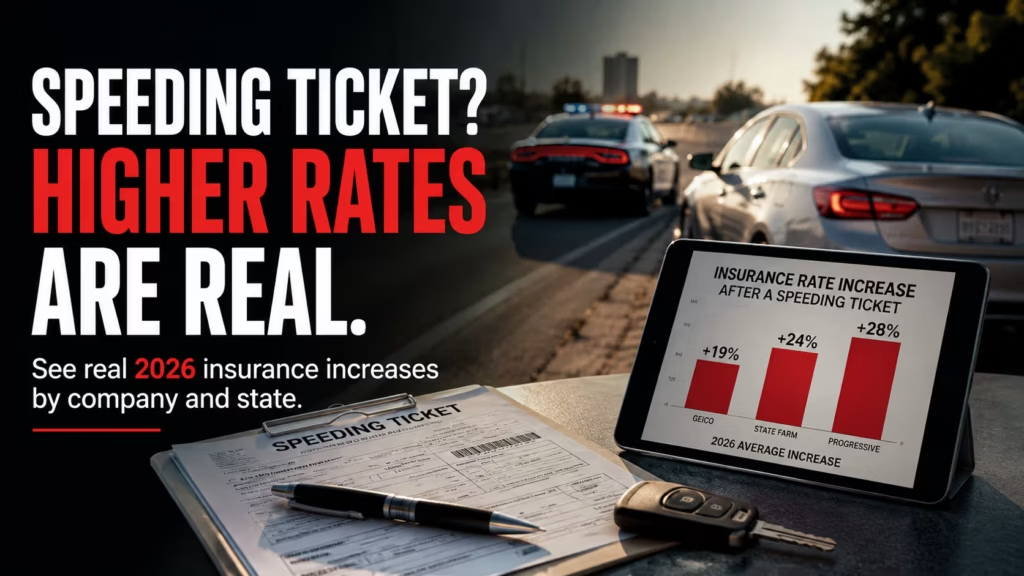
A single speeding ticket increases full coverage car insurance in the United States by an average of 20% to 30% in 2026, which translates to roughly $300 to $600 extra per year ($25 to $50 per month). Speeding is the single most common moving violation cited across U.S. roadways, affecting millions of everyday drivers who have never had an accident or needed high-risk filings. Because auto insurance carriers evaluate risk mathematically based on your Motor Vehicle Record (MVR), receiving a speeding ticket tells underwriters that your statistical probability of causing a crash has increased. However, the exact rate hike varies dramatically based on your auto insurance company, your state of residence, and how many miles per hour (MPH) over the posted limit you were driving.
Key Takeaway: Car insurance after a speeding ticket rises by an average of 24% nationwide in 2026, raising national full coverage averages from roughly $2,100 to over $2,600 annually. State Farm, Auto-Owners, Country Financial, and Erie offer the most lenient rate increases, with State Farm averaging only a 9% to 15% rate hike for a first offense. Speeding tickets remain on your driving record and impact insurance premiums for three to five years. Drivers can avoid or offset this rate surge by completing court-approved traffic school, shopping quotes prior to policy renewal, and taking advantage of stackable discounts.
Unlike extreme traffic violations that immediately push drivers into high-risk insurance markets requiring specialized filings, getting a ticket for driving 10 to 15 MPH over the speed limit is a violation most standard insurance companies accommodate. However, staying with your current carrier without comparing rates after a ticket is one of the most expensive mistakes American drivers make. This guide breaks down exact 2026 rate increases by carrier and state, explains how long citations penalize your policy, and details concrete steps to get cheap car insurance after a speeding citation.
Navigate This Guide:
- How Much Does Car Insurance Go Up After a Speeding Ticket in 2026?
- Which Companies Have the Cheapest Car Insurance After a Speeding Ticket?
- How Long Does a Speeding Ticket Stay on Your Insurance Record?
- How Does Speeding Severity (MPH Over Limit) Affect Insurance Rates?
- How Do Speeding Ticket Penalties Differ by State & Major City?
- Does Traffic School Remove a Speeding Ticket From Your Insurance?
- What Is the Difference Between a Speeding Ticket and SR-22 / DUI Insurance?
- How Can You Lower Your Car Insurance After a Speeding Ticket?
- Frequently Asked Questions
How Much Does Car Insurance Go Up After a Speeding Ticket in 2026?
Following a single speeding ticket, average national rates for full coverage auto insurance jump from approximately $175 per month ($2,100/year) to over $218 per month ($2,618/year). For state-minimum liability coverage, monthly rates increase from roughly $55 to $72 per month. If you receive a second or third ticket within a rolling 36-month window, premium increases escalate sharply as carriers reclassify you as a frequent offender.
First Speeding Ticket
Full Coverage Spike
Two Speeding Tickets
Insurance Premiums
It is crucial to understand that your car insurance rate does not jump the exact day an officer hands you a speeding citation or the day you pay the court fine. Insurers do not maintain live tracking of police databases. Instead, the court reports your conviction to your state’s Department of Motor Vehicles (DMV). When your auto policy comes up for its semi-annual or annual renewal, your insurer orders an updated Motor Vehicle Record (MVR). Only then is the rate surcharge calculated and applied to your new billing cycle.
Which Companies Have the Cheapest Car Insurance After a Speeding Ticket?
Auto insurance companies utilize proprietary actuarial formulas to calculate risk. As a result, two different insurance companies can look at the exact same driver with one speeding ticket and quote rates that differ by over $1,000 per year. In 2026 market benchmarks, certain regional and national carriers consistently penalize speeding citations far less aggressively than competitors.
Drivers facing unexpected rate hikes often wonder why baseline premiums differ so vastly between carriers. As analyzed in our deep-dive guide on car insurance rates going up in 2026, overall market inflation, rising vehicle repair costs, and regional litigation environments heavily compound individual violation surcharges.
How Long Does a Speeding Ticket Stay on Your Insurance Record?
A speeding ticket affects your auto insurance policy for **3 to 5 years**, depending on state legislation and your insurer’s rating window. However, the financial impact of a speeding ticket is not uniform throughout that entire duration. Insurers typically structure surcharges on a declining scale:
How Does Speeding Severity (MPH Over Limit) Affect Insurance Rates?
Not all speeding citations are created equal. Driving 6 MPH over the limit on an open interstate reflects a very different risk level than driving 35 MPH over the limit in a school zone or dense residential area. Insurance companies categorize citations into minor, major, and excessive speeding tiers:
Minor Speeding (1 to 14 MPH Over)
- Average Insurance Increase: 15% to 22%
- DMV Points: Typically 1 to 2 points
- Eligibility: Usually eligible for traffic school dismissal in most states
- Carrier Impact: Minor surcharge; easily offset by shopping around or adding discounts
Major / Excessive Speeding (15 to 29+ MPH Over)
- Average Insurance Increase: 30% to 50%+
- DMV Points: 3 to 4 points; severe license risk
- Special Laws: May trigger “Super Speeder” fines (e.g., Georgia) or reckless driving charges
- Carrier Impact: Can cause immediate loss of preferred driver tier or policy non-renewal
How Do Speeding Ticket Penalties Differ by State & Major City?
State regulatory frameworks dictate how DMV points are assessed, how long records remain public, and whether insurers are legally permitted to drop preferred discounts after a single offense. Metropolitan areas with higher traffic enforcement density—such as Los Angeles, Houston, Atlanta, Miami, Chicago, and Phoenix—see higher volumes of speeding citations annually.
See Your Actual 2026 Rate After a Ticket
Compare affordable auto insurance quotes from top carriers for your exact city, vehicle, and driving record before your policy renews.
GET YOUR 2026 CAR INSURANCE QUOTESDoes Traffic School Remove a Speeding Ticket From Your Insurance?
Yes, in many states, completing a state-approved **traffic school, defensive driving course, or driver improvement program** is the single most effective legal method to prevent a speeding ticket from raising your auto insurance rates.
When you complete an authorized course after receiving a court deferral, the court dismisses the violation or marks it as “confidential / masked” on your public Motor Vehicle Record. Because insurance underwriters only price violations visible on your public MVR, a masked ticket triggers **zero premium increase**.
- Eligibility Requirements: Usually requires a valid driver’s license, a minor speeding violation (typically under 20 MPH over the limit), and no traffic school attendance within the past 12 to 24 months.
- Course Format: Most states allow 100% online completion via accredited mobile-friendly platforms in 4 to 8 hours.
- Double Benefit: In addition to masking the ticket, some insurers offer a voluntary 5% to 10% defensive driving discount for completing the course.
What Is the Difference Between a Speeding Ticket and SR-22 / DUI Insurance?
A common misconception among drivers receiving their first citation is confusing a standard speeding ticket with high-risk violation categories like DUIs or SR-22 requirements. These represent completely distinct tiers of risk within insurance underwriting:
Standard Speeding Citation
- Violation Class: Minor / Moderate moving violation
- Insurance Impact: Average 20% to 30% rate increase
- SR-22 Filing Required? NO. Standard policy remains intact
- Carrier Availability: Retain access to all major standard carriers (State Farm, GEICO, Progressive)
- Market Classification: Standard / Preferred Driver Tier
DUI / SR-22 High-Risk Requirement
- Violation Class: Major criminal offense / License suspension
- Insurance Impact: Average 70% to 150%+ rate surge
- SR-22 Filing Required? YES. State certificate proving minimum financial responsibility
- Carrier Availability: Often requires non-standard carriers or specialized high-risk divisions
- Market Classification: Non-Standard / High-Risk Tier. Read our detailed SR-22 insurance cost & rules guide.
Note that if you drive an electric vehicle, speeding ticket surcharges combine with higher baseline repair expenses. Review our analysis on cheap electric car insurance quotes to see how EV technology impacts policy costs.
How Can You Lower Your Car Insurance After a Speeding Ticket?
If your speeding ticket is already recorded on your public driving record and traffic school is no longer an option, you can still take aggressive, practical steps to prevent your annual premium from skyrocketing.
Frequently Asked Questions
How much does car insurance go up after a speeding ticket in 2026?
A single speeding ticket increases full coverage car insurance by an average of 20% to 30% nationwide, translating to an extra $300 to $600 per year ($25 to $50 a month). The exact hike depends on your speed over the posted limit, state laws, and your insurer’s rating table.
Which car insurance company is cheapest after a speeding ticket?
State Farm, Auto-Owners, Country Financial, Erie, and USAA (for military families) consistently offer the lowest rate increases for drivers with a single speeding citation. State Farm raises rates by only about 9% to 15% on average for a first offense.
How long does a speeding ticket affect your car insurance rates?
In most states, a speeding ticket remains on your Motor Vehicle Record (MVR) and affects your insurance rates for three to five years. Premium surcharges are highest in years one and two, gradually tapering off in year three before dropping entirely.
Does a speeding ticket show up on car insurance immediately?
No. Your insurer does not actively monitor court filings in real time. Rate adjustments only occur when your insurer pulls your MVR prior to your policy’s semi-annual or annual renewal date.
Can taking traffic school hide a speeding ticket from insurance?
Yes. In states like California, Texas, Florida, and Arizona, completing an approved defensive driving or traffic safety course can mask or dismiss a first-time speeding ticket, preventing points from appearing on your MVR and avoiding an insurance increase.
Do you need an SR-22 insurance filing for a speeding ticket?
No. Standard speeding citations do not require an SR-22 certificate. SR-22 filings are reserved for severe violations such as DUIs, driving without insurance, or reckless driving suspensions.
Official Data Sources & Industry References:
• National Association of Insurance Commissioners (NAIC): naic.org
• Insurance Information Institute (III): iii.org
• Highway Loss Data Institute (HLDI) & IIHS: iihs.org
• State Department of Motor Vehicles (DMV) / Department of Insurance (DOI) statutory rate filings (2026 data).