
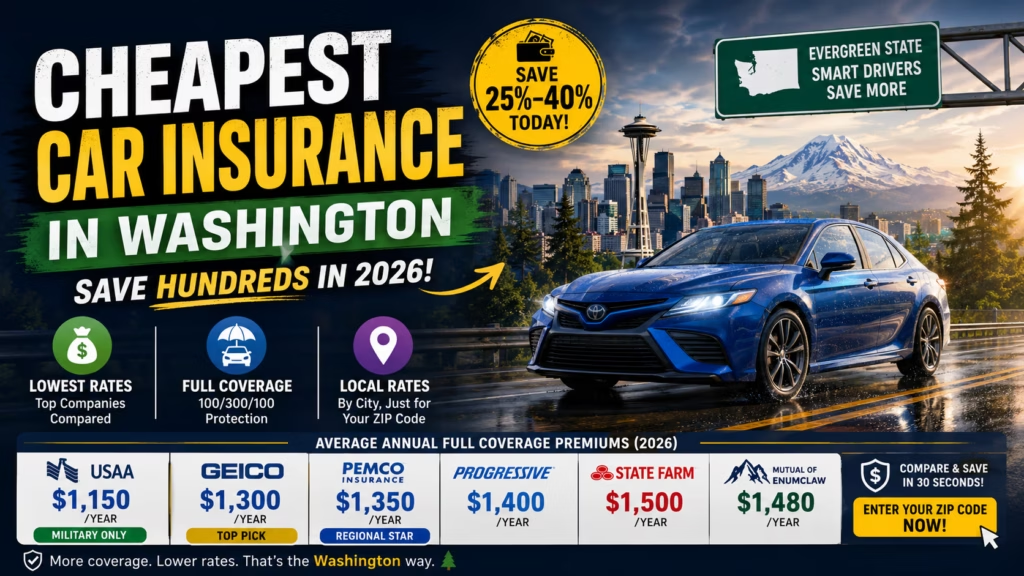
Washington State keeps you on your toes — literally and financially. While its average full coverage premium of $1,650 per year hovers near the national norm, the gap between a rain-soaked Seattle commute and a dry Spokane summer can swing your rate by hundreds of dollars. In 2026, the Evergreen State rewards drivers who understand its unique risk map and carrier landscape.
Quick Answer: The cheapest car insurance in Washington State for 2026 is GEICO at $1,300/year ($108/month) for full coverage, followed by USAA at $1,150/year (military only) and Progressive at $1,400/year. Regional champions like PEMCO often beat national carriers for safe drivers. For minimum coverage, rates start as low as $450 to $660 per year depending on your ZIP code and driving history.
The truth is, Washington’s competitive market — packed with national giants and beloved local insurers — creates a rare opportunity. If you know which companies dominate your ZIP code and which discounts stack, you can pocket 25% to 40% in savings without cutting corners on protection.
In this 2026 guide, we’ll unpack the cheapest car insurance companies in Washington, city-by-city rate comparisons, the state’s minimum coverage rules, and battle-tested strategies to keep your hard-earned money right where it belongs.
📑 Jump to Section:
Why Are Car Insurance Rates in Washington Moderate?
Washington sits in the middle of the pack nationally, but that “average” label hides sharp regional contrasts. Here’s what shapes your premium:
- At-Fault Tort System: Washington places financial responsibility on the driver who causes the accident. This keeps litigation costs lower than in no-fault states, preventing the rampant claim inflation seen in Florida or Michigan.
- Concentrated Urban Risk: Seattle-Tacoma-Bellevue accounts for over half the state’s population. The I-5 corridor’s chronic congestion, frequent rain, and high cost of living inflate premiums inside the metro area — while rates drop sharply once you cross the Cascades.
- Competitive Regional Market: Unlike states dominated by two or three carriers, Washington features strong regional players like PEMCO and Mutual of Enumclaw that keep national brands honest with aggressive pricing for safe drivers.
- Weather-Related Claims: Seattle’s 152 rainy days per year aren’t just a nuisance — they’re a statistical risk. Hydroplaning and wet-road collisions drive up comprehensive and collision claims west of the mountains.
According to Insurance Information Institute (III) 2026 data, Washington ranks as the 22nd most expensive state for auto insurance — but Seattle’s premiums alone would rank inside the top 10 if isolated.
Cheapest Car Insurance Companies in Washington (2026 Rankings)
We analyzed average annual premiums for a 40-year-old driver with a clean record, full coverage (100/300/100 liability + comprehensive + collision with $500 deductible), across all major Washington ZIP codes. Here are the winners:
| Rank | Insurance Company | Avg. Annual Premium | Best For |
|---|---|---|---|
| 1 | USAA Military Pick | $1,150/year | Active military, veterans, and eligible families. Huge presence around Joint Base Lewis-McChord and Naval Base Kitsap. |
| 2 | GEICO Top Pick | $1,300/year | Best overall for most WA drivers. Strong digital tools, excellent rates across all regions including pricey King County. |
| 3 | PEMCO Regional Star | $1,350/year | Northwest-born mutual company. Exceptional customer service and competitive rates for safe drivers, especially in Western WA. |
| 4 | Progressive | $1,400/year | High-risk drivers, younger motorists, and those who want Name Your Price tools. Strong SR-22 support. |
| 5 | State Farm | $1,500/year | Best for bundling home + auto. Massive agent network across Washington, strong in rural Eastern WA communities. |
| 6 | Mutual of Enumclaw | $1,480/year | Local favorite for farm, ranch, and rural property bundles. Excellent claims satisfaction in Eastern Washington. |
| 7 | Farmers | $1,550/year | Competitive for senior drivers and those with classic or older vehicles. Good multi-policy discounts. |
| 8 | Allstate | $1,700/year | Accident forgiveness and Claim Satisfaction Guarantee. Higher base rates but strong for drivers who want premium service. |
*Source: Quadrant Information Services, 2026. Rates are averages and vary significantly by ZIP code, age, credit score, driving record, and vehicle type. Always obtain personalized quotes before purchasing.
Average Car Insurance Rates by Washington City (2026)
Your city matters enormously in Washington. The rainy Puget Sound metro commands the highest premiums, while the drier, less congested east side offers genuine bargains. Here’s what GEICO — the cheapest national carrier for most WA drivers — charges across major cities:
| City | Avg. Annual Premium (GEICO) | Monthly Cost | Why It Costs What It Costs |
|---|---|---|---|
| Seattle | $1,700 | $142 | Highest in WA. I-5 congestion, 152 rainy days/year, elevated vehicle theft, high repair costs. |
| Bellevue | $1,600 | $133 | Affluent Eastside suburb with high vehicle values and I-90/I-405 traffic. Just below Seattle. |
| Tacoma | $1,550 | $129 | Port traffic, I-5 corridor exposure, moderate urban density. Slightly cheaper than Seattle. |
| Vancouver | $1,400 | $117 | Portland metro proximity. I-5 bridge congestion but lower theft rates than Seattle. |
| Olympia | $1,380 | $115 | State capital with moderate traffic. Government workforce helps stabilize risk profiles. |
| Bellingham | $1,300 | $108 | Smaller city, less congestion. Proximity to Canadian border adds minor cross-border exposure. |
| Spokane | $1,350 | $113 | Largest Eastern WA city. Drier climate reduces weather claims, but urban density keeps rates moderate. |
| Yakima | $1,250 | $104 | Lowest rates in a major WA city. Rural setting, minimal traffic, low crime, affordable repairs. |
*Note: These figures represent full coverage (100/300/100 + comp/coll, $500 deductible) for a 40-year-old with clean record. Minimum liability coverage costs approximately 60% to 70% less.
Want your exact rate? Enter your ZIP code here to get a personalized 2026 estimate based on your specific location, vehicle, and driving history.
Washington Minimum Car Insurance Requirements
Before you shop, understand what Washington law actually requires — and why the bare minimum is rarely enough in a state with Seattle-level medical costs.
Required Liability Coverage (25/50/10)
- Bodily Injury per Person: $25,000
- Bodily Injury per Accident: $50,000
- Property Damage per Accident: $10,000
Uninsured/Underinsured Motorist (UM/UIM)
Washington requires insurers to offer UM/UIM coverage equal to your liability limits. You can decline it in writing, but experts strongly recommend keeping it. Approximately 15% of Washington drivers are uninsured — one of the higher rates on the West Coast. UM/UIM protects you when they cause an accident. Given that a single ER visit in Seattle can exceed $25,000, this coverage is not optional for prudent drivers.
Should You Upgrade Beyond Minimums?
Absolutely. Washington’s minimums are among the lowest in the country. A single serious accident on I-5 can exhaust $25,000 in bodily injury coverage within hours. Experts recommend:
- 100/300/100 liability for most drivers
- 250/500/100 if you own a home in King County or have significant assets
- Full coverage (comprehensive + collision) if your vehicle is worth more than $4,000
How to Save Money on Car Insurance in Washington
Washington’s competitive market means discounts are abundant — but you have to ask for them. Here are the 7 most powerful money-saving strategies for Evergreen State drivers in 2026:
- Bundle Home and Auto Insurance (Save 10% – 20%): If you own a home or rent in Washington, combining your policies with State Farm, GEICO, or PEMCO instantly slashes your car premium. Bundling is the single fastest way to reduce costs, especially in expensive King County ZIP codes.
- Complete a Defensive Driving Course (Save 5% – 10%): Washington approves multiple online and in-person defensive driving courses. Most insurers honor this discount for 3 years. The course costs around $25 and pays for itself within 2 months.
- Raise Your Deductible (Save 10% – 15%): Increasing your comprehensive and collision deductible from $500 to $1,000 drops your premium significantly. Only do this if you have an emergency fund to cover the higher out-of-pocket cost.
- Pay Your Premium Annually (Save 5% – 10%): Monthly processing fees add up. Paying your 6-month or 12-month premium in full eliminates these fees and often triggers a paid-in-full discount.
- Maintain a Clean Driving Record: A single at-fault accident in Washington can spike your premium by 35% to 50% for 3 years. A speeding ticket on I-5 or I-90 adds roughly 20%. Drive carefully — your wallet depends on it.
- Improve Your Credit Score: Washington allows insurers to use credit-based insurance scores. Drivers with excellent credit pay up to 40% less than those with poor credit. Even a 50-point improvement can yield meaningful savings.
- Shop Around Every 6 Months: Washington’s market is too competitive to stay loyal to an overpriced insurer. Rates change constantly, especially in high-turnover Puget Sound. Compare rates from multiple carriers in under 30 seconds using our tool below.
Get Your Personalized Teen Car Insurance Quote
Enter your ZIP code below to get a highly accurate 2026 estimate based on your exact location, vehicle, and teen driver profile.
Get My ZIP Code Estimate NowSpecial Considerations for Washington Drivers
Rain, Hydroplaning, and Comprehensive Coverage
Seattle’s famous drizzle isn’t just a mood — it’s a claims multiplier. Wet roads contribute to 30% more collision claims in Western Washington compared to the state average. Comprehensive coverage is essential, especially if you park outdoors. Ensure your policy covers flood and water damage without exclusions. Good tires and safe following distances reduce your risk, but the right coverage is your financial backstop.
Rideshare Drivers (Uber & Lyft)
Driving for Uber or Lyft in Seattle, Bellevue, or Tacoma? Your personal auto policy will not cover you during Periods 1 and 2 (app on, no passenger; en route to pickup). You need a rideshare endorsement.
State Farm, GEICO, and Progressive all offer rideshare coverage in Washington for an additional $10 to $25 per month. Without it, a single accident during a rideshare trip can leave you financially ruined. This is especially critical on Seattle’s rain-slicked streets where accident risk is elevated.
SR-22 & High-Risk Insurance
Washington requires SR-22 filing for drivers with DUIs, license suspensions, or serious traffic violations. The SR-22 itself is just a certificate of financial responsibility — but the underlying premium increase is severe (often 200% to 400%).
For high-risk WA drivers, The General and Progressive are the most common SR-22 options. Expect to pay $3,200 to $5,800+ per year until the violation drops off your record (typically 3 to 5 years). A DUI in Seattle can push your annual premium past $6,000.
Good Student Discounts for Teen Drivers
Washington has over 350,000 teen drivers. If your student maintains a B average (3.0 GPA) or higher, most insurers offer 10% to 25% off. This applies to high school and college students under 25. With UW, WSU, and Western Washington in-state, the distant student discount (for students 100+ miles away without a car) can save up to 30%.
Government & Military Employee Discounts
Washington’s massive federal and military workforce — especially around Joint Base Lewis-McChord, Naval Base Kitsap, and Fairchild AFB — qualifies for special discounts. USAA serves military members and families at unbeatable rates. GEICO offers federal employee discounts. If you work for the government, ask your insurer specifically about federal employee or military discounts — they are rarely advertised but can save 5% to 15%.
Frequently Asked Questions About Washington Car Insurance
Who has the cheapest car insurance in Washington State?
GEICO offers the cheapest car insurance in Washington for most drivers in 2026, with average annual premiums of $1,300 for full coverage. USAA is even cheaper at $1,150 per year, but is exclusively available to military members, veterans, and their eligible families. PEMCO, a regional mutual insurer, often matches or beats GEICO for drivers with clean records, averaging $1,350 per year. Progressive follows at $1,400 per year, making it ideal for younger or high-risk drivers.
How much is car insurance per month in Washington State?
In 2026, the average monthly cost of full coverage car insurance in Washington is approximately $138 per month ($1,650 per year). However, this varies dramatically by location: Seattle drivers pay around $142/month with the cheapest carrier, while Yakima drivers pay as low as $104/month. Minimum liability coverage starts at roughly $38 to $55 per month depending on your ZIP code, age, and driving record.
What is the minimum car insurance required in Washington State?
Washington law mandates minimum liability coverage of 25/50/10: $25,000 bodily injury per person, $50,000 bodily injury per accident, and $10,000 property damage per accident. The state requires insurers to offer uninsured/underinsured motorist (UM/UIM) coverage, though you can decline it in writing. Experts strongly recommend keeping UM/UIM and upgrading to at least 100/300/100 for adequate financial protection — especially given Seattle’s high medical costs.
Why is Seattle car insurance so expensive?
Seattle car insurance costs 20% to 30% more than the state average due to four factors: (1) heavy traffic congestion on I-5, I-90, and SR-520 creating daily accident opportunities, (2) 152 rainy days per year increasing hydroplaning and wet-road collisions, (3) higher cost of living driving up medical and auto body shop rates, and (4) dense urban population creating more collision frequency. Seattle drivers pay $1,700/year on average, while Yakima drivers pay just $1,250/year — a $450 annual difference for identical coverage.
Does Washington require uninsured motorist coverage?
Not mandatory, but strongly recommended. Washington requires insurers to offer UM/UIM coverage with limits equal to your liability limits, but you can decline it in writing. With approximately 15% of Washington drivers uninsured — one of the highest rates on the West Coast — UM/UIM is essential protection. If an uninsured driver hits you on I-5 and you lack UM/UIM, you’ll pay your medical bills and vehicle repairs entirely out of pocket.
How much does insurance go up after an accident in Washington?
A single at-fault accident in Washington typically increases your premium by 35% to 50% for 3 years. For a driver paying $1,300/year, that’s an extra $455 to $650 annually — or $1,365 to $1,950 total over the penalty period. Some insurers, like Allstate, offer accident forgiveness programs that prevent your first accident from affecting your rate. Given Seattle’s high traffic volume and wet roads, accident forgiveness is worth considering for Puget Sound drivers.
Bottom Line: Washington Rewards Smart Shoppers
Washington’s car insurance market is a genuine win for consumers — if you shop strategically. With average full coverage premiums near the national average and a competitive landscape that includes strong regional players, the Evergreen State gives you a real opportunity to save. The key is understanding the Seattle premium bubble and using every discount available.
Your action plan for 2026:
- Get quotes from at least 5 companies — GEICO, PEMCO, Progressive, State Farm, and USAA (if eligible). Don’t ignore Mutual of Enumclaw if you’re east of the Cascades.
- Bundle your home or renters policy for an instant 10% to 20% discount.
- Ask about every discount — defensive driving, good student, low mileage, paid-in-full, federal employee, and telematics.
- Never settle for 25/50/10 minimums — upgrade to at least 100/300/100.
- Re-shop every 6 months — loyalty is expensive in a competitive market.
- Enter your ZIP code below to see your real, personalized rate in under 30 seconds.
Sources: Washington State Office of the Insurance Commissioner, Insurance Information Institute (III), Quadrant Information Services (2026 Rate Projections), Forbes Advisor Car Insurance Analysis 2026, National Highway Traffic Safety Administration (NHTSA), Washington State Department of Transportation.