
Fact-Checked & Reviewed by Licensed US Auto Insurance Experts | Updated for 2026
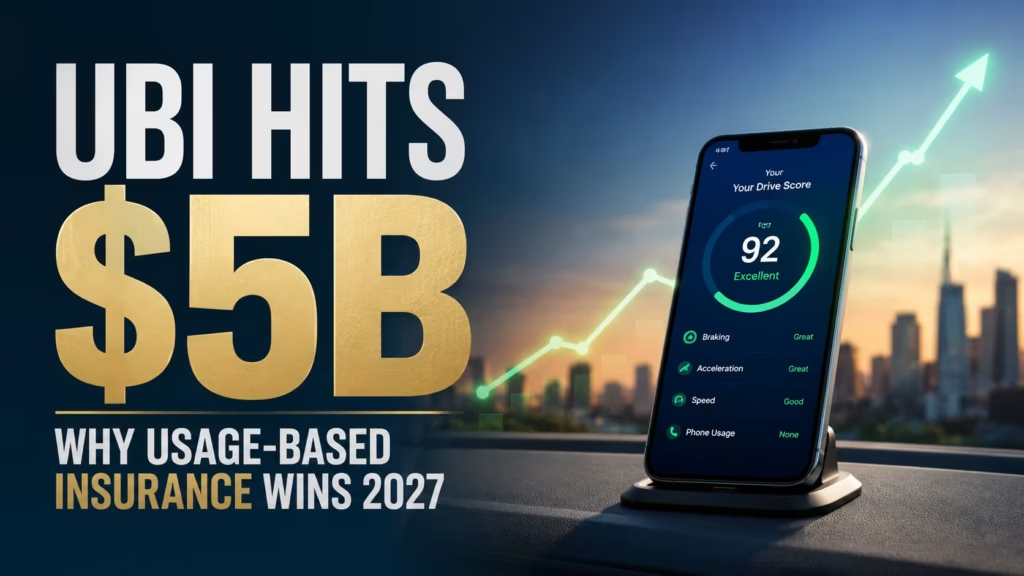
Usage-based insurance is no longer an experiment. It is a $4.2 billion market in 2026, projected to cross $5 billion by 2027 and reach $19.1 billion by 2035. That trajectory — an 18.3% compound annual growth rate — makes UBI the fastest-expanding segment in American auto insurance. What started as a niche offering for tech-savvy early adopters has become a mainstream product pushed by Progressive, State Farm, Allstate, and Nationwide. If you have not evaluated a telematics policy in the last 12 months, you are likely overpaying.
Key Takeaway
Usage-based insurance uses real driving behavior — mileage, braking, acceleration, time of day, and phone usage — to calculate premiums instead of traditional proxies like age, gender, or credit score. In 2026, safe drivers save an average of 22%, with top performers cutting premiums by up to 40%. If you drive fewer than 8,000 miles annually, avoid late-night trips, and do not brake hard, switching to a telematics program is the single highest-ROI move you can make before your next renewal.
The shift is structural, not cyclical. Remote work has permanently reduced commuting mileage for millions. Smartphone apps have eliminated the need for plug-in hardware. And AI-driven risk models now parse telemetry data with a granularity that was impossible five years ago. The result: insurers can price risk accurately, safe drivers get rewarded, and the old system of subsidizing high-mileage commuters with flat-rate premiums is cracking.
📑 Navigate This Guide:
- The $5 Billion Market: Hard Numbers
- How Does Usage-Based Insurance Actually Work?
- Which UBI Programs Save the Most?
- Why Remote Workers Are the Biggest Winners
- What Data Do Insurers Track — and What Don’t They?
- UBI by State: Where Regulations Help or Hurt
- Privacy, Data Ownership, and Your Rights
- How AI Is Reshaping UBI Pricing Models
- Common Mistakes That Kill Your UBI Discount
- Is UBI Worth It? A Decision Framework
- Your 2027 UBI Action Plan
- Frequently Asked Questions
The $5 Billion Market: Hard Numbers Behind the UBI Explosion
The global automotive UBI market stood at $3.55 billion in 2025. By 2026, it hit $4.2 billion. The 2027 projection is just under $5 billion, and by 2035 the industry expects $19.1 billion in annual UBI premiums globally. The 18.3% CAGR between 2026 and 2035 dwarfs the growth rate of traditional auto insurance, which hovers around 3% annually in the United States.
Domestically, the J.D. Power 2026 U.S. Insurance Shopping Study found that 44% of recent shoppers consider UBI important in their decision process. Nearly half of all new auto insurance customers express active interest in a usage-based program. That is not a fringe demographic. That is nearly every other person buying a policy.
What is driving this capital inflow? Three forces. First, telematics hardware costs have collapsed. A smartphone app replaces a $100 OBD-II dongle. Second, the pandemic permanently altered driving patterns. The 2020 remote-work cohort never fully returned to five-day commuting, creating a massive pool of underpriced low-mileage drivers that UBI can accurately capture. Third, AI models trained on billions of miles of telemetry can now distinguish a safe driver from a risky one with far greater precision than traditional actuarial tables.
How Does Usage-Based Insurance Actually Work?
Traditional auto insurance prices risk using proxies: your age, ZIP code, credit-based insurance score, marital status, and vehicle model. These factors are correlated with claims frequency, but they are indirect. A 45-year-old homeowner in a low-crime suburb with a clean record might still drive 18,000 aggressive miles per year. A 28-year-old renter in an urban ZIP code might drive 4,000 careful miles annually. Traditional pricing cannot tell the difference. UBI can.
When you enroll, your insurer collects telemetry through one of two methods. The majority of 2026 programs use a smartphone app that runs in the background and detects vehicle movement via GPS and accelerometer. Some carriers still offer or require a plug-in OBD-II device that reads directly from the vehicle’s diagnostic port. The app or device records speed, acceleration, braking force, cornering G-force, time of day, trip duration, and mileage. Some programs also detect phone handling while the vehicle is in motion.
This raw data feeds into a proprietary algorithm that generates a driving score — typically on a scale of 0 to 100. Your score is then mapped to a discount tier. Most programs offer a guaranteed participation discount (usually 5-10%) simply for signing up, followed by a performance-based adjustment after a 30- to 90-day monitoring window. Once your discount is locked in, it generally remains for the life of the policy, though some carriers re-verify annually.
Which UBI Programs Save the Most in 2026?
Not all telematics programs are built identically. The discount ceiling, the data weighting, the monitoring period, and the penalty structure vary significantly. Here is how the major players compare based on published program terms and aggregated consumer filings.
Which program wins? It depends on your driving fingerprint. If you are a low-mileage urban driver with occasional hard braking due to traffic, State Farm or Nationwide may treat you more fairly than Progressive. If you are a rural driver with long, smooth commutes and minimal night driving, Snapshot’s 30% ceiling is hard to beat. The only way to know for certain is to run parallel quotes.
Why Remote Workers and Retirees Are the Biggest Winners
UBI is fundamentally a mileage discount dressed in telemetry clothing. Yes, braking and acceleration matter. But the single largest variable in every algorithm is miles driven. A driver covering 4,000 miles per year is statistically unlikely to file a claim regardless of how aggressively they corner. A driver covering 16,000 miles is exposed to risk for four times as many hours.
Remote workers who transitioned to permanent work-from-home arrangements after 2020 are the most obvious beneficiaries. The U.S. Census Bureau’s 2025 American Community Survey shows that roughly 28% of full-time employees still work remotely at least three days per week. That cohort drives significantly fewer miles than their 2019 baseline. Yet many are still paying premiums calculated on pre-pandemic commuting assumptions.
Retirees represent the second major winner. Drivers aged 65+ who no longer commute, avoid rush hour, and rarely drive after dark check every positive box in a telematics algorithm. The average retiree enrolled in Nationwide SmartRide or State Farm Drive Safe & Save saves between 20% and 35%, according to carrier-reported data.
What Data Do Insurers Track — and What Rights Do You Have?
Transparency around telematics data has improved significantly since 2023, driven by state legislation and consumer backlash. Here is exactly what major UBI programs collect in 2026, and what they do not.
✅ Data Typically Collected
- Total mileage — the dominant pricing factor
- Hard braking events — deceleration exceeding a threshold, usually 7-8 mph per second
- Rapid acceleration — sudden speed increases flagged as aggressive
- Cornering force — lateral G-force on turns
- Time of day — late-night driving (10 PM – 4 AM) is penalized
- Trip duration — longer trips vs. short errands
- Phone usage — screen-on events while vehicle is moving
- Location/GPS — where you drive, not just how
❌ Data Generally NOT Collected
- Destination — carriers track routes but rarely sell destination data
- Conversations — microphone access is not standard in UBI apps
- Infotainment content — what you stream or listen to is not captured
- Biometrics — heart rate, body temperature, or health data is excluded
- Passenger identity — the app cannot tell who is driving
Under the NAIC’s 2025 Privacy of Consumer Information model guidance, insurers must disclose the specific data elements collected, the retention period, and whether the data is shared with third parties. California’s Consumer Privacy Act (CCPA) and Colorado’s Privacy Act grant consumers the right to request deletion of their telematics data upon policy cancellation. In practice, most major carriers now provide a dashboard where you can review your own driving score, dispute individual events (such as a hard-braking flag caused by a pothole), and opt out of GPS tracking while retaining mileage-based discounts.
UBI by State: Where Regulations Help or Hurt Your Discount
Auto insurance is regulated at the state level, and UBI is no exception. The same driver with identical habits will receive different discount sizes depending on where their garage is registered.
Ohio, Arizona, and Texas consistently produce the highest average UBI discounts. These states have competitive insurance markets with dozens of carriers, permissive telematics regulations, and no restrictions on how driving behavior data can be weighted in rate-setting. A safe driver in suburban Dallas or Columbus can realistically expect a 25-35% reduction.
California is more restrictive. Proposition 103 limits the factors insurers can use to set rates, and while telematics is permitted, the California Department of Insurance closely scrutinizes whether algorithms create proxy discrimination. The practical effect: UBI discounts in California tend to be smaller, often capped in the 15-20% range, but the programs are also less likely to penalize drivers for factors outside their control.
Massachusetts and Hawaii prohibit the use of credit-based insurance scores in rate-setting. For drivers in these states with poor credit but excellent driving habits, UBI is not just a discount — it is an escape hatch from a pricing model that would otherwise overcharge them by hundreds of dollars per year.
Michigan presents a unique case. The state’s 2020 auto insurance reform eliminated mandatory unlimited personal injury protection (PIP), but UBI adoption has been slower due to the complexity of coordinating telematics discounts with Michigan’s residual PIP choices. Drivers here should verify that their UBI discount applies to the full policy premium or only to the liability portion.
Privacy, Data Ownership, and the Fine Print Most Drivers Skip
The most common objection to UBI is not financial — it is privacy. And it is not unfounded. In 2024, a class-action lawsuit against a major carrier alleged that telematics data was retained indefinitely and shared with data brokers for marketing purposes. The case settled, but it triggered a wave of state legislative action.
By 2026, the landscape has shifted. The NAIC model bulletin on telematics privacy, adopted in whole or in part by 34 states, requires carriers to:
- Obtain explicit, informed consent before collecting location data
- Provide a plain-language summary of what is tracked and why
- Allow consumers to access, correct, and delete their data
- Prohibit sale of telematics data to non-insurance entities
- Notify consumers within 30 days if a data breach occurs
Still, not all carriers are equal. When shopping for UBI, ask three specific questions: (1) How long is my telematics data retained after policy cancellation? (2) Is any portion of this data shared with affiliates or third parties? (3) Can I opt out of GPS tracking while keeping the mileage and behavior discount? If the agent cannot answer clearly, shop elsewhere.
How Artificial Intelligence Is Reshaping UBI Pricing Models
The first generation of UBI algorithms was relatively crude: count hard brakes, measure mileage, apply a formula. The 2026 generation uses machine learning models trained on tens of billions of miles of aggregated telemetry. These models can identify subtle patterns that correlate with claims risk.
For example, AI analysis at one major carrier found that drivers who consistently brake hard at the same intersection — suggesting a dangerous commute route rather than aggressive behavior — file 40% more claims than drivers with similar hard-brake counts but random distribution. The algorithm now weights contextual hard braking differently than random hard braking. Another carrier discovered that phone usage during the first 90 seconds of a trip is a stronger predictor of accidents than phone usage at any other time, likely because it indicates distraction during the cognitive transition from parked to driving.
This granularity benefits safe drivers. If you are genuinely low-risk, AI models will identify that signal with increasing precision. The flip side: risky drivers can no longer hide behind demographic proxies. A 40-year-old homeowner with a clean record but erratic telemetry will pay closer to their true risk cost.
Common Mistakes That Destroy Your UBI Discount
During my years reviewing policyholder complaints and carrier underwriting files, the same errors appear repeatedly. Avoiding these mistakes is the difference between a 30% discount and a 5% participation token.
Letting someone else drive your car during the monitoring window. UBI apps cannot distinguish the policyholder from a spouse or teenage child. If your teenager borrows the car and accelerates hard from every stoplight, your score absorbs the penalty. Lock the app or disable the vehicle during the monitoring phase if others in your household drive aggressively.
Hard braking for traffic, not danger. Rush-hour congestion in cities like Atlanta, Houston, or Los Angeles forces frequent braking. Most programs allow you to dispute individual events, but many drivers never check their dashboard. Review your trip log weekly during the monitoring window and contest flags caused by traffic flow, not risky behavior.
Driving at 11 PM for a pharmacy run. Time-of-day weighting is brutal. A single 10-mile trip at 11:30 PM can damage your score more than five 10-mile trips at 9:00 AM. If you need something late, wait until morning or send someone else.
Keeping the phone in your lap. Phone usage detection is triggered by screen-on events, not just calls. If your phone rests on your lap and the screen activates with every notification, the app logs a distraction event. Mount the phone on the dash and enable Do Not Disturb While Driving.
Is UBI Worth It? A Brutally Honest Decision Framework
UBI is not universally superior. It is superior for specific driver profiles. Use this framework.
✅ UBI Is Likely Worth It If…
- You drive under 8,000 miles per year
- You rarely drive between 10 PM and 4 AM
- You accelerate and brake smoothly
- You do not handle your phone while driving
- You park in a garage or secure driveway
- You are comfortable sharing telemetry data
- Your current premium is based on outdated mileage estimates
❌ UBI May Hurt You If…
- You drive over 12,000 miles annually
- You work night shifts or regularly drive late
- You commute in heavy stop-and-go traffic
- You have a lead foot or brake aggressively
- You frequently let others drive your vehicle
- You have strong privacy concerns about location tracking
- Your state caps UBI discounts below 15%
The break-even analysis is straightforward. If your current annual premium is $2,000 and you qualify for a 25% UBI discount, you save $500 per year. Over a three-year policy life, that is $1,500 — enough to cover a significant deductible or fund an emergency repair account. If you only qualify for 10%, the $200 annual savings may not justify the privacy trade-off or the behavioral monitoring hassle.
Get Your 2026 Car Insurance Quotes
Compare telematics, pay-per-mile, and traditional policies side by side. See exactly how much UBI can save you based on your actual driving habits.
GET YOUR 2026 CAR INSURANCE QUOTESYour 2027 UBI Action Plan: Three Moves to Make This Week
- Audit your mileage immediately. Check your odometer or your vehicle’s trip computer. If your annual mileage has dropped below 8,000 since you last updated your policy, you are overpaying. Call your current carrier and request a mileage adjustment, or better, get UBI quotes from three carriers that will verify your reduced exposure automatically.
- Run parallel quotes with telemetry. Request standard and UBI quotes from Progressive, State Farm, and one regional carrier in your state. Ask each agent: What is the guaranteed participation discount? What is the maximum performance discount? Can my rate increase based on telemetry? Is GPS tracking mandatory or optional? Write down the answers. The variance in program structure often exceeds $300 per year.
- Optimize for 90 days, then lock in. If you enroll, treat the monitoring window as a probationary period. Enable Do Not Disturb While Driving. Mount your phone. Avoid late-night trips. Allow extra following distance. Dispute any hard-braking flags caused by traffic. Once your discount locks in, it typically persists for the policy term and often renews at the same tier.
Frequently Asked Questions About Usage-Based Insurance
How much can I save with usage-based insurance in 2027?
Safe drivers enrolled in usage-based insurance programs save an average of 22% annually, with top-tier drivers saving up to 40%. On a typical $2,158 annual premium, a 30% UBI discount translates to roughly $647 in yearly savings. Progressive Snapshot, State Farm Drive Safe & Save, and Allstate Drivewise all offer maximum discounts between 25% and 30%, though actual savings depend on your mileage, braking patterns, phone usage behind the wheel, and late-night driving frequency.
Is usage-based insurance worth it for remote workers?
Yes. Remote workers driving fewer than 8,000 miles per year are among the strongest candidates for UBI savings. Since telematics programs weight mileage heavily, a vehicle that sits in a driveway four or five days a week almost always qualifies for a substantial discount. Additionally, remote workers typically avoid rush-hour congestion and late-night driving, two behavioral factors that telematics algorithms penalize. If you transitioned to remote work after 2020 and have not updated your policy, you are likely overpaying by $300 to $600 annually.
What driving data do UBI programs actually track?
UBI programs track speed, hard braking frequency, rapid acceleration, cornering force, time of day, total mileage, and phone usage while driving. Some programs also monitor GPS location, though California, Colorado, and Virginia regulations now require explicit consent for location tracking and mandate easy opt-out mechanisms. The data is collected via a smartphone app or a plug-in OBD-II device. Insurers use this telemetry to build a driving score that directly determines your discount or surcharge.
Can my car insurance rates go up with UBI?
They can. While most major insurers advertise UBI as a discount opportunity, some programs reserve the right to increase premiums if telemetry reveals risky behavior. Hard braking, consistent speeding, late-night driving between 10 PM and 4 AM, and phone distraction can all lower your driving score. However, several carriers now offer “guaranteed discount” UBI products where the worst-case scenario is zero savings rather than a surcharge. Always read the program terms before enrollment, and ask your agent whether negative scoring is possible.
Which states have the best UBI discounts?
UBI availability and discount size vary by state due to regulatory caps and competitive pressure. Ohio, Arizona, and Texas consistently show the largest average UBI discounts because of high carrier competition and permissive telematics regulations. Conversely, California restricts how insurers can use telematics data in rate-setting, which can limit maximum discounts. Massachusetts and Hawaii prohibit the use of credit-based insurance scores, making UBI an even more attractive alternative for rate reduction in those states.
Does UBI replace my credit-based insurance score?
Not entirely. Most carriers still use credit-based insurance scores as a base rating factor, then layer the UBI discount on top. However, the weight of the telematics score is increasing. At some carriers, the UBI driving score now influences 40-50% of the final premium, with traditional factors like credit and ZIP code playing a smaller role. In states where credit scoring is prohibited, UBI becomes the primary behavioral differentiator.
What happens to my UBI data if I switch insurers?
Under NAIC model guidelines adopted by most states, your telematics data belongs to you. If you cancel your policy, the insurer must either delete the data or provide you with a copy, depending on state law. You cannot transfer your driving score from one carrier to another — each insurer uses its own proprietary algorithm. If you switch, you start the monitoring window fresh. This is why choosing the right program the first time matters.
Can I use UBI if I drive a company car or borrow vehicles frequently?
Standard UBI programs are tied to a specific vehicle and policy. If you drive multiple cars regularly, the app or device only captures data for the enrolled vehicle. Some insurers are piloting “driver-centric” portable UBI policies that follow the individual across vehicles, but these are not yet mainstream. If you frequently borrow cars or use car-sharing services, a traditional policy with broad coverage may be more practical than a vehicle-locked UBI program.
Usage-based insurance is not a marketing gimmick. It is a structural reallocation of premium dollars from high-mileage, high-risk drivers to low-mileage, low-risk drivers. The $5 billion milestone in 2027 is simply the market catching up to a reality that has been true for years: how you drive matters more than who you are on paper. The drivers who recognize this shift now will keep hundreds of dollars in their pocket every year. The ones who wait will keep subsidizing everyone else.
Sources: J.D. Power 2026 U.S. Auto Insurance Study; J.D. Power 2026 U.S. Insurance Shopping Study; National Association of Insurance Commissioners (NAIC); NAIC Telematics & UBI Resources; Insurance Information Institute (Triple-I); U.S. Census Bureau American Community Survey; California Office of the Attorney General — CCPA; carrier-published program disclosures for Progressive Snapshot, State Farm Drive Safe & Save, Allstate Drivewise, Nationwide SmartRide, and GEICO DriveEasy.