
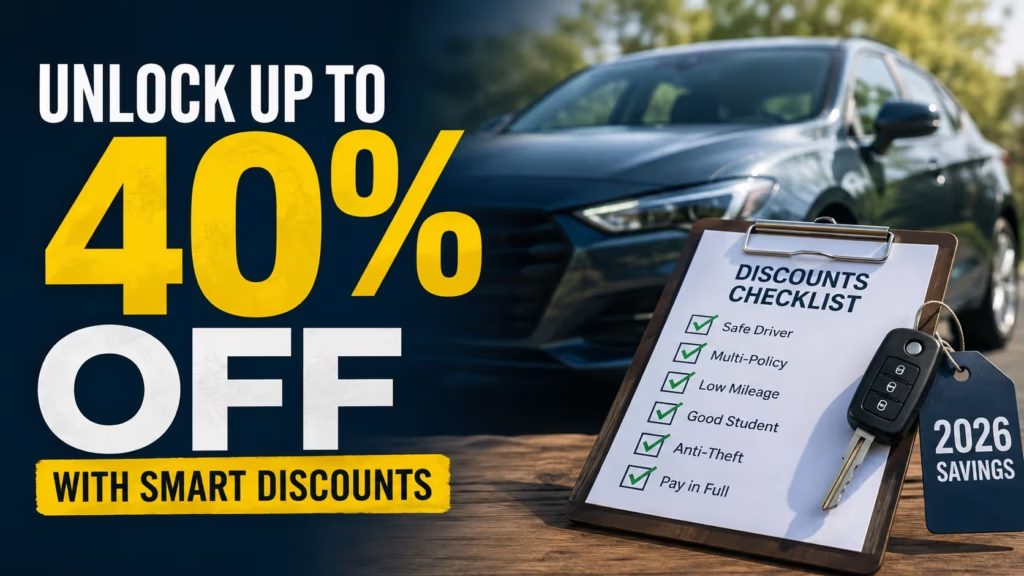
Most drivers are getting a fraction of the car insurance discounts they actually qualify for. GEICO alone lists 23 separate discounts. Farmers offers 19. American Family offers 17. Yet almost none of them apply automatically — a bundling credit has to be requested, a telematics discount needs annual re-enrollment, and a good student discount vanishes without warning the semester a GPA slips below 3.0.
Stack the right combination and you can realistically cut a full-coverage premium by 20% to 40%. Stack the wrong combination — or forget to re-verify the ones you already have — and you’re quietly overpaying every renewal.
Key Takeaway: Car insurance discounts fall into three groups — policy discounts (bundling, multi-vehicle, payment method), driver discounts (safe driving, good student, low mileage), and vehicle discounts (anti-theft, ADAS, EV). Bundling and safe-driver credits usually save the most, 10% to 25% each, while telematics programs add another 10% to 40% depending on the insurer and how you actually drive. Stacked together, drivers regularly cut premiums by 20% to 40%. GEICO, Farmers, and American Family currently run the widest discount menus among national carriers, and the credits that disappear quietest — good student, low mileage, telematics — are the ones that require you to re-prove eligibility at every renewal.
In practice, discount eligibility changes more often than people assume. A teen ages out of the good student discount. A homeowner refinances and lets a bundled policy lapse without realizing it broke the multi-policy credit. A driver switches to remote work and their real annual mileage drops well below the number their insurer has on file. None of these trigger an automatic review — the burden sits on you. What follows is a complete breakdown of every major 2026 discount category, what each one is actually worth, and how to make sure you’re getting credit for all of it.
How Much Can Car Insurance Discounts Actually Save You in 2026?
Stacked correctly, car insurance discounts can cut a full-coverage premium by 20% to 40%. That range holds up across the industry data available in 2026, though where you land inside it depends entirely on which discounts you qualify for and how disciplined you are about re-proving eligibility every renewal.
Stacked Discounts
Most of Any Major Insurer
Savings, 2026
(vs. 15%–25% Advertised)
Telematics Savings
Good Student Discount
One detail most drivers get wrong: discounts don’t add together, they multiply against what’s left. A 20% discount followed by a 10% discount doesn’t produce 30% off — it produces roughly 28%, because the second discount applies to the balance remaining after the first one is subtracted. That math still favors stacking aggressively; it just means the marginal value of each additional discount shrinks slightly as you add more. A driver combining a bundling discount, a safe-driver discount, and a telematics credit is realistically looking at the 25%–35% range once the multiplication is worked through, not a simple sum of the advertised percentages.
What Are the Three Types of Car Insurance Discounts?
Car insurance discounts fall into three broad categories — policy discounts, driver discounts, and vehicle discounts — and knowing which bucket a given discount sits in tells you whether it’s something you can influence directly or something already baked into how you live and what you drive.
How Much Do Bundling and Multi-Policy Discounts Actually Save?
Bundling auto with home, renters, or condo insurance under one carrier typically saves 10% to 25% on the combined premium, according to advertised rates from major carriers. Independent analysis from the Insurance Information Institute puts realistic savings closer to 14% to 18%, once you account for the loyalty and claims-free discounts on your standalone policies that don’t always carry over intact.
What Carriers Advertise
- 15%–25% multi-policy discount is the standard marketing range
- Figures usually reflect a maximum, not an average outcome
- The percentage is applied against each insurer’s own base rate, which varies widely
What Independent Data Shows
- ~14% average when switching both policies to a new carrier
- ~18% average when adding a policy to your existing carrier, since tenure credits carry over
- Real dollar savings depend more on your starting base rate than the headline percentage
That last point is the one that trips people up: an insurer advertising a 25% bundle discount on a base rate that’s 30% above the market average still costs more than an insurer offering 10% off a competitively priced policy. Always request the final combined dollar total from at least two or three carriers before assuming the bigger percentage is the better deal.
Bundling isn’t the only policy-level lever worth pulling. A few others are easy to overlook:
Get Your 2026 Car Insurance Quotes
Compare rates and discount eligibility from top U.S. carriers side by side before your next renewal.
GET YOUR 2026 CAR INSURANCE QUOTESWhich Discounts Reward Safe Drivers, Students, and Low Mileage?
Driver-based discounts are earned through behavior and circumstance rather than paperwork alone, which is why they carry some of the widest savings ranges — and why they’re also the discounts most likely to be re-checked at renewal.
Is Telematics (Usage-Based Insurance) Worth It in 2026?
Telematics programs track real driving behavior — speed, braking, acceleration, phone handling, sometimes location — through a mobile app or plug-in device, and use that data to personalize your rate. The discount potential is real, up to 40% at the top end. What most comparison articles skip is the equally real downside: several of the largest programs can raise your premium if the app decides you’re a risky driver, while a handful guarantee they never will.
Which Vehicle Safety and Technology Discounts Can Lower Your Premium?
Vehicle-based discounts follow the car rather than the driver, which makes them the simplest to verify — the equipment either shows up on the vehicle’s build sheet or it doesn’t.
Which Insurers Offer the Most Car Insurance Discounts in 2026?
A 2026 Yahoo Finance analysis of 20 major insurers, scored on rate competitiveness, total discounts offered, and coverage breadth, found real separation between carriers on this specific point. The number of discounts available doesn’t guarantee the lowest premium, but it does widen how much room you have to stack credits.
Why Do Car Insurance Discounts Disappear at Renewal?
Discounts almost never get “removed” with an explanation. They simply stop appearing on the next declarations page, and the renewal notice shows a new total without flagging what changed. In practice, these six scenarios account for most of the disappearing discounts we see:
- Good student discount aging out or the GPA slipping. The credit requires a resubmitted transcript every semester or year, and it drops immediately once a GPA falls below the insurer’s threshold — there’s no grace period.
- Telematics discount lapsing from non-re-enrollment. Several programs require opting back in annually. Miss the window and the credit disappears without a separate notice.
- Multi-policy discount unwinding after a bundled policy is canceled. Refinancing a mortgage or switching renters insurance to a different provider often breaks the bundle without anyone flagging the change.
- Paperless or autopay discount breaking from a declined card. An expired card on file can silently cancel this credit for an entire policy term.
- Low-mileage discount vanishing as actual driving creeps up. A mileage estimate given two years ago rarely matches a current commute, especially after a job or address change.
- Loss-free or safe-driver discount resetting after an at-fault claim. This is the one drivers notice fastest, since it usually coincides with a rate increase large enough to draw attention on its own.
Do Car Insurance Discounts Work the Same in Every State?
No. Car insurance rates and discount programs are filed and approved state by state, and a handful of states restrict the rating factors and telematics mechanisms that make certain discounts possible in the first place. The National Association of Insurance Commissioners (NAIC) develops model regulations, but each State Insurance Department decides which version its own state actually adopts — which is why the same discount can be worth real money in one state and simply unavailable in another.
Your 2026 Action Plan: How to Stack Discounts for Maximum Savings
The following sequence is what actually moves a renewal number, in the order it pays to do it:
1. Audit Your Current Declarations Page
List every discount currently applied, along with its dollar value. This is your baseline for spotting anything that quietly disappears next renewal — you can’t catch a missing discount you never wrote down in the first place.
2. Request the Full Discount Menu in Writing
Ask your agent or the carrier’s support team for a complete list of discounts available in your state, not just the ones already applied to your policy. Most insurers won’t volunteer this list unprompted, and state availability varies enough that the online marketing page isn’t always the full picture.
3. Bundle Strategically and Compare Dollar Totals
Get a bundled quote and a standalone quote side by side from at least two or three carriers. Compare the final combined dollar cost, not the advertised percentage — a smaller discount on a competitively priced policy consistently beats a bigger discount layered on an inflated base rate.
4. Enroll in Telematics With the Surcharge Risk in Mind
Confirm upfront whether the program can raise your rate for risky driving or only ever adds a discount. Programs like State Farm’s Drive Safe & Save carry no downside by design. Programs like Progressive Snapshot or Farmers Signal can move your rate in either direction, so an honest look at your own driving habits belongs before enrollment, not after.
5. Calendar Your Renewal and Resubmit Documentation Early
Set a reminder 45 to 60 days before renewal to resubmit transcripts, mileage estimates, or telematics re-enrollment. The discounts that require periodic proof are, by a wide margin, the ones most likely to fall off without anyone noticing.
Real-World Stacking Examples
Frequently Asked Questions About Car Insurance Discounts
How much can I save by stacking car insurance discounts in 2026?
Stacked discounts can reduce a full-coverage premium by 20% to 40%, though savings apply sequentially rather than adding together — a 20% discount followed by a 10% discount produces roughly 28% total savings, not 30%. The largest gains typically come from combining a bundling discount (10%-25%), a safe driver or good student discount (5%-25%), and a telematics program (10%-40% depending on the insurer and your actual driving).
Which car insurance company offers the most discounts?
According to a 2026 Yahoo Finance analysis of 20 major insurers, GEICO offers the widest menu with 23 distinct discounts, followed by Farmers with 19 and American Family with 17. USAA offers 15 discounts but is limited to military members, veterans, and their immediate families.
Does bundling home and auto insurance always save money?
Not automatically. Carriers advertise bundling discounts of 15% to 25%, but Insurance Information Institute data shows actual savings average closer to 14% when switching both policies to a new carrier and about 18% when adding a policy to an existing carrier, since some standalone loyalty discounts don’t carry over. Compare the final combined dollar cost across insurers rather than relying on the advertised percentage alone.
Why did my car insurance discount disappear at renewal?
Discounts usually drop off quietly rather than being actively canceled. Common causes include a good student discount expiring when a dependent’s GPA falls or they leave school, a telematics discount lapsing because the program requires annual re-enrollment, a multi-policy discount disappearing after a bundled home or renters policy is canceled, a paperless billing discount breaking due to a declined autopay card, and a low-mileage discount vanishing once actual mileage exceeds the threshold you originally reported.
Is telematics car insurance available in every state?
No. California’s Proposition 103 restricts primary auto rating factors to driving safety record, annual mileage, and years of driving experience, which has kept several major usage-based programs, including Progressive Snapshot and State Farm’s Drive Safe & Save, out of the state. Drive Safe & Save is also unavailable in Massachusetts and Rhode Island. Availability is set state by state, so confirm with your specific carrier before enrolling.
What GPA do I need for the good student discount?
Most insurers require at least a 3.0 GPA, or B average, though Allstate accepts a 2.7 GPA and some carriers also accept a top-20% class ranking, Dean’s List placement, or qualifying standardized test scores for homeschooled students. Age limits vary: GEICO and Progressive cap the discount at 23, while Allstate, State Farm, and USAA extend it to 25. Documentation typically needs to be resubmitted every semester or year, and the discount is removed the moment a GPA falls below the threshold.
The Discounts Exist. Getting Credit for Them Is on You.
Nothing in this guide requires an insurer to change its pricing model or requires legislation to pass. Every discount described here is already filed, approved, and sitting on a rate table somewhere — the only missing step is a driver who asks for it, documents it, and checks that it’s still there next year.
The gap between what’s available and what most people actually collect isn’t really about eligibility. It’s about the fact that discounts require ongoing maintenance — a transcript resubmitted, a telematics app re-enrolled, a declarations page actually read before it’s filed away. Drivers who treat their policy as something to revisit twice a year, not just at renewal, consistently end up in the lower half of the 20%-to-40% range this guide opened with.
Start with the audit. Compare bundled and standalone quotes on dollar totals, not percentages. Enroll in telematics with your eyes open about which programs can move your rate in either direction. None of it requires switching carriers to be worth doing — though if your current insurer’s discount menu is thin, that comparison is worth running too.
Sources: National Association of Insurance Commissioners (NAIC), Insurance Information Institute (Triple-I), Yahoo Finance 2026 Car Insurance Discount Analysis, MoneyGeek, State Farm Drive Safe & Save, Progressive Snapshot, GEICO Discounts, American Family, Experian: State Credit-Score Restrictions, Maryland Insurance Administration Telematics Survey (via MoneyGeek).