
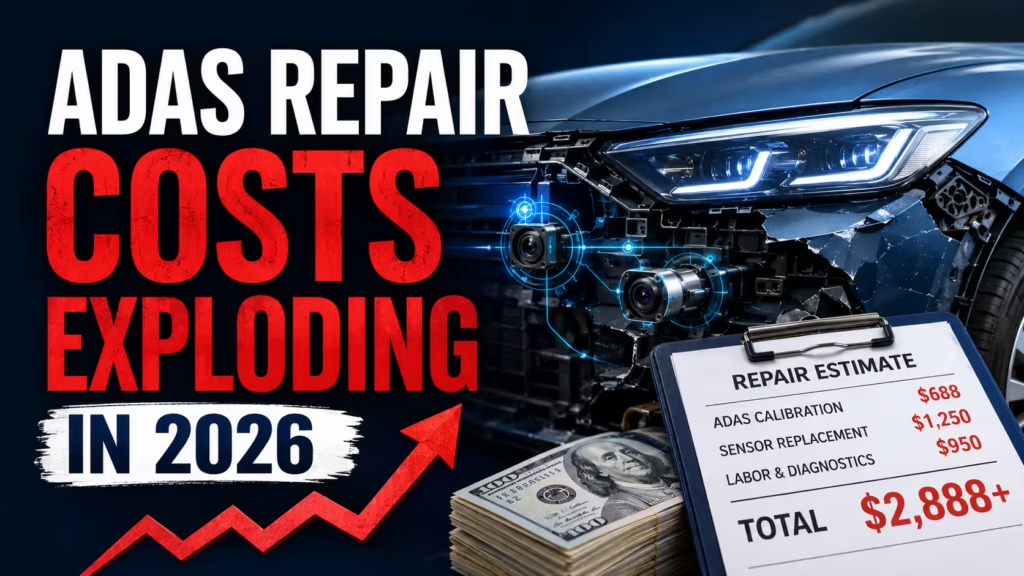
Ten years ago, a cracked windshield cost about $300 to replace. Today, on a vehicle with Advanced Driver Assistance Systems (ADAS), the same repair can easily exceed $1,500. And that is just the tip of the iceberg.
According to Mitchell’s 2026 industry data, the share of repair estimates that include an ADAS calibration line grew 31.4% year-over-year in 2025, with an average cost of $688 per estimate when a calibration was present. The number of calibrations per repair rose nearly 10% over 2024. Meanwhile, CCC Intelligent Solutions reports that calibrations now appear on 28.3% of all repairable appraisals — up from 21.8% the previous year, a 30% jump in just twelve months.
Key Takeaway: ADAS-equipped vehicles can cost up to 4× more to repair than traditional vehicles, with calibration fees averaging $688 per claim and the average total cost of repair (TCOR) hitting $4,818 in 2025. The single most important move for drivers in 2026 is to shop insurance quotes aggressively — carriers price ADAS risk very differently, and the gap between the cheapest and most expensive policy for the same vehicle can exceed $500 per year. If you drive under 8,000 miles annually, switching to usage-based or pay-per-mile insurance can offset these rising repair-driven premiums.
This is not a problem for tomorrow. It is already showing up on your insurance renewal notice — even if you have never filed a claim. Every ADAS sensor that gets knocked out of alignment in a fender-bender, every windshield replacement that requires camera recalibration, and every radar unit that needs reprogramming is pushing the entire risk pool higher. Here is exactly what is happening, what it costs, and how to keep your premium from exploding along with your repair bill.
📑 Navigate This Guide:
- What Is ADAS and Why Does It Matter?
- The Hard Numbers: How ADAS Is Driving Up Repair Costs
- Real-World Repair Costs You Need to Know
- Why ADAS Repairs Are So Expensive
- How ADAS Affects Your Car Insurance Premium
- What You Can Do to Protect Your Wallet
- Your 2026 ADAS Action Plan
- Frequently Asked Questions
What Is ADAS and Why Does It Matter in 2026?
Advanced Driver Assistance Systems (ADAS) include features that have gone from luxury add-ons to standard equipment on most new vehicles sold in the United States:
- Automatic Emergency Braking (AEB) — now mandatory on all new vehicles under 8,500 lbs since September 2029 per NHTSA rules, but already standard on 90%+ of 2024–2026 models
- Lane Departure Warning & Lane Keep Assist
- Adaptive Cruise Control (ACC)
- Blind-Spot Monitoring
- Forward Collision Warning
- Parking Sensors, Backup Cameras, and 360° Camera Systems
These systems rely on a network of cameras, radar units, ultrasonic sensors, and LiDAR that must be precisely calibrated after any repair. The smallest misalignment — even from a minor fender-bender or a windshield replacement — can cause large deviations in the field of view or scan area, potentially leading to false warnings, system failure, or improper vehicle functionality. This is not a suggestion. It is an OEM-mandated requirement.
According to projections by the Insurance Institute for Highway Safety (IIHS) and the Highway Loss Data Institute, eight ADAS systems will be present in half or more of registered vehicles by 2029, compared to just three by 2027. The U.S. car parc is becoming a sensor network on wheels — and every sensor is a potential repair cost.
The Hard Numbers: How ADAS Is Driving Up Repair Costs
The data from the industry’s most authoritative sources leaves no room for debate. ADAS is fundamentally altering the economics of collision repair:
The trajectory is staggering. In 2017, only 0.9% of repairable appraisals included a calibration. By 2025, that share had surged to more than 23% — and in Direct Repair Program (DRP) claims, which represent vehicles that are actually repaired, nearly one-third (33%) of appraisals now include a calibration. The growth rate is accelerating, not slowing.
Calibration penetration has more than doubled in three years. The CCC report notes that average calibration fees have nearly doubled in just five years, reaching about $500 per repairable vehicle — and that was before the 2025 spike. Mitchell’s newer data puts the average at $688 when calibrations are present on the estimate.
Real-World Repair Costs: What ADAS Fixes Actually Cost You
Statistics tell part of the story. Real invoices tell the rest. Here is what American drivers are actually paying:
Here is the kicker: less than 45% of calibrations are captured on the initial estimate. The majority — 54.5% — show up later as supplements. That means you get your car back, think the repair is done, and then the shop calls you two weeks later saying they discovered an uncalibrated sensor and need the vehicle back. This extends cycle times, frustrates policyholders, and inflates the final bill beyond what anyone expected.
Why ADAS Repairs Are So Expensive: The Four Forces
Several converging factors are driving the ADAS repair cost explosion. Understanding them helps you make smarter insurance and vehicle purchase decisions:
How ADAS Affects Your Car Insurance Premium (Even If You Never File a Claim)
Here is the part most drivers do not realize: you are already paying for ADAS repairs, whether your car has the technology or not.
Insurers calculate premiums based on the potential cost of a claim across the entire risk pool. As the average cost of repairs skyrockets due to ADAS technology, the risk pool for every driver increases. The result: higher premiums for everyone — even if you drive a 2010 Honda Civic with zero sensors.
According to CCC Intelligent Solutions’ Crash Course 2026 report, the average total cost of repair (TCOR) reached $4,818 for 2025, a 1.7% increase over 2024. While that may sound modest, it is important context: repairable claim volume declined 9.7% in 2025. Fewer accidents happened, but each one that did cost more to fix. For vehicles 6 years old or newer, the average TCOR is $5,721 — a staggering 55.4% higher than vehicles 7 years or older.
Kyle Krumlauf, Senior Director of Industry Analytics at CCC, called one data point the “number one stat” of 2025: over 28% of repairable claims included a calibration in Q4 2025, up 6.5 percentage points year over year. That represents roughly a 30% increase in the share of repairable vehicles requiring calibration — in just one year.
✅ How Smart Drivers Offset ADAS Premiums
- Shop aggressively: Carriers use different risk models — the quote variance for the same ADAS vehicle can exceed $500/year
- Switch to UBI: Usage-based insurance rewards safe, low-mileage drivers with 20-40% discounts
- Pay-per-mile: If you drive under 6,000 miles/year, savings of 30-50% are common
- Higher deductible: Lower your premium if you have emergency savings
- Garage discount: Mention secure parking — some insurers offer mitigation credits
⚠️ What Raises Your Premium Further
- Comprehensive claims: Even a cracked windshield on an ADAS car can trigger a $1,500+ claim
- Luxury brands: German and luxury Asian brands have the most expensive sensor arrays
- Living in high-risk states: Climate surcharges in CA, FL, and LA compound repair cost inflation
- Not shopping at renewal: Auto-renewing without comparing quotes is the #1 way to overpay
- Low credit score: In most states, poor credit can increase your rate by 50-100%
The structural shift is clear: as ADAS-equipped vehicles dominate the car parc, low-dollar claims are becoming increasingly rare. With one calibration, fewer than 10% of DRP repairs fall below the $2,000 threshold; with multiple calibrations, that figure drops to just 3%. For insurers, this means resetting expectations around severity. For you, it means your next fender-bender is far more likely to be a $3,000–$5,000 repair than a $1,000 one.
What You Can Do: Six Strategies to Beat the ADAS Cost Surge
You cannot stop the technology from spreading, but you can control how much it costs you. Here are six actionable strategies:
- Factor ADAS into your car purchase. Before buying a new car, research repair costs for its ADAS systems. Some brands — particularly certain domestic and Korean manufacturers — have cheaper ADAS parts and more widely available technicians. A vehicle with a simpler sensor suite can save you thousands over its lifetime.
- Choose a vehicle with lower repair costs. The IIHS and NAIC data consistently show that vehicles with simpler ADAS implementations (fewer cameras, no LiDAR, standard radar) cost significantly less to repair. Avoid vehicles with over-the-air update dependencies for sensor calibration unless you are comfortable with dealership-only service.
- Maintain a clean driving record. This is the oldest advice for a reason — it still works. Avoiding accidents is the only guaranteed way to avoid ADAS repair costs. With telematics programs now mainstream, safe driving habits can earn you a 22% average discount (and up to 40% for top performers), directly offsetting ADAS-driven premium increases.
- Shop around for insurance every renewal. This is the single highest-ROI action you can take. Some insurers are better at managing ADAS risk than others. Newer, AI-native carriers may price your vehicle’s sensor suite more accurately than legacy carriers using broad actuarial tables. Spend 15 minutes, save $300–$600.
- Consider your deductible carefully. A higher deductible lowers your premium, but you will pay more out-of-pocket if you need ADAS repairs. Given that even minor damage now routinely exceeds $2,000, a $1,000 deductible is increasingly risky. Run the numbers: if raising your deductible from $500 to $1,000 saves you $200/year, you break even after 2.5 years without a claim. If you are accident-prone, keep it low.
- Verify your repair shop’s calibration capability. Shops that perform calibrations in-house often complete repairs faster and at lower cost than those subletting to dealerships. Ask before you choose a shop: “Do you have OEM-certified ADAS calibration equipment for my make and model?” If they hesitate, find another shop.
Get Your 2026 Car Insurance Quotes
Lock in today’s best rates before the next wave of ADAS-driven price changes. Compare telematics, pay-per-mile, and traditional policies in one step — and see exactly how much you can save.
GET YOUR 2026 CAR INSURANCE QUOTESYour 2026 ADAS Action Plan (Profit From the Shift)
- Audit your current policy for ADAS exposure. Pull up your declaration page. What is your comprehensive deductible? What is your collision deductible? If you own a 2020+ vehicle, assume your next claim will cost 50-100% more than you think. Adjust coverage accordingly.
- Get three quotes specifically mentioning your ADAS features. When requesting quotes, list your vehicle’s ADAS systems explicitly. Ask each carrier: “How do you price vehicles with adaptive cruise control, lane keep assist, and automatic emergency braking?” The answers will reveal which insurers have modernized their risk models.
- Switch to usage-based or pay-per-mile insurance if eligible. If you drive under 8,000 miles per year, you are subsidizing high-mileage drivers on a traditional policy. Programs like Progressive Snapshot, GEICO DriveEasy, and Nationwide SmartMiles can offset ADAS premium inflation with behavior-based discounts of 20-40%.
Frequently Asked Questions About ADAS Repair Costs & Insurance
How much does ADAS calibration cost in 2026?
The average cost of an ADAS calibration when present on a repair estimate is $688, according to Mitchell’s 2026 data. Calibration fees have nearly doubled in five years, reaching approximately $500 per repairable vehicle on average. Specific procedures vary: static camera calibration ($300–$400), radar calibration ($300–$400), and backup camera/sensor calibration ($250–$300). Luxury vehicles with multiple sensors can see repair bills exceeding $4,000–$5,000.
Why are ADAS-equipped vehicles so expensive to repair?
Four forces drive the cost: 1) Calibration complexity — sensors require precise OEM-prescribed alignment, often adding 2–4 hours of labor; 2) Parts inflation — OEM parts rose 4.21% in 2025, with plastic sensor-housing components seeing the steepest increases; 3) Tariffs and supply chain — over half of aftermarket materials are imported from Mexico, Canada, and China, subject to higher U.S. tariffs; 4) Labor shortages — certified ADAS technicians are scarce, driving up rates and extending timelines.
Does ADAS technology increase my car insurance premium?
Yes. Insurers price premiums based on the total risk pool’s expected claim costs. With 28.3% of repairable claims now including calibrations and the average TCOR at $4,818, the entire pool is repricing upward. Even if you drive an older vehicle without ADAS, you are affected because insurers spread risk across all policyholders. However, you can offset this by shopping for carriers with better ADAS risk models, choosing higher deductibles, or switching to usage-based insurance.
What percentage of collision repairs require ADAS calibration in 2026?
According to CCC Intelligent Solutions, calibrations appeared on 28.3% of all repairable appraisals in 2025 — up 30% from 21.8% the previous year. In DRP claims (vehicles that are actually repaired), nearly one-third (33%) include calibration. Industry projections from Caliber Collision indicate around 60% of repairs needed calibration in 2025, rising to 65% in 2026. By 2029, the Highway Loss Data Institute projects eight ADAS systems will be in half or more of registered vehicles.
How can I avoid paying too much for ADAS repairs?
Six strategies: 1) Research repair costs before buying; 2) Choose vehicles with simpler, cheaper ADAS implementations; 3) Maintain a clean driving record; 4) Shop insurance aggressively every renewal; 5) Consider a higher deductible if you have savings; 6) Verify your repair shop has in-house OEM-certified calibration equipment — subletting to dealerships adds cost and delay.
Will my insurance cover ADAS calibration after an accident?
If you carry collision or comprehensive coverage, yes — ADAS calibration is part of the repair cost and is covered under your policy, subject to your deductible. However, the key issue is whether the calibration is identified upfront on the initial estimate or appears later as a supplement. Supplements delay the repair and can create disputes. Choose a repair shop that performs thorough pre-repair diagnostics to identify all calibration needs before work begins.
Should I avoid buying a car with ADAS to save on repairs?
Not necessarily. ADAS features like Automatic Emergency Braking reduce accident frequency and severity, which can lower your long-term claim risk. The trade-off is higher repair costs when accidents do happen. For most drivers, the safety benefits outweigh the repair cost risk — but you should factor the potential $3,000–$5,000 repair bill into your emergency fund and insurance deductible decisions. If you are a low-mileage driver, usage-based insurance can neutralize the premium impact.
The ADAS Cost Wave Is Here — Surf It or Drown
Every year you auto-renew an outdated policy is another year of overpaying for a risk landscape that has fundamentally changed. The ADAS repair cost explosion is not a future problem — it is live, active, and already baked into your 2026 premium.
The drivers who win in this environment are the ones who: shop quotes aggressively, switch to behavior-based pricing if they are low-mileage, verify their repair shops have real calibration capability, and factor repair complexity into their vehicle purchase decisions. The drivers who lose are the ones who assume a fender-bender still costs $800 and that their five-year-old policy still makes sense.
It costs nothing but 15 minutes to get three quotes. The return on that time could be $500 or more this year — and the peace of mind that when your ADAS-equipped vehicle needs repair, your policy actually covers what you think it covers.
Sources: CCC Intelligent Solutions — Crash Course 2026: Complexity Compounds, CCC — The Current State of Calibrations, Mitchell/Enlyte — Navigating Complexity in Collision Claims, Coherent Market Insights — ADAS Calibration Service Market 2026-2033, Insurance Institute for Highway Safety (IIHS), National Association of Insurance Commissioners (NAIC), Insurance Information Institute (III), Autobody News — Aging Fleet, Rising Complexity.