
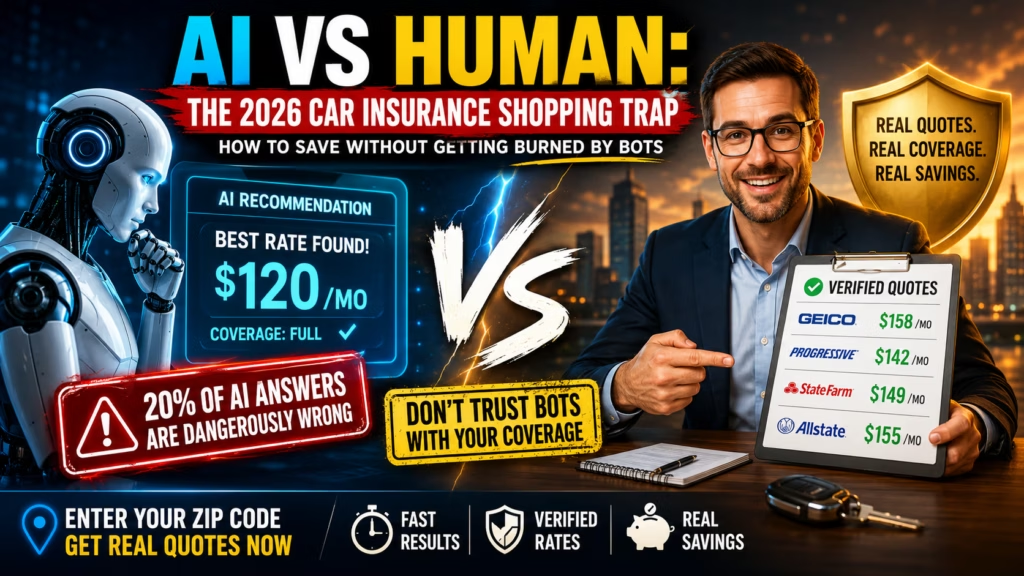
Quick Answer: In 2026, 32% of car insurance shoppers use AI tools like ChatGPT — but 1 in 5 AI answers contain critical errors that can leave you dangerously underinsured. Use AI only for research, never for final decisions. Always verify AI suggestions with real-time quotes from a trusted comparison tool. The smartest approach is a hybrid one: let AI explain coverage basics, then get verified human-backed quotes to lock in real savings.
You’ve seen the headlines. You’ve probably tried it yourself. You type “cheapest car insurance 2026” into ChatGPT, and within seconds, you have what looks like a personalized recommendation. It feels like magic. It feels like you’ve beaten the system. But here’s the terrifying truth that insurance companies don’t want you to know: that AI-generated advice could be dead wrong — and you won’t find out until after an accident, when it’s far too late.
The Hard Truth: Artificial intelligence is revolutionizing how Americans shop for car insurance — 32% of shoppers used AI in 2026, and they switch policies 1.3x more often. But 20% of AI insurance responses contain major accuracy problems, from hallucinated policy features to rates that simply don’t exist. If you’re using AI as your only guide, you’re gambling with your financial future.
This guide reveals exactly how to harness the speed of AI without falling into its traps. You’ll discover which questions AI can safely answer, which ones require a human expert, and a single ZIP-code tool that gives you real, verified quotes from top insurers — no hallucinations, no guesswork, just actual savings.
📑 Jump to Section:
The AI Shopping Explosion — And Why It’s Only Getting Bigger
In 2026, using AI to shop for car insurance isn’t a futuristic concept — it’s mainstream. According to the J.D. Power 2026 U.S. Auto Insurance Study, nearly one-third of all insurance shoppers now engage with AI tools during their search process. And it’s not hard to see why:
- Instant answers at 2 a.m.: No waiting for business hours or sitting on hold. AI responds immediately — a huge advantage for busy families and shift workers.
- No sales pressure: Chatbots don’t earn commissions. Users feel more comfortable asking “dumb” questions about deductibles, liability, and coverage gaps.
- Perceived objectivity: Many consumers assume AI is neutral — a fair referee that won’t push them toward a pricier policy to earn a bonus.
- Speed of comparison: AI can summarize the differences between GEICO, Progressive, and State Farm in seconds, something that would take a human hours of reading.
But this explosion in AI adoption masks a dangerous reality: the technology is being deployed faster than its accuracy can be guaranteed. And in insurance — a product you can’t return if it fails — a wrong answer isn’t just inconvenient; it’s potentially bankrupting.
The Hidden Dangers: 20% of AI Insurance Answers Are Flat-Out Wrong
Let’s cut through the hype. A comprehensive analysis of AI insurance responses from platforms like ChatGPT, Gemini, and Claude found that one in five answers contained major factual errors. Not minor typos — serious, coverage-altering mistakes that could leave you on the hook for tens of thousands of dollars.
The worst part? AI sounds incredibly confident — even when it’s dead wrong. It doesn’t hedge or express uncertainty unless programmed to. To the average consumer, a hallucinated rate quote looks exactly as authoritative as a real one. And that false sense of security is precisely what makes AI so dangerous in the insurance space.
How to Use AI Safely: 4 Non-Negotiable Rules
We’re not telling you to avoid AI entirely. When used correctly, it’s an outstanding research assistant. But you must follow these four ironclad rules to avoid getting burned:
Why Human Expertise Still Wins in 2026 — and Always Will
It might seem old-fashioned, but a licensed human insurance agent brings three things to the table that AI — at least in 2026 — fundamentally cannot replicate:
🤖 What AI Does Well
- Definitions and explanations: “What is gap insurance?” answered in 2 seconds.
- General comparisons: Summarizing the public reputations of major carriers.
- Checklists: Reminding you of discounts you might qualify for — good student, low mileage, etc.
- 24/7 availability: No waiting for office hours.
🧠 Where Human Agents Excel
- State-specific regulations: Knowing that California has different liability rules than Texas — and pricing accordingly.
- Carrier underwriting quirks: Understanding that Progressive might penalize a certain credit profile while GEICO doesn’t — nuances no AI model can track in real time.
- Complex risk profiles: A DUI, a teenage driver, and a home business? An agent can bundle and structure coverage creatively. AI gives generic advice.
- Claims advocacy: When you have an accident, a human agent fights for you. A chatbot can’t negotiate with a claims adjuster.
The critical point: AI doesn’t have your back when something goes wrong. A human agent does. And in insurance — where the whole point is protecting yourself from catastrophe — that relationship matters. When your car is totaled and you’re arguing with an adjuster about its value, a chatbot can’t pick up the phone and advocate for you.
The Perfect Hybrid Strategy: Let AI Speed You Up, Let Humans Protect You
The smartest consumers in 2026 don’t choose AI or a human — they use both in sequence. Think of it like this:
- Start with AI: Use ChatGPT or a similar tool to educate yourself. Ask it to explain coverages, list typical discounts, and summarize the reputations of the top 5 insurers. Read the responses — but don’t trust the numbers.
- Move to a verified comparison tool: This is where you get real, bindable quotes. Our ZIP code estimator below pulls live rates from multiple A-rated carriers simultaneously. These are the actual prices you’d pay — not a chatbot’s guess from a stale database.
- Consult a human for the final check: If your situation is complex (multiple drivers, a home business, a DUI, or poor credit), speak with a licensed agent before finalizing. Ask them to review your chosen policy and confirm it truly covers your specific risk profile. This 15-minute conversation can save you from a $20,000 mistake.
Step-by-Step: Shop for Car Insurance the Smart Way in 2026
Follow this exact sequence to leverage AI safely while locking in the lowest verified rates:
- Identify Your Coverage Needs: Use an AI tool to understand what liability, comprehensive, collision, uninsured motorist, and gap insurance actually do. Ask it to explain each in plain English. (5 minutes)
- Get Real-Time Verified Quotes: Enter your ZIP code below to see actual rates from GEICO, Progressive, State Farm, and other top insurers — no AI estimates, just real numbers. (2 minutes)
- Compare Apples to Apples: Ensure every quote has identical coverage limits. If one quote has a $1,000 deductible and another has $500, you’re not comparing fairly. AI can’t spot this — but you can. (3 minutes)
- Verify Discounts with a Human: Call the top 2-3 insurers and ask a licensed agent: “I’m seeing this quote online. Are there any additional discounts I qualify for that aren’t reflected?” Often, agents can apply loyalty, bundling, or occupation-based discounts that automated tools miss. (10 minutes)
- Read Reviews, Not AI Summaries: Check recent customer reviews on independent sites — not the star ratings that AI scrapes. Look for patterns in complaints about claims handling and rate increases after accidents. (10 minutes)
- Lock It In: Once you’ve verified everything, purchase the policy directly through the insurer’s website or agent — never through an AI interface that could alter your information in transit. (5 minutes)
Get Your Personalized Car Insurance Quote (No AI Hallucinations)
Enter your ZIP code below to get a highly accurate 2026 estimate based on your exact location, vehicle, and driver profile. Real rates, from real insurers, in real time.
Get My ZIP Code Estimate NowFrequently Asked Questions About AI and Car Insurance Shopping
Is AI reliable for shopping car insurance in 2026?
Not fully. AI can be a helpful educational tool, but it’s not reliable for making final purchasing decisions. A 2026 study found that 20% of AI-generated insurance answers contain major accuracy issues — from hallucinated policy features to outdated rates. Use AI to learn the basics, then verify everything with real-time quotes from licensed sources.
What are the risks of using ChatGPT for car insurance?
The four biggest risks are: (1) Hallucinated coverage details — AI invents policy features that don’t exist; (2) Outdated rates — training data is often 6-18 months old; (3) State regulation blind spots — AI ignores state-specific insurance laws; and (4) Generic one-size-fits-all advice that ignores your unique risk profile. Any of these can result in paying for inadequate coverage without realizing it.
Can AI help me find cheaper car insurance?
AI can help you understand what discounts to ask about, but it cannot give you a real, bindable quote. J.D. Power’s 2026 study found that AI users are 1.3x more likely to switch policies — but only when they verified AI suggestions with actual quotes. The savings come from comparing verified rates, not trusting a chatbot’s estimate.
Is a human insurance agent better than AI?
For complex decisions, absolutely yes. Human agents understand state-specific regulations, carrier-specific underwriting quirks, and can advocate for you during a claim. AI is faster for simple definitions and general comparisons, but it cannot replicate the personalized judgment and claims advocacy of a licensed professional.
How do I avoid AI insurance mistakes?
Follow four rules: (1) Use AI only for research, never final decisions; (2) Cross-check every AI claim with a verified source; (3) Never enter personal information into public AI tools; (4) Always get at least 5 real, verified quotes through a trusted comparison tool before purchasing. The hybrid approach — AI for speed, humans for verification — is the safest way to shop in 2026.
Will AI replace insurance agents entirely?
Not in the foreseeable future. While AI is excellent at automating simple tasks (explaining terms, listing discounts), insurance involves complex judgment calls, state regulations, and claims negotiations that AI cannot currently handle. The industry is moving toward a hybrid model where AI handles routine inquiries and human agents focus on complex cases, personalized advice, and claims advocacy.
Bottom Line: Use AI Wisely, Verify Everything, Save Real Money
AI is not your enemy — but it’s also not your friend. It’s a tool, and like any tool, its value depends entirely on how you use it. Use AI to educate yourself, not to decide for you. Use it to generate ideas, not to finalize contracts. And always, always verify its output against real, human-backed quotes.
Your 2026 car insurance shopping action plan:
- Let AI teach you the basics — coverages, terms, discounts — in 5 minutes.
- Enter your ZIP code above to see verified, real-time quotes from A-rated insurers — zero AI guesswork.
- Compare the real numbers side by side and pick the policy that actually fits your budget and coverage needs.
- Call a human agent for a final review if your situation is complex.
- Re-shop every 6 months — because real rates change, even when AI’s training data doesn’t.
Don’t let a chatbot’s confident mistake become your $20,000 regret. Get real quotes, real savings, and real peace of mind.
Sources: J.D. Power 2026 U.S. Auto Insurance Study, European Broadcasting Union AI Accuracy Analysis, Forbes Advisor Car Insurance, Insurance Information Institute (III), National Association of Insurance Commissioners (NAIC), Craig Thunell (President, AADirect) interview on AI insurance risks.