
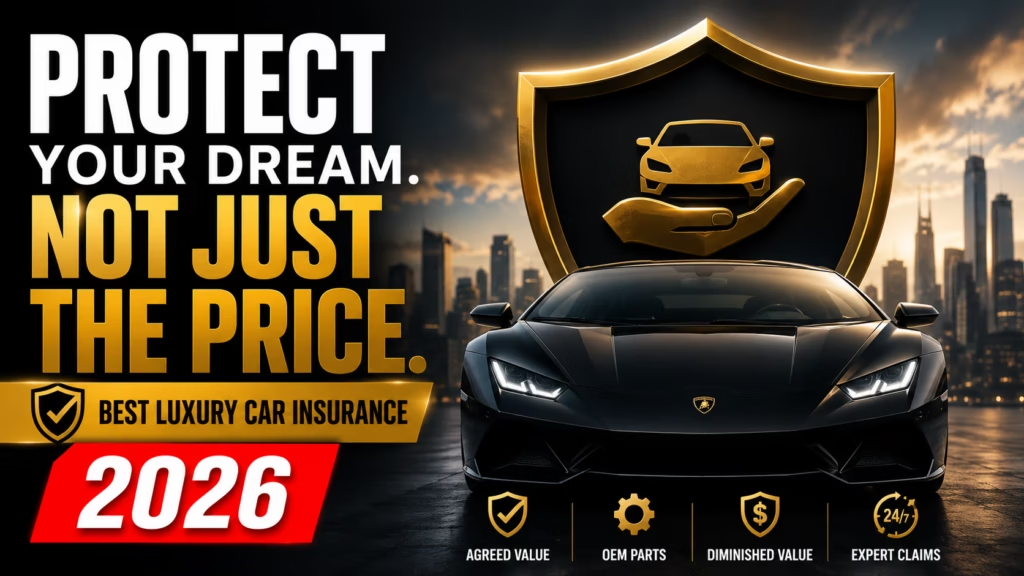
Your Mercedes-Benz S-Class, Porsche 911, or BMW 7 Series isn’t just a car — it’s a six-figure asset that demands specialized protection. Standard auto insurance policies from GEICO or Progressive may leave you dangerously underinsured the moment you file a claim. In 2026, the average luxury vehicle owner pays $2,800 to $5,500+ per year for proper coverage — roughly 75% to 240% more than a standard sedan — but the gap in coverage quality is even wider than the gap in price.
Quick Answer: The best luxury car insurance in 2026 comes from Chubb and Pure Insurance — carriers that specialize in high-net-worth clients and offer agreed value policies, guaranteed OEM parts, and automatic diminished value coverage. For those seeking a balance of quality and cost, Amica and State Farm deliver strong luxury endorsements with competitive premiums. Expect to pay $2,500–$4,000/year for a Mercedes-Benz E-Class or BMW 5 Series, and $4,500+ for a Porsche 911. Never settle for an actual cash value policy on a vehicle worth over $60,000.
The truth most insurers won’t tell you: a standard policy totals your $90,000 BMW at actual cash value — subtracting depreciation — while a specialized agreed value policy from Chubb or Pure Insurance guarantees the full $90,000. That’s not a minor detail. It’s the difference between replacing your car and swallowing a $20,000 loss.
In this comprehensive 2026 guide, we’ll reveal the top luxury car insurance companies, break down exact costs by brand, explain the five non-negotiable coverage features every high-end vehicle owner must demand, and show you exactly how to save 15% to 35% without sacrificing an ounce of protection.
📑 Jump to Section:
Why Is Luxury Car Insurance So Much More Expensive?
Luxury car insurance premiums run 75% to 400% higher than standard auto policies — and the reasons are rooted in hard financial reality, not arbitrary pricing. Here’s exactly what drives the cost:
- Exponentially Higher Repair Costs: A fender bender in a Toyota Camry might cost $1,800 to fix. The same accident in a Mercedes-Benz S-Class with advanced driver-assistance sensors, laser headlights, and aluminum body panels can exceed $12,000. Luxury vehicles use proprietary materials and technology that independent shops cannot service, forcing repairs into certified facilities with labor rates of $150–$250/hour.
- Specialized OEM Parts: A BMW OEM headlight assembly costs $2,000–$4,500. Aftermarket alternatives don’t exist for many luxury models. Insurers that default to generic parts will leave you fighting for genuine replacements — or paying the difference out of pocket.
- Higher Theft Rates: Luxury brands — particularly Range Rover, Mercedes-Benz, and BMW — appear consistently on the NHTSA’s most-stolen vehicles list. High-end SUVs and sedans are targeted by organized theft rings, and their parts command premium prices on the black market.
- Performance = Higher Accident Risk: Vehicles with 400+ horsepower, aggressive acceleration, and top speeds exceeding 150 mph are statistically involved in more severe accidents. A Porsche 911 or BMW M8 generates higher liability claims than a Honda Accord — and insurers price that risk accordingly.
- Diminished Value Exposure: A luxury car that’s been in an accident — even perfectly repaired — loses 10% to 25% of its resale value. Standard policies ignore this. Specialized luxury policies cover it. That protection costs money but preserves your asset’s worth.
According to Insurance Information Institute (III) 2026 data, the average annual premium for a luxury sedan like the BMW 5 Series or Mercedes-Benz E-Class sits at $2,800–$3,200 — nearly double the $1,600 average for a standard mid-size sedan. Exotic vehicles (Ferrari, Lamborghini, McLaren) can reach $8,000 to $20,000+ annually.
Best Insurance Companies for Luxury Cars (2026 Rankings)
Not all insurers understand luxury vehicles. We evaluated carriers across four critical criteria: agreed value availability, OEM parts guarantees, diminished value coverage, and financial strength for high-limit policies. Here are the definitive 2026 rankings:
*Source: Company filings, AM Best ratings, Quadrant Information Services 2026 projections. Rates reflect full coverage for a 45-year-old driver with excellent credit and clean record in a major metropolitan area.
5 Non-Negotiable Coverage Features for Luxury Cars
Buying insurance for a luxury vehicle without these five features is like buying a Patek Philippe and insuring it as a Timex. Here’s what your policy absolutely must include:
1. Agreed Value (Not Actual Cash Value)
Agreed value is a contractual guarantee: if your car is totaled, you receive the exact amount you and the insurer agreed upon when the policy was written — zero depreciation, zero haggling. Actual cash value (ACV) subtracts depreciation, meaning your two-year-old $95,000 Porsche Panamera might be valued at $68,000 by the insurer’s adjuster. The difference is catastrophic. Chubb, Pure Insurance, AIG Private Client, and Hagerty all offer true agreed value. Mainstream carriers generally do not.
2. Guaranteed OEM Parts
After an accident, your insurer will specify replacement parts. Without an OEM endorsement, they’ll use aftermarket, recycled, or reconditioned parts that may not fit perfectly, perform identically, or maintain your vehicle’s safety engineering. For a Lexus LS or Cadillac Escalade, this matters enormously. Chubb and Pure Insurance include OEM guarantees automatically. Amica, State Farm, and USAA require an explicit endorsement — always ask for it in writing.
3. Diminished Value Coverage
Even repaired perfectly, a luxury car with an accident history loses 10% to 25% of its resale value — a $8,000 to $25,000 hit on a $100,000 vehicle. Diminished value coverage pays you that difference. This is standard with Chubb and Pure Insurance. Most mainstream insurers either exclude it or require you to sue the at-fault driver to recover it — a nearly impossible path. Demand this coverage upfront.
4. High Liability Limits (250/500/100 Minimum)
Luxury car owners are lawsuit targets. If you cause a serious accident, plaintiffs’ attorneys will investigate your assets. Carrying state minimum liability limits (often 25/50/20) is reckless when you own a vehicle worth more than many people’s homes. Start at 250/500/100 and strongly consider 500/500/250 plus a $1 million to $5 million umbrella policy. Chubb, Pure, and AIG build high limits into their standard offerings.
5. Flatbed-Only Roadside Assistance
Luxury and performance vehicles — especially all-wheel-drive models from Audi, BMW, and Mercedes-Benz — can suffer severe drivetrain damage if towed with two wheels on the ground. Your policy’s roadside assistance must specify flatbed towing only. Chubb, Pure Insurance, and Hagerty include this automatically. If you use AAA or a standard insurer’s roadside program, verify flatbed availability or upgrade to a premium roadside plan.
Average Insurance Cost by Luxury Brand (2026)
Your choice of luxury brand dramatically impacts your premium. Here’s what full coverage (100/300/100 + comprehensive + collision, $1,000 deductible, excellent credit) costs annually in 2026 for popular luxury models:
*Rates are national averages for a 45-year-old driver with excellent credit and clean record. Actual premiums vary by ZIP code, driving history, annual mileage, and chosen insurer. Exotic vehicles (Ferrari, Lamborghini, McLaren, Bentley, Rolls-Royce) typically range from $8,000 to $20,000+ annually and require specialized quotes.
Want your exact luxury car insurance rate in 2026? Enter your ZIP code here to get a personalized estimate based on your specific vehicle, location, and driver profile — it takes less than 30 seconds.
Get Your Personalized Luxury Car Insurance Quote
Enter your ZIP code below to get a highly accurate 2026 estimate based on your exact location, luxury vehicle, and driver profile.
Get My ZIP Code Estimate NowHow to Lower Your Luxury Car Insurance Premium
Luxury car insurance is expensive — but you’re not powerless. These six proven strategies can reduce your premium by 15% to 35% without compromising the specialized coverage your vehicle demands:
- Increase Your Deductible Strategically (Save 10% – 20%): Raising your comprehensive and collision deductible from $500 to $1,000 or even $2,500 delivers substantial premium reduction. Luxury car owners typically have the financial reserves to absorb a higher deductible in exchange for lower annual costs. Chubb and Pure Insurance even offer deductibles up to $10,000 for maximum savings on ultra-high-value policies.
- Bundle with Home, Valuable Articles, and Umbrella (Save 10% – 20%): Chubb, Pure Insurance, and AIG reward multi-policy households with significant discounts. If you own a luxury vehicle, you likely have a high-value home, jewelry, art, or collectibles. Bundling everything with one high-net-worth carrier simplifies claims and unlocks stacking discounts unavailable through separate insurers.
- Install GPS Tracking and Anti-Theft Systems (Save 5% – 15%): Luxury vehicles are theft magnets. Installing a GPS tracker (LoJack, Teletrac Navman), an immobilizer, and parking in a secured garage signals to insurers that your vehicle is a lower risk. Chubb and Pure Insurance explicitly discount vehicles with active tracking systems. Range Rover and Mercedes-Benz owners especially benefit from this.
- Report Accurate Annual Mileage (Save 5% – 15%): Many luxury car owners drive their vehicles sparingly — weekends, special occasions, and leisure trips. If you drive under 7,500 miles per year, inform your insurer. Hagerty and Chubb offer substantial low-mileage discounts. Even mainstream carriers like State Farm and Amica reduce rates for verified low usage.
- Maintain an Impeccable Driving Record (Save 20% – 40%): A single at-fault accident in a luxury vehicle can spike your premium by 40% to 60% for three to five years. A speeding ticket adds 15% to 25%. Given that luxury car premiums already run $2,500+, the dollar impact of violations is enormous. Defensive driving is the single most powerful money-saving tool at your disposal.
- Compare Specialized vs. Mainstream Insurers Every 12 Months (Save 10% – 25%): The luxury insurance market is less static than the standard market. New entrants, changing underwriting appetites, and regional rate adjustments mean last year’s best policy may not be this year’s best. Compare quotes from at least two specialized carriers (Chubb, Pure) and two mainstream carriers with luxury endorsements (Amica, State Farm) annually.
Special Considerations for Exotic & Collector Luxury Cars
Exotic Vehicles (Ferrari, Lamborghini, McLaren, Bentley, Rolls-Royce)
Vehicles in this category require specialized insurers only. A standard GEICO or Progressive policy is completely inadequate. AIG Private Client, Chubb, and Hagerty dominate this space. Expect annual premiums of $8,000 to $25,000+, agreed value coverage, mandatory garage storage requirements, and strict mileage limits (often 2,500–5,000 miles/year). Some policies even require proof of advanced driving training for vehicles exceeding 600 horsepower.
Classic and Collector Luxury Cars
A 1985 Mercedes-Benz 560SL or 1973 Porsche 911 Carrera RS is not a “used car” — it’s a collector asset. Hagerty, Grundy, and American Collectors Insurance specialize in agreed-value policies for classic luxury vehicles. These policies typically cost 40% to 60% less than standard auto insurance because the vehicles are driven minimally and stored securely. However, they come with strict usage restrictions: no daily commuting, no errands, and often a guaranteed garage requirement.
Modified and Tuned Luxury Cars
If you’ve modified your BMW M4 with aftermarket turbos, an ECU tune, custom exhaust, or upgraded suspension, you must disclose all modifications to your insurer. Failure to do so can result in claim denial. Chubb and Hagerty are the most modification-friendly insurers, allowing you to insure the vehicle at an agreed value that reflects the full cost of modifications. Expect premiums to increase 15% to 30% for heavily modified vehicles.
Electric Luxury Vehicles (Tesla Model S/X, Porsche Taycan, Lucid Air, Mercedes EQS)
Electric luxury vehicles present unique insurance challenges: limited certified repair shops, extremely high battery replacement costs ($15,000–$25,000+), and complex sensor calibration after accidents. Tesla Insurance offers direct coverage for Tesla vehicles, but third-party specialists like Chubb and Pure Insurance provide broader protection. Expect premiums 20% to 35% higher than comparable gasoline luxury models. Always confirm your chosen body shop is certified for your specific EV before an accident occurs.
Frequently Asked Questions About Luxury Car Insurance
What is the best insurance company for luxury cars?
For 2026, Chubb and Pure Insurance are the definitive leaders in luxury car insurance. They specialize exclusively in high-net-worth clients and offer agreed value policies, guaranteed OEM parts, and automatic diminished value coverage — protections that mainstream carriers like GEICO and Progressive either exclude entirely or offer only as limited endorsements. Among mainstream insurers, Amica and State Farm provide the best balance of quality coverage and competitive pricing for luxury vehicles like BMW, Mercedes-Benz, and Lexus, especially when bundled with home and umbrella policies.
How much does luxury car insurance cost per month?
In 2026, luxury car insurance costs between $200 and $460+ per month for full coverage, depending on the vehicle. A Lexus ES 350 averages $200/month, a Mercedes-Benz E-Class $250/month, a Porsche 911 $375/month, and a Maserati Ghibli $433/month. Exotic vehicles like Ferraris and Lamborghinis can exceed $800–$1,700/month. These figures assume excellent credit, a clean driving record, and a $1,000 deductible. Your actual rate depends heavily on your ZIP code, driving history, and chosen insurer — get a personalized quote using the ZIP code tool on this page.
What is agreed value vs. actual cash value for luxury cars?
Agreed value guarantees a predetermined payout if your luxury car is totaled, with zero depreciation deductions. If you and your insurer agree your Porsche 911 is worth $110,000 when the policy is written, you receive exactly $110,000. Actual cash value (ACV) subtracts depreciation, so that same Porsche might be valued at only $78,000 after two years — leaving you with a $32,000 shortfall. Agreed value is essential for any luxury vehicle worth over $60,000. Chubb, Pure Insurance, AIG Private Client, and Hagerty offer true agreed value. Most mainstream insurers do not.
Does my luxury car insurance cover OEM parts?
Not by default with most insurers. Standard carriers like GEICO, Progressive, and Allstate default to aftermarket, used, or reconditioned parts to reduce claim costs. For luxury vehicles, this is a serious problem — non-OEM parts can compromise safety, performance, and resale value. To guarantee genuine manufacturer parts, you must either (1) purchase a policy from Chubb, Pure Insurance, or AIG Private Client, where OEM parts are standard, or (2) purchase an explicit OEM parts endorsement from Amica, State Farm, or USAA. Always verify OEM coverage in writing on your policy declarations page.
How can I save money on luxury car insurance without sacrificing coverage?
You can reduce your luxury car insurance premium by 15% to 35% without sacrificing protection by: (1) raising your deductible to $1,000 or $2,500, (2) bundling your luxury auto policy with home, valuable articles, and umbrella coverage through a high-net-worth specialist like Chubb or Pure Insurance, (3) installing a GPS tracking and anti-theft system, (4) accurately reporting low annual mileage if you drive under 7,500 miles per year, (5) maintaining an impeccable driving record, and (6) comparing quotes from specialized and mainstream insurers annually. Never drop to actual cash value or remove OEM parts coverage to save money — those short-term savings will cost you far more in a claim.
Is luxury car insurance worth the extra cost?
Absolutely — if you choose the right policy. A standard auto insurance policy on a $90,000 luxury car is a false economy. You’ll pay lower premiums but face catastrophic gaps: actual cash value totaling that pays 30% to 40% less than replacement cost, aftermarket parts that degrade your vehicle, and zero diminished value recovery after an accident. Proper luxury car insurance from a specialist costs more upfront but protects the full value of your asset. For most luxury vehicle owners, the additional $800 to $1,500 per year for specialized coverage is significantly less than the $20,000 to $40,000 loss a standard policy creates in a single major claim.
Bottom Line: Protect Your Luxury Investment the Right Way
Your luxury car is not a commodity vehicle, and insuring it like one is a financial mistake you’ll regret at claim time. The 2026 market offers clear winners: Chubb and Pure Insurance for those who demand the absolute best protection, and Amica and State Farm for luxury owners seeking a smart balance of coverage quality and cost.
Your action plan for 2026:
- Demand agreed value coverage — if your insurer doesn’t offer it, switch to one that does.
- Verify OEM parts and diminished value coverage in writing on your declarations page.
- Set liability limits at 250/500/100 or higher and add an umbrella policy.
- Get quotes from both specialized carriers (Chubb, Pure) and mainstream insurers with luxury endorsements (Amica, State Farm).
- Use the strategies in this guide to save 15% to 35% without cutting coverage corners.
- Enter your ZIP code below to get your personalized 2026 luxury car insurance estimate in under 30 seconds.
Sources: Chubb Personal Risk Services, Pure Insurance, AIG Private Client Group, Insurance Information Institute (III), Quadrant Information Services (2026 Rate Projections), Forbes Advisor Car Insurance Analysis 2026, National Highway Traffic Safety Administration (NHTSA), AM Best Financial Strength Ratings.