
Every time you open your California car insurance bill, you brace yourself. The state’s dense cities, sky-high repair costs, and wildfire risks push the average full-coverage premium past $2,300 a year—one of the highest in the nation. Yet thousands of California drivers pay well under $1,800 for the exact same protection. They aren’t gaming the system. They’re exploiting a little-known advantage: Proposition 103 makes your credit score irrelevant, and that levels the playing field in ways no other state allows. If you’re not capitalizing on this, you’re leaving serious money on the table.
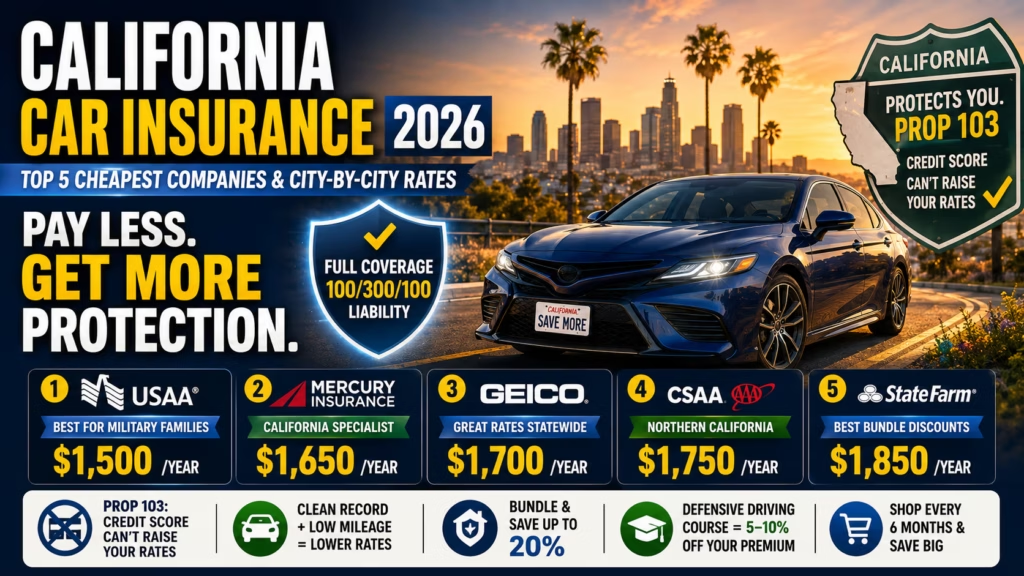
Quick Answer: The cheapest car insurance in California is USAA ($1,500/year) for military families and Mercury Insurance ($1,650/year) for the general public. Thanks to Proposition 103, insurers cannot use your credit score to set rates—so even if your credit is bad, you can still qualify for the absolute best price based solely on your driving record, ZIP code, and annual mileage. Stacking a low-mileage discount and a defensive driving course can push your rate even lower.
Here is exactly why California premiums are so high, which five companies consistently offer the cheapest rates, what you’ll pay in Los Angeles, San Francisco, and San Diego, and the seven most powerful ways to cut your bill—starting with the credit score ban that works in your favor.
Why California Car Insurance Costs a Small Fortune
California’s average full-coverage premium sits around $2,340 per year—roughly 25% above the national average. Several structural forces keep rates elevated, but understanding them lets you shop smarter.
- Crushing population density. Los Angeles, San Francisco, and San Jose are among the most congested cities in America. More cars per square mile translate directly into higher accident frequency and more claims.
- Sky-high repair costs. Labor rates, California-specific emissions equipment, and OEM parts prices are some of the steepest in the country. A routine fender bender often costs 30–50% more to fix here than in the Midwest.
- Wildfire and theft exposure. Comprehensive claims from wildfires (especially in Northern California and the Inland Empire) and high vehicle theft rates in urban centers add a permanent surcharge to every policy.
- Prop 103’s rate regulation. While the ban on credit scoring is a consumer victory, the requirement that every rate change be approved by the Insurance Commissioner slows carriers’ ability to adjust pricing. This can cause rates to be slightly stickier on the high side for drivers with flawless records who would otherwise earn an excellent-credit discount in other states.
You cannot change the geography, but you can switch to a carrier that weighs these factors most favorably. And in California, local knowledge matters enormously.
The 5 Cheapest Car Insurance Companies in California (2026 Rate Data)
Based on the latest filings with the California Department of Insurance and data from Quadrant Information Services, these rates represent a 40-year-old driver with a clean record, full coverage (100/300/100 liability plus comprehensive and collision with a $500 deductible), and 12,000 annual miles.
- 1. USAA – $1,500/year. Available only to military members, veterans, and their families. If you’re eligible, this is the unbeatable benchmark.
- 2. Mercury Insurance – $1,650/year. A California-specific powerhouse. Mercury’s underwriting model is finely tuned to local risks and often beats the nationals for clean-record drivers in suburban and rural ZIP codes.
- 3. GEICO – $1,700/year. Consistently affordable statewide, with particularly strong rates in San Diego and Sacramento.
- 4. CSAA (AAA Northern California) – $1,750/year. Regional specialist with excellent bundled roadside assistance and strong member satisfaction scores.
- 5. State Farm – $1,850/year. The bundling champion: combine your auto policy with homeowners or renters insurance and the combined discount often drops the auto portion below $1,700.
Progressive and Farmers hover in the $1,900–$2,000 range. Allstate, despite strong accident forgiveness, averages above $2,100. If you’re paying more than $2,000 and your record is clean, you are almost certainly overinsured with the wrong company.
What You’ll Pay City by City
Your ZIP code is one of the heaviest rating factors in California. These averages represent the cheapest available carrier (usually Mercury or GEICO) for the same clean driver profile:
- Los Angeles: $2,100 (traffic density and theft rates are the highest in the state)
- San Francisco: $2,050 (congestion and cost of repairs drive the premium)
- Riverside: $1,900
- San Diego: $1,800
- San Jose: $1,800
- Sacramento: $1,750
- Fresno: $1,650
- Bakersfield: $1,600 (lowest congestion among major cities)
The gap between Los Angeles and Bakersfield is $500 per year. Even moving from one Los Angeles neighborhood to another can change your rate. Always quote with the exact ZIP code where the car is garaged overnight.
California Minimum Coverage Is a Financial Trap
California law requires only 15/30/5 liability limits—$15,000 for bodily injury per person, $30,000 per accident, and a shockingly low $5,000 for property damage. These are the lowest state minimums in the entire country. A single moderate accident can exhaust $5,000 in property damage in seconds; a serious injury will obliterate the $15,000 per-person limit. The at-fault driver is then personally sued for the remainder. Your wages can be garnished and your assets seized.
Carrying at least 100/300/100 liability limits and adding matching Uninsured/Underinsured Motorist coverage (about 15% of California drivers are uninsured) costs roughly $25–$40 extra per month. That small sum is the only barrier between you and financial catastrophe.
6 Proven Ways to Lower Your California Premium
- Take advantage of the low-mileage discount. If you drive fewer than 7,500 miles per year—common among remote workers and city dwellers—you can save 5–15%. Report your exact mileage honestly at every renewal.
- Complete a defensive driving course. California mandates a 5–10% discount for drivers age 55 and older who complete an approved course, and many insurers extend similar discounts to all ages voluntarily. The cost is around $20–$40 and the discount lasts three years.
- Bundle your home or renters insurance. Multi-policy discounts in California can reach 20%. Mercury, State Farm, and GEICO offer the most aggressive bundling savings.
- Raise your comprehensive deductible to $1,000. Wildfire and theft are your main comp risks. A higher deductible can cut your premium by 10–14% without significantly increasing your out-of-pocket exposure.
- Pay your premium in full. Monthly installment fees add up to $60–$120 per year. Paying the six-month or annual term upfront eliminates those fees and often triggers an additional paid-in-full discount.
- Shop your policy every six months without fail. California’s competitive market means the carrier that gave you the best rate last year may no longer be the cheapest. Loyalty earns you nothing.
Special California Factors That Can Save or Cost You Thousands
Proposition 103: The Credit Score Ban That Works in Your Favor
Since 1988, California has prohibited insurers from using credit-based insurance scores. This means your premium is determined entirely by your driving record, years of experience, ZIP code, and annual mileage. If you have poor credit or no credit history, you are not punished at all. Drivers with excellent credit may pay slightly more here than they would in a state that rewards high scores, but the overall effect is a fairer market—and Mercury Insurance often emerges as the best-priced option under this rating structure.
Wildfire and Comprehensive Coverage
If you live in a wildfire-prone area—the hills above Los Angeles, the Sierra foothills, or large portions of Northern California—comprehensive coverage is non-negotiable. Some insurers have restricted new policies in extremely high-risk zones, so securing coverage early and maintaining continuous protection is critical. Ask about a separate wildfire deductible; some carriers impose a percentage-based deductible that can be substantially higher than your standard comprehensive deductible.
Rideshare and Delivery Driving
California law requires rideshare companies to provide coverage, but only during specific periods. Personal policies exclude all business use. If you drive for Uber, Lyft, DoorDash, or Instacart, you must add a rideshare endorsement. Mercury, State Farm, and GEICO offer them for $15–$30 per month. Without it, any accident that occurs while the app is on will result in a denied claim and a policy cancellation.
SR-22 After a DUI or Serious Violation
California requires an SR-22 certificate for DUI convictions, driving without insurance, and multiple serious moving violations. Expect your premium to at least double. Progressive, The General, and Direct Auto are the most competitive SR-22 carriers in California, though Mercury and GEICO also offer SR-22 filings in some cases.
Stop Overpaying for California Car Insurance Today
California’s unique rules can either work for you or against you. Because credit scores are banned, you have a rare opportunity to get the absolute lowest rate purely by keeping a clean driving record and shopping intelligently. Start with USAA if you’re eligible, then run Mercury and GEICO side-by-side. Stack every discount, never settle for the renewal price, and keep your liability limits high enough to protect everything you’ve built.
👉 Are you overpaying because of your credit? Use our 30-second estimate tool to compare baseline rates in your ZIP code and see where you stand.
Sources: California Department of Insurance (Proposition 103 rate filings), Quadrant Information Services (2026 rate data), Insurance Information Institute (III), National Association of Insurance Commissioners (NAIC), California Office of Traffic Safety.