
Every figure in this article is traced to the primary sources listed under Sources.
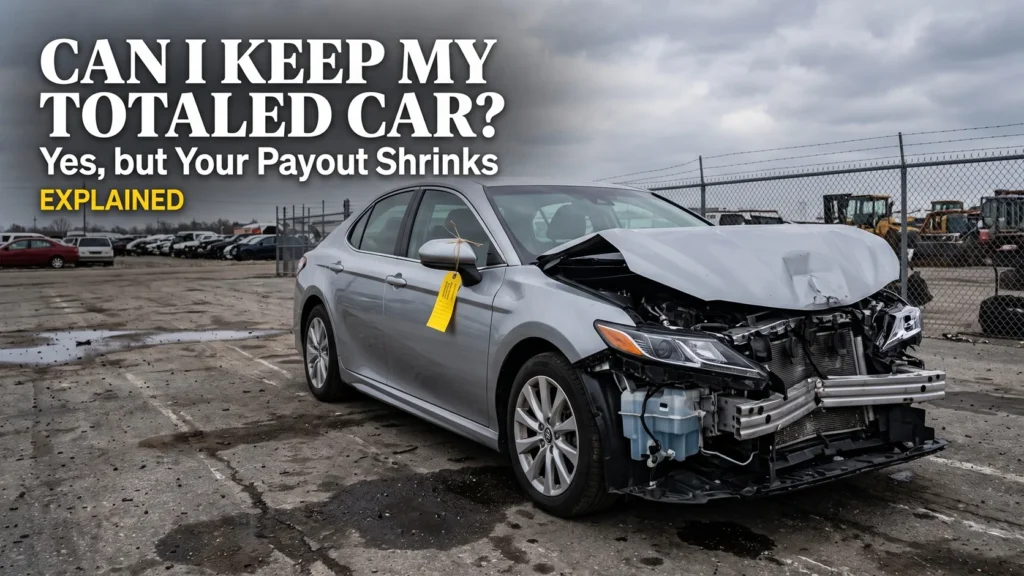
Yes, in many states you can keep your car after it is declared a total loss, but your insurance payout will be reduced by the vehicle’s salvage value. The insurer pays you the actual cash value (ACV) minus what the wrecked car would have sold for at salvage auction. You then receive a salvage title, and the car generally cannot be driven until it is repaired and inspected. This answer applies as of October 2026.
Key Takeaway: When your car is totaled, the insurer’s default is to take the car and pay you the full ACV, minus your deductible. Keeping the car is a separate choice called owner-retained salvage. It lets you keep the vehicle, but you are essentially buying the wreck from the insurer by accepting a smaller check. That can make sense if the car has sentimental value, if you are a mechanic who can repair it, or if you want to sell parts. It rarely makes sense if you need a replacement vehicle quickly, because the reduced payout may not cover a new car. You also need to consider that a salvaged vehicle can be harder to insure, and some insurers may require additional inspections or charge higher premiums.
Key Findings
- You can usually keep the car Many states allow owner-retained salvage, but the insurer deducts the salvage value from your payout.
- Your check will be smaller The insurer pays actual cash value minus salvage value minus your deductible.
- State rules vary Delaware and North Carolina, for example, require specific forms, inspections, or salvage certificates before the car can be retitled or driven.
How does owner-retained salvage work?
When your car is declared a total loss, the insurer calculates its actual cash value (ACV) — what the car was worth just before the accident. If you choose to keep the vehicle, the insurer subtracts the salvage value, which is what a salvage yard or rebuilder would pay for the wreck. You receive the difference, minus your deductible. You then get a salvage title, and the car must usually be repaired and inspected before it can be driven again.
Consider a hypothetical example. Suppose the insurer determines your car’s ACV is $10,000. The salvage value is $2,500. If you keep the car, you receive $7,500 (minus your deductible). If you surrender the car, you receive $10,000 (minus your deductible). The $2,500 difference is the price you pay to keep the wreck. These numbers are illustrative; your actual ACV and salvage value will depend on your car’s make, model, age, mileage, condition, and local market.
What changes by state or policy?
Rules vary by state as of October 2026. Delaware, for example, requires you to obtain a salvage certificate and have the vehicle inspected by the Delaware State Police Auto Theft Unit before it can be retitled and driven. North Carolina law (N.C. Gen. Stat. § 20-109.1) requires the insurer to give you an owner-retained salvage form if you want to keep the vehicle. Some states may not allow owner retention at all, or may impose additional inspection or titling requirements. Your insurance policy may also specify how salvage value is determined. Always ask your insurer and your state DMV for the exact rules that apply to you.
What should drivers do now?
Ask your insurer whether owner-retained salvage is allowed in your state. Request the proposed salvage value in writing, along with the ACV calculation. Check with your state DMV about salvage title, inspection, and registration requirements. Get repair estimates before you decide, and confirm whether your insurer will still cover a salvaged vehicle.
Compare quotes for your next policy
If you are shopping for car insurance, you can compare quotes for the same coverage limits and deductibles.
GET YOUR CAR INSURANCE QUOTESFrequently Asked Questions About Totaled Cars
Can I keep my totaled car and still get a payout?
Yes. The insurer will deduct the salvage value from the actual cash value, so you receive a smaller check but keep the vehicle.
How much will I get if I keep my totaled car?
You get the actual cash value minus the salvage value and your deductible. For example, if the ACV is $10,000 and salvage is $2,500, you receive $7,500 minus deductible.
The Bottom Line
You can usually keep your totaled car, but you will receive a smaller insurance check because the insurer deducts the salvage value. The car will carry a salvage title, and you must meet your state’s repair and inspection rules before driving it again.
How We Verified This
We reviewed the NAIC Consumer Guide to Auto Insurance for the definition of ACV, Delaware’s owner-retained salvage certificate rules (2 Del. Admin. Code § 2283), and North Carolina’s salvage retention statute (N.C. Gen. Stat. § 20-109.1). We also cross-checked industry explanations of the total loss formula. State rules change, so confirm the current requirements with your state insurance department or DMV. This article is general information, not legal or financial advice and not a personal quote. Reviewed against the cited sources and approved by the editor before publication.
Sources
- NAIC, Consumer Guide to Auto Insurance (definition of actual cash value), accessed October 18, 2026.
- Delaware Administrative Code, 2 Del. Admin. Code § 2283-1.0 (Owner-Retained Salvage Certificates), accessed October 18, 2026.
- North Carolina General Statutes, N.C. Gen. Stat. § 20-109.1 (Surrender of titles to salvage vehicles), accessed October 18, 2026.
- AAA, Totaled Car — What Happens When Your Car Is a Total Loss?, June 30, 2026.
- WalletHub, Totaled Car Guide: Key Things to Know in 2026, February 26, 2026.
Last updated: