
You pay your premium every month. You carry the card. You assume the policy will show up when metal meets metal. But in 2026, that assumption is costing American drivers billions.
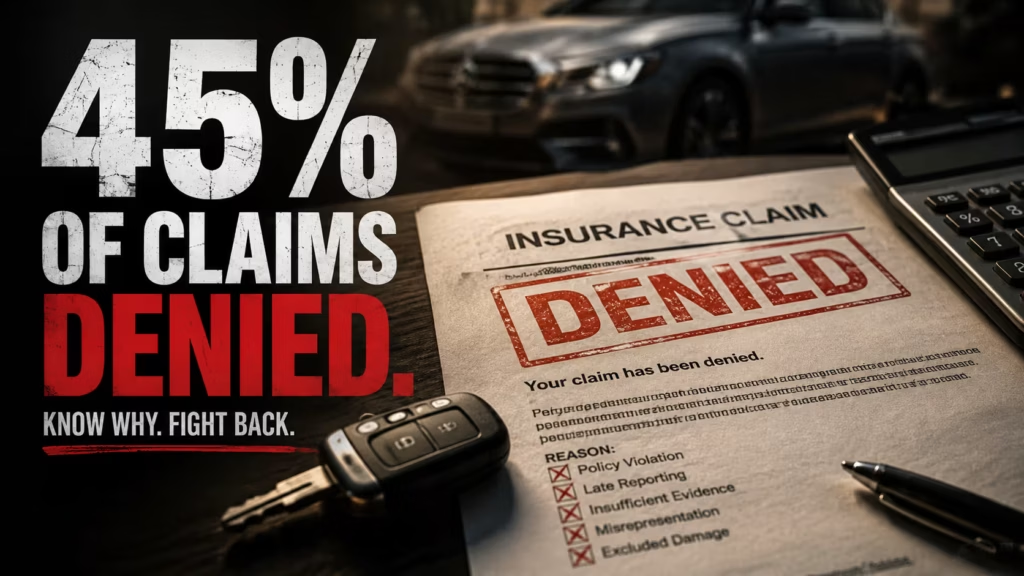
According to a Wall Street Journal analysis of thousands of carrier regulatory filings, auto insurers paid zero dollars on 45% of auto liability and medical claims they resolved last year. A decade ago, that figure hovered around 35%. The trend is not a glitch. It is a business model.
Key Takeaway: In 2026, nearly one in two auto liability and medical claims ends in denial. The surge is driven by aggressive fraud scrutiny, hidden household-member exclusions, strict reporting deadlines, and technicalities buried in policy language. To protect your payout, disclose every household driver age 14 or older, document every accident scene exhaustively, report claims within 24 hours, and read the permissive-use clause before handing your keys to anyone.
Americans are legally required to buy car insurance as a condition of driving. Yet the product is increasingly designed to collect premiums while minimizing payouts. During a claim analysis at most insurance companies, the first question is no longer “What happened?” It is “How can we decline this?” This guide breaks down exactly why claims are being denied at record rates, the specific policy traps that trip up policyholders, and the step-by-step playbook to fight back.
Navigate This Guide:
- Why Was My Car Insurance Claim Denied?
- Auto Insurance Claim Denial Reasons
- Car Insurance Claim Denied After Accident
- What to Do If Insurance Denies Your Claim
- How to Appeal a Denied Car Insurance Claim
- How to Fight a Car Insurance Claim Denial
- How to Dispute a Car Insurance Claim
- Denied Car Insurance Claim Attorney
- How to Protect Yourself From Claim Denials
- Frequently Asked Questions
Why Was My Car Insurance Claim Denied? The 45% Reality
The numbers are not abstract. They represent real people who submitted claims after real crashes and walked away with nothing. The Wall Street Journal’s review of NAIC-mandated filings reveals a hard shift:
with zero payout in 2025-2026
a decade ago
in the past 12 months
since Q1 2022
of $1,000+ (up from 23%)
“ghost broker” scheme alone
Insurers and consumer advocates disagree on the root cause. The industry cites an uptick in fraud — including AI-enhanced fake claims and “ghost broker” schemes — as justification for tighter scrutiny. Consumer advocates argue carriers are exploiting fine-print exclusions to avoid paying legitimate claims. In practice, both forces are true, and the policyholder is caught in the middle.
In June 2026, a single ghost broker was arrested for procuring over 1,120 auto insurance policies using fraudulent data and social media apps, defrauding three carriers out of $832,000 in premiums while pocketing $84,470 from victims. Cases like these give insurers political cover to deny claims more aggressively. The result is a system where the burden of proof has shifted from the carrier to the driver.
Auto Insurance Claim Denial Reasons: What Insurers Won’t Tell You
Most denial letters cite a specific policy provision. The problem is that many policyholders have never read that provision — or did not know it existed when they signed the application. Here are the denial categories growing fastest in 2026, based on NAIC complaint data and carrier filings.
Car Insurance Claim Denied Due to Non-Disclosure
This is the nuclear option for insurers. If the carrier determines you failed to disclose a “material fact” during the application process, it can rescind the policy entirely — effectively pretending you never had coverage — and refund only the premiums paid.
Consider the case of Christopher Benton, a California lab technician who hit another car in what he described as a “little bumper accident” in 2023. Benton carried $5,000 in liability coverage. Allstate-owned National General refused to pay. The reason? His 15-year-old son was not listed on the policy. The teenager was not in the truck. He did not have a license. But National General’s application required disclosure of all household members ages 14 or over. Benton said neither he nor his broker knew the requirement existed. He is now part of a class-action lawsuit alleging the application was deliberately designed to hide that clause.
Auto Claim Denied Due to Policy Lapse
A policy lapses when the premium is not paid by the grace-period deadline. In most states, the grace period is 10 to 30 days. If an accident occurs during a lapse, the carrier owes nothing. A very common scenario I see during policy reviews: the driver set up autopay on a credit card that expired, missed the grace-period notice buried in email spam, and had a crash on day 31. The denial is absolute. No appeal inside the carrier will overturn it because there was no contract in force.
Car Insurance Claim Denied for Late Reporting
Most policies require you to report an accident “as soon as reasonably possible” or within 24 to 72 hours. In practice, carriers interpret this strictly. If you wait four days because you were negotiating privately with the other driver, the insurer may deny the claim for “prejudice” — arguing that the delay hampered its ability to investigate. State laws vary: New York requires notice “promptly,” while California mandates “within a reasonable time.” But carriers write the policy language, and they define “reasonable” in their favor.
Auto Claim Denied for Unauthorized Driver
Handing your keys to a friend can cost you everything. Some policies include “permissive use” coverage for occasional, non-listed drivers. Others are “named driver only,” meaning anyone not explicitly listed is excluded. In 2026, more carriers are moving to named-driver-only structures for standard policies, burying the change in renewal paperwork. If your friend borrows your car and sideswipes a guardrail, the carrier will ask one question first: “Were they listed?” If the answer is no, the claim dies.
Insurance Claim Denied Due to Misrepresentation
Misrepresentation is broader than non-disclosure. It includes stating your vehicle is parked in a garage when it is street-parked, claiming a shorter commute than you actually drive, or forgetting to mention a fender-bender from three years ago. Carriers now run LexisNexis and CLUE reports at claim time, not just at application. If the data does not match your original answers, they have grounds to deny. In many states, the misrepresentation must be “material” to the risk to justify denial, but fighting that definition requires legal help.
Car Insurance Claim Denied for Fraud Suspicion
Fraud denials are rising, partly because AI tools now flag claims automatically. If the carrier’s algorithm detects inconsistencies — say, damage inconsistent with the reported speed, or a witness whose phone number traces back to the claimant — the claim is routed to a Special Investigations Unit (SIU). During an SIU review, the claim is frozen. If the unit finds “reasonable suspicion” of fraud, the denial letter arrives citing policy language that voids coverage for fraudulent acts. The threshold for “reasonable suspicion” is lower than proof. It is enough to stall or kill your claim.
Car Insurance Claim Denied for Modified Vehicle
Lift kits, engine tuning chips, aftermarket exhausts, and window tinting can all trigger denials. Why? Because modifications alter the vehicle’s risk profile from what the carrier underwrote. If you did not report the modification — and many drivers do not, assuming it is irrelevant — the carrier can argue the policy was issued for a stock vehicle, not a modified one. In practice, cosmetic mods rarely trigger denials unless they contribute to the loss. But performance modifications almost always do, especially if they affect speed, handling, or braking.
Car Insurance Claim Denied for Racing or Illegal Activity
This is the cleanest denial in the book. If the carrier can prove you were street racing, fleeing police, or driving with a suspended license, coverage evaporates. The burden of proof is on the carrier, but police reports make it easy. A single citation for “exhibition of speed” or “reckless driving” on the accident report gives the insurer everything it needs. In many states, this exclusion applies to the entire policy, not just the specific incident.
Car Insurance Claim Denied for Excluded Damage
Standard exclusions include flood damage without comprehensive coverage, wear-and-tear, mechanical failure, and intentional damage. But in 2026, carriers are narrowing comprehensive definitions. Some policies now exclude “gradual deterioration” of paint or rust, arguing it is maintenance, not an insurable event. Others exclude rodent damage unless you can prove it occurred in a single, identifiable incident. Read the “Exclusions” section of your declarations page. It is usually three pages of dense text that nobody reads — until the denial arrives.
Car Insurance Claim Denied After Accident: Real Cases
The Wall Street Journal investigation uncovered patterns that should alarm every policyholder. These are not edge cases. They are standard operating procedure at several major carriers.
What to Do If Insurance Denies Your Claim
The moment the denial letter hits your mailbox, the clock starts ticking. Most carriers allow 30 to 60 days for an internal appeal. State insurance departments have longer windows — often one to three years — but administrative deadlines are unforgiving. Here is the exact sequence that licensed claims professionals recommend.
Step 1: Demand the Denial Letter and the Specific Policy Language
Do not accept a verbal denial. Under NAIC model laws and most state regulations, the carrier must provide a written denial letter citing the specific policy provision and the factual basis for the decision. If the letter is vague — and many are — request a supplemental explanation in writing. Every vague statement is a potential weakness in their position.
Step 2: Gather Evidence Immediately
Collect every document related to the claim:
- Police report — even for minor accidents. An official report creates a contemporaneous record that is hard for the carrier to dispute.
- Photos and video — from the scene, of all vehicles, of road conditions, of traffic signals, and of any visible injuries.
- Witness contact information — written statements are better. If a witness saw the other driver run a red light, that fact belongs in your appeal.
- Medical records — if bodily injury is involved, document the treatment timeline from day one.
- Repair estimates — get two independent estimates, not just the carrier’s preferred shop.
Step 3: Check Your State’s Bad-Faith Laws
Some states — notably California, New York, and Florida — have robust bad-faith insurance statutes that penalize carriers for unreasonably denying claims. In California, an insurer that unreasonably denies a claim can be liable for the full amount of the judgment plus attorney fees and emotional distress damages. In other states, bad-faith remedies are weaker. Check your state insurance department’s consumer guide before deciding whether to escalate.
How to Appeal a Denied Car Insurance Claim
The internal appeal is your first and cheapest shot at reversal. Treat it like a legal brief, not a complaint letter.
Insurance Claim Denial Appeal Letter: What to Include
Your appeal letter should be one to two pages, single-spaced, and structured as follows:
- Policy and claim numbers at the top, with the date of loss.
- Direct response to each denial reason. If they cite non-disclosure, explain why the omission was not material or why the question was ambiguous. Attach proof.
- Legal and regulatory context. Cite your state’s insurance code or NAIC guidelines that support your position. Even a single statute citation signals that you are not a pushover.
- Deadline reminder. State that you expect a written response within the carrier’s mandated appeal window — typically 30 to 60 days.
- Escalation threat. Note that you reserve the right to file a complaint with the state insurance department and to pursue legal remedies if the denial is upheld.
Send the letter via certified mail with return receipt requested. Email is faster, but certified mail creates a paper trail that regulators and courts respect.
How to Fight a Car Insurance Claim Denial
If the internal appeal fails, you have three lanes of attack. Choose based on the dollar amount and the complexity of the denial.
State Insurance Department Complaint
- Cost: Free
- Best for: Clear-cut denials under $25,000
- Timeline: 30 to 90 days for review
- Power: The department can fine the carrier and order payment, but cannot award damages beyond the policy limit
Small Claims Court
- Cost: $50 to $200 in filing fees
- Best for: Property damage denials under your state’s limit (typically $5,000 to $15,000)
- Timeline: 2 to 6 months
- Power: You represent yourself. No attorneys required. The judge decides on evidence, not policy interpretation.
Civil Litigation
- Cost: Contingency fee (25% to 40% of recovery)
- Best for: Bodily injury, bad-faith denials, or claims exceeding $25,000
- Timeline: 12 to 36 months
- Power: Full discovery, depositions, and potential punitive damages in bad-faith states
Appraisal Clause (Property Only)
- Cost: $300 to $600 per appraiser
- Best for: Disputes over repair cost or total-loss valuation
- Timeline: 30 to 60 days
- Power: Binding decision on value, but does not address liability or coverage questions
Denied Car Insurance Claim Attorney: When to Hire One
Not every denial warrants an attorney. But some absolutely do. In practice, the threshold is lower than most drivers think.
Hire an attorney immediately if:
- The denied claim involves bodily injury to you or a third party. Medical costs compound quickly, and liability exposure can exceed policy limits.
- The carrier alleges fraud or misrepresentation. These accusations can affect your ability to obtain future insurance and may trigger criminal referral.
- The denial is based on a technicality that seems manufactured — such as a household-member clause you were never told about.
- The claim value exceeds $10,000. At that threshold, attorney fees on contingency are typically offset by higher recovery.
- You live in a bad-faith state (California, Florida, New York, Washington, West Virginia) where carriers face punitive damages for unreasonable denials.
You can probably handle it yourself if:
- The dispute is purely about repair cost or total-loss valuation. Use the appraisal clause instead.
- The denial is for a policy lapse that you acknowledge, and you simply need to negotiate a reinstatement.
- The claim is under $2,500 and small claims court is available in your jurisdiction.
Most bad-faith insurance attorneys offer free consultations and work on contingency. If the attorney declines your case, ask why. A rejection often means the denial is legally defensible, which tells you whether further investment is rational.
How to Dispute a Car Insurance Claim and Win
Disputing a claim is not about emotion. It is about documentation, deadlines, and leverage. The drivers who win disputes share one trait: they treat the process like a business negotiation, not a customer-service complaint.
Document the Scene Like a Claims Adjuster
If you are reading this before an accident, prepare now. Keep a disposable camera or ensure your phone has cloud backup. At the scene:
- Photograph all four sides of every vehicle before they are moved.
- Photograph the intersection, traffic controls, skid marks, and debris fields.
- Get the other driver’s insurance card, registration, and license — photograph them.
- Ask witnesses for their full name, phone number, and what they saw. Record the conversation if state law permits single-party consent.
- Call the police for any accident on a public road. A police report number is the strongest single piece of evidence in a disputed claim.
Understand the Carrier’s Incentive Structure
Adjusters are evaluated on closure speed, severity management, and litigation avoidance. They are not evaluated on your satisfaction. When you dispute a claim, your goal is to make denial more expensive than payment. That means:
- Citing state regulations that trigger supervisory review.
- Mentioning bad-faith exposure if your state allows it.
- Threatening regulatory complaint to the state insurance department — a metric that affects the carrier’s license standing.
- Providing overwhelming evidence that makes a denial indefensible in front of a regulator or jury.
Use the Appraisal Clause for Property Disputes
Most auto policies contain an appraisal clause that triggers when you and the carrier disagree on the amount of loss. Each side hires an independent appraiser. If they disagree, an umpire decides. The umpire’s decision is binding. In practice, this process costs $600 to $1,200 total and resolves valuation disputes in 45 to 60 days — faster and cheaper than litigation.
How to Protect Yourself From a Car Insurance Claim Rejected
The best dispute is the one you never have to file. Here is the prevention checklist that licensed agents use for their own families.
Get Your 2026 Car Insurance Quotes
Compare rates from carriers with strong claim-payout records. See how much you can save and protect yourself before the next renewal.
GET YOUR 2026 CAR INSURANCE QUOTESFrequently Asked Questions About Car Insurance Claim Denials
What percentage of car insurance claims are denied?
In 2026, auto insurers denied payment on 45% of auto liability and medical claims they resolved, according to Wall Street Journal analysis of regulatory filings. That is up from roughly 35% a decade ago. The denial rate for property damage claims is lower — approximately 15% to 20% — but rising.
Why do insurance companies deny claims?
Carriers deny claims for four primary reasons: fraud prevention, policy technicalities (non-disclosure, lapse, late reporting), risk mitigation (unauthorized drivers, excluded damage), and cost control. In practice, the line between legitimate fraud prevention and technicality-based denial has blurred. Consumer advocates argue carriers are increasingly using the latter to avoid payouts.
How long do I have to appeal a denied car insurance claim?
Most carriers require a formal internal appeal within 30 to 60 days of the denial letter. State insurance departments typically accept complaints within one to three years, but missing the carrier’s internal deadline often weakens your position. Act immediately.
Can an insurance company deny my claim for lack of evidence?
Yes. The burden of proving a covered loss falls on the policyholder, not the carrier. If you cannot provide photos, a police report, witness statements, or repair estimates, the insurer can deny for “failure to cooperate” or “insufficient proof of loss.” This is why scene documentation is critical.
What should I do if my car insurance claim is disputed?
Request the specific reason in writing. Gather all evidence. File an internal appeal within the carrier’s deadline. If that fails, escalate to your state insurance department, consider small claims court for property damage under $15,000, or hire a bad-faith attorney for larger or bodily-injury claims.
Is a car insurance claim denial letter required by law?
Under NAIC model laws adopted by most states, yes. The carrier must provide a written denial letter stating the specific policy provision and factual basis for the denial. If you receive only a phone call or email summary, demand the formal letter. It is your roadmap for appeal.
Can I fight a denial for a modified vehicle?
Yes, but the fight is uphill. If the modification was cosmetic and did not contribute to the loss, argue that the exclusion is not material. If the modification was performance-related, your best path is often negotiation rather than litigation, unless the carrier failed to ask about modifications on the application.
Sources: Wall Street Journal, National Association of Insurance Commissioners (NAIC), Insurance Information Institute (Triple-I), TransUnion Q1 2026 Insurance Personal Lines Trends, LexisNexis 2026 U.S. Auto Insurance Trends Report, State Insurance Department Consumer Guides, Carrier Regulatory Filings 2026.