
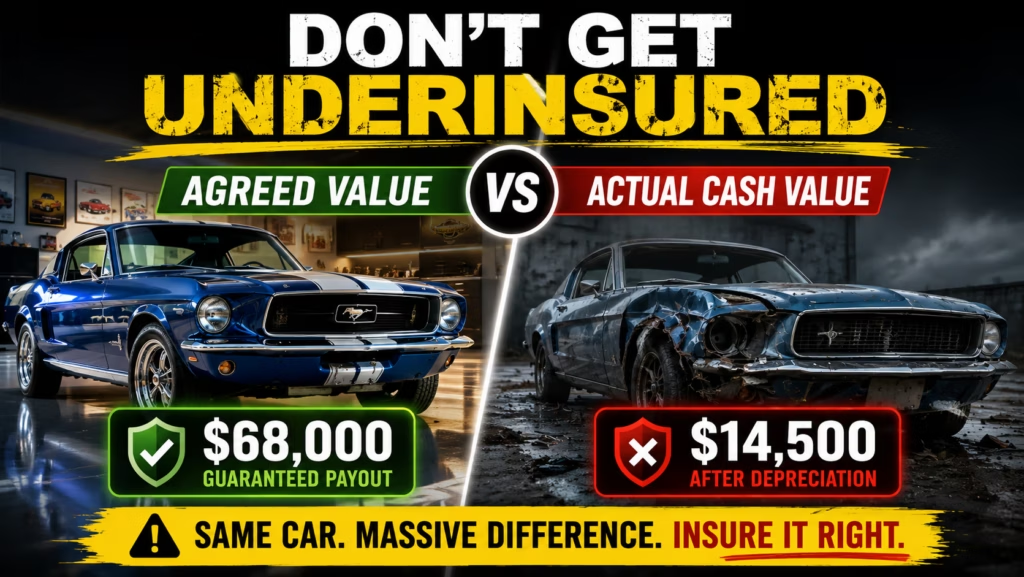
You spent a decade restoring a 1967 Mustang Fastback to concours condition. Every hose clamp is period-correct. Every panel gap is factory-spec. Then a distracted driver runs a red light, and your standard auto insurer cuts you a check for $14,500—the “actual cash value” of a depreciated 57-year-old Ford. The market value? $68,000. That scenario plays out every single day because owners trust regular carriers with irreplaceable assets.
Quick Answer: Standard auto insurance uses Actual Cash Value (ACV), which factors in depreciation and will undervalue your classic by 40–70%. Specialty classic car insurance uses Agreed Value—a guaranteed payout you and the insurer lock in before a loss. If your vehicle is 20+ years old, driven under 5,000 miles annually, and garage-kept, you qualify for coverage that costs less than a standard policy while protecting the true worth of your investment.
Confusing ACV with Agreed Value is the most expensive mistake a collector can make. Here is exactly how classic car insurance works, which carriers dominate the specialty market in 2026, and how to lock in a guaranteed payout that reflects your vehicle’s real collector value.
Why Standard Auto Insurance Fails Collector Vehicles
Mainstream carriers like GEICO, State Farm, and Allstate operate on a replacement and depreciation model. That model collapses when applied to an appreciating asset. Three core problems destroy your financial protection:
- Actual Cash Value destroys equity. ACV equals replacement cost minus depreciation. A 1969 Chevrolet Camaro SS that would sell for $55,000 at auction might carry an ACV of $17,000 in a standard policy database. After a total loss, that $38,000 gap is your problem—permanently.
- Aftermarket and generic parts gut authenticity. Standard policies authorize the cheapest available replacement parts. For a classic, that means Chinese reproduction sheet metal instead of OEM or NOS (New Old Stock) components. Your car loses originality and value with every non-period-correct repair.
- No protection for appreciating markets. A standard policy’s coverage ceiling is static. Meanwhile, classic vehicle values have appreciated 12–18% annually in certain segments since 2020. Without an inflation guard or periodic revaluation clause, you are perpetually underinsured.
Agreed Value vs. Stated Value: The Distinction That Saves Collections
Even within specialty insurance, terminology traps exist. Understanding the difference between Agreed Value and Stated Value prevents catastrophic misunderstandings at claim time.
- Agreed Value (what you want): A binding contract provision. You submit documentation—photos, appraisal, restoration receipts—and the insurer approves a dollar figure. If the car is totaled, that is exactly what you receive. No depreciation. No negotiation.
- Stated Value (what you should avoid): A deceptive middle ground. You state the vehicle’s value, but the policy language includes a clause allowing the insurer to pay either the stated amount or the ACV—whichever is lower. This is common in “collector endorsements” from standard carriers. Read the fine print ruthlessly.
The 2026 Specialty Insurance Landscape: Who Actually Delivers
Not all classic insurers are equal. Claims experience, mileage flexibility, and parts sourcing guarantees separate the market leaders from marketing operations. Based on current policyholder satisfaction data and claims audits, here are the definitive rankings:
- Hagerty (Market Leader): Insures over 2 million collector vehicles. True Agreed Value. Guaranteed flatbed towing. Spare parts coverage up to $750 automatically included. In-house valuations team updates market data continuously. Club discounts for AACA, Porsche Club of America, and hundreds of marque organizations.
- Grundy (Zero Deductible Specialist): The only major carrier offering $0 deductible across the board with no premium penalty. Slightly stricter usage enforcement—absolutely no errands or commuting of any kind. Ideal for trailer queens and show-only vehicles.
- American Modern (Chubb Subsidiary): Strong option for lower-value classics ($15,000–$40,000) and owners who want slightly more mileage flexibility—some policies permit up to 7,500 annual miles. Backed by Chubb’s financial strength rating.
- Heacock Classic: Specializes in European exotics and vintage racing vehicles. Offers track-day liability extensions that most competitors exclude entirely.
Critical warning: Avoid binding classic coverage through your standard carrier’s “classic add-on.” These products are frequently Stated Value policies dressed in Agreed Value marketing language. When a $65,000 Porsche 912 is declared a total loss, you do not want to discover the fine print during the claims process.
What Qualifies as a Classic for Insurance Purposes
Specialty underwriters evaluate eligibility through a specific lens. Meeting these criteria opens access to Agreed Value policies and rates 30–60% below standard premiums:
- Age threshold: Minimum 20 model years old for standard classic designation. Vehicles 40+ years qualify as antique, often with additional coverage perks.
- Annual mileage cap: Typically 1,000–5,000 miles. Odometer verification required at renewal. Pleasure-use policies with 7,500–10,000 mile limits exist but carry higher premiums.
- Secure storage: Locked, enclosed garage is non-negotiable for 95% of specialty carriers. Carports, driveways, and street parking result in automatic declination.
- Primary vehicle requirement: Every licensed driver in the household must have a separate, insured daily driver. The classic cannot serve as backup transportation.
- Driving record: Clean MVR strongly preferred. A single DUI in the past 5 years disqualifies you from most specialty programs.
Cost Reality Check: Specialty Coverage Is Cheaper Than Standard
The pricing inversion surprises every new collector. Because classics are driven sparingly and maintained obsessively, loss ratios are dramatically lower than daily-driver pools. Typical 2026 annual premiums for a clean-record driver with garage storage:
- Hagerty, $30,000 Agreed Value, 2,500 miles/year: $340–$480
- Grundy, $45,000 Agreed Value, 2,000 miles/year, $0 deductible: $380–$520
- American Modern, $20,000 Agreed Value, 5,000 miles/year: $260–$410
- Standard carrier, ACV only, same vehicle profiles: $400–$700 annually—with catastrophic coverage gaps
You are literally paying more for worse protection if you stay with a standard policy. For high-value exotics and rare Ferraris or Shelby Cobras, premiums scale to $900–$2,200 annually, but the Agreed Value guarantee prevents six-figure losses that ACV would leave exposed.
How to Establish and Defend Your Vehicle’s Agreed Value
Insurers will not accept an inflated number. Documentation rigor determines both your approved value and your claims experience:
- Professional appraisal (vehicles over $50,000): A certified appraiser’s report carries more weight than any other evidence. Expect to pay $150–$400 for a thorough written appraisal.
- High-resolution photography: Exterior, interior, engine bay, undercarriage. Document every angle. Restoration photos add significant credibility.
- Comparable sales data: Hagerty Valuation Tool, Bring a Trailer closed auctions, Barrett-Jackson and Mecum results. Screen-capture comparable sales and retain them.
- Restoration receipts: Every dollar spent on mechanical, body, and interior work supports a higher Agreed Value. Organize receipts chronologically.
Reassess your Agreed Value every 24 months. Market appreciation in the collector segment can outpace your policy’s inflation guard. A car insured at $40,000 in 2022 might legitimately command $52,000 in 2026.
Frequently Asked Questions
Does classic car insurance cover modified vehicles and restomods?
Yes, through specialized endorsements. Hagerty and Grundy both offer modified/restomod coverage. You must disclose all non-original modifications—engine swaps, aftermarket suspension, custom interiors—with receipts. Undisclosed modifications can void coverage at claim time. If your build is extreme (pro-touring, custom chassis), Heacock and K&K Insurance offer programs specifically engineered for heavily modified vehicles.
Can I drive my classic to work occasionally?
Almost universally no. Specialty policies prohibit commuting of any frequency. Even occasional workplace appearances can trigger coverage disputes. If you genuinely want to drive your classic on predictable commuting days, seek a “pleasure use” endorsement with a higher mileage allowance—but disclose your intentions upfront. Honesty at underwriting prevents claim denial later.
What happens if my classic appreciates mid-policy?
Policies with inflation guard automatically increase Agreed Value by 2–6% annually to track market appreciation. However, rapid appreciation in hot segments (air-cooled 911s, vintage Broncos, Japanese domestic market legends) can outstrip this mechanism. Notify your carrier if comparable sales suggest a significant value increase mid-term; most can adjust coverage via endorsement.
Protect What Standard Insurance Will Not
Your classic represents years of searching, restoring, and perfecting. A standard auto policy treats it like a depreciating transportation appliance and pays accordingly. Specialty Agreed Value coverage closes that gap entirely—often at a lower premium than you pay now. Quote Hagerty and Grundy first. Read every policy’s valuation clause before binding. And remember: the insurer’s promise means nothing if the contract language does not back it up in black and white.
👉 Are you overpaying because of your credit? Use our 30-second estimate tool to compare baseline rates in your ZIP code and see where you stand.
Sources: Hagerty Insurance 2026 Rate Filings, Grundy Worldwide Claims Data, American Modern Insurance Group (Chubb), Federal Trade Commission Auto Insurance Scoring Guidelines, Barrett-Jackson Auction Company Market Reports, Bring a Trailer Auction Analytics, LexisNexis Risk Solutions Insurance Credit Score Database.