
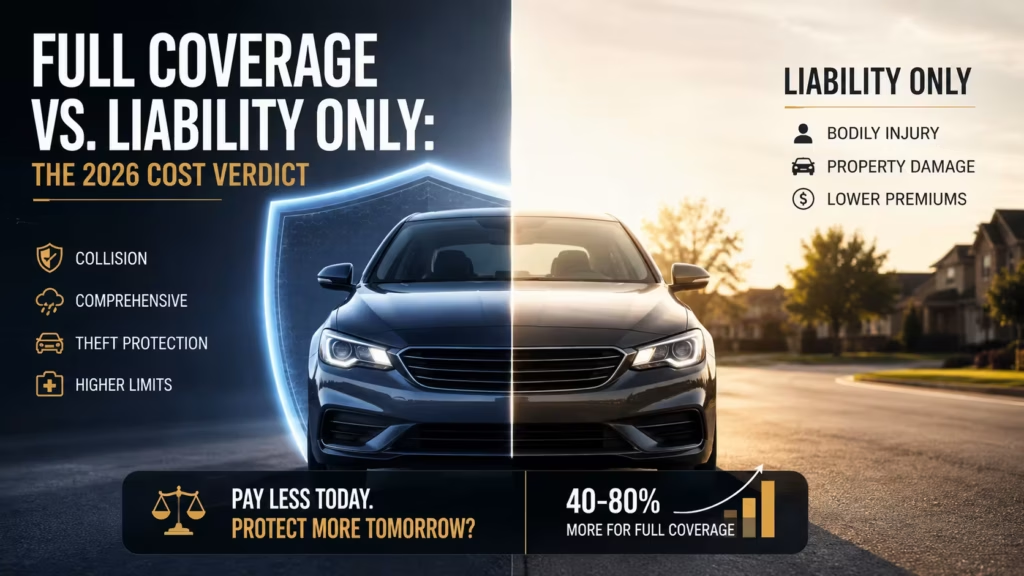
Full coverage costs 40% to 80% more than liability-only insurance, but that gap only matters relative to what your car is actually worth. A driver with a $32,000 loan balance has no real decision to make. A driver with a paid-off 2013 sedan almost certainly does.
Key Takeaway: Liability-only insurance covers damage you cause to other people and their property, and nothing on your own vehicle. Full coverage adds comprehensive and collision, which pay to repair or replace your car after an accident, theft, or weather event. The financial breakeven point is roughly 10% of your car’s actual cash value spent annually on comprehensive and collision premiums. Below that value, dropping full coverage and self-insuring the difference usually saves money over time. Above it, or with any active loan or lease, full coverage remains the correct call.
Every year, agents field the same question from two very different drivers asking for opposite reasons. One wants to lower a payment on a car worth $2,800. The other wants to make sure a $45,000 truck is actually protected. The math behind each answer is not opinion — it is arithmetic anyone can run in five minutes with a valuation tool and a calculator. This guide walks through that arithmetic, the state-by-state legal minimums that set the floor for liability-only coverage, and the specific scenarios where the “obvious” choice is actually the wrong one.
Navigate This Guide:
- What Is the Difference Between Full Coverage and Liability Only?
- How Much More Does Full Coverage Cost in 2026?
- What Does Liability-Only Insurance Actually Cover?
- What Does Full Coverage Add?
- Is Liability-Only Insurance Legal in Every State?
- When Should You Drop Full Coverage?
- When Should You Keep Full Coverage?
- Does Your Lender Require Full Coverage?
- What Happens If You Cause an Accident With Only Liability?
- How Do Deductibles Change the Math?
- Frequently Asked Questions
What Is the Difference Between Full Coverage and Liability Only Insurance?
“Full coverage” is not an official policy type — you will not find that phrase in a state insurance code or a policy declarations page. It is industry shorthand for a bundle of three coverages: liability, comprehensive, and collision. Liability-only means exactly what it sounds like: the policy carries liability protection and nothing else.
The distinction that actually matters is whose property gets paid for. Liability pays the other driver. Comprehensive and collision pay you. A driver who carries liability-only and causes a wreck will watch the insurer cut a check to the other party while paying out of pocket for their own repair bill. That is the entire trade-off in one sentence, and every decision in this guide flows from it.
Liability Only
- Covers: The other driver’s medical bills, lost wages, and property damage
- Your car: Not covered under any circumstance
- Monthly cost (100/300/100): $75-$130 for a typical clean-record driver
- Deductible: None — liability has no deductible
- Best for: Older, paid-off vehicles worth less than $4,000
Full Coverage
- Covers: Everything liability covers, plus your own vehicle
- Your car: Repaired or replaced up to actual cash value
- Monthly cost (same liability + comp/coll): $140-$230 for the same driver
- Deductible: Separate deductibles apply for comprehensive and collision, typically $500-$1,000
- Best for: Financed, leased, or newer vehicles worth more than $6,000
How Much More Does Full Coverage Cost Than Liability Only in 2026?
Adding comprehensive and collision to a liability-only policy increases the total premium by 40% to 80% nationally, based on 2026 rate filings tracked by Quadrant Information Services. The exact spread depends heavily on the vehicle’s age, repair cost profile, and theft rate — not just its sticker price.
Here is what a 35-year-old driver with a clean record and a mid-size sedan is actually paying per month in 2026, assuming 100/300/100 liability limits and a $500 comprehensive/collision deductible:
Monthly Average
Monthly Average
for Comp/Collision
on Cars Over 10 Years Old
Notice how that last figure shrinks the decision for older cars. On a vehicle worth $3,500, comprehensive and collision might only cost $35 to $50 more per month than liability alone — not the $80 gap you would see on a brand-new SUV. In practice, this is exactly why the “drop full coverage on old cars” advice has to be checked against your specific vehicle rather than applied as a blanket rule.
What Does Liability-Only Insurance Actually Cover?
Liability insurance pays for damage you cause to other people, never your own vehicle. It has two required components in nearly every state:
- Bodily injury liability (BI)
- Pays medical bills, lost wages, and legal defense costs for the other driver and their passengers if you are found at fault.
- Property damage liability (PD)
- Pays to repair the other person’s vehicle, fence, mailbox, or storefront — whatever you damaged.
Most states set minimum limits around 25/50/25, meaning $25,000 per person and $50,000 per accident for bodily injury, plus $25,000 for property damage. During a claim analysis at most insurance companies, those minimums get exhausted fast — a single emergency room visit with imaging and a short hospital stay routinely runs past $50,000, and the average new vehicle price now exceeds $48,000 according to Kelley Blue Book data. That gap between what the minimum pays and what a serious claim costs is why agents almost universally recommend 100/300/100 regardless of whether a driver carries full coverage or liability-only.
What Does Full Coverage Add? Comprehensive and Collision Explained
Full coverage layers two optional coverages on top of liability, and they answer different questions about how your car got damaged.
Together, these two coverages mean your own vehicle is protected in almost any realistic damage scenario. Without them, you are self-insuring — which is a legitimate financial strategy, but only when you have done the math to confirm it, not because you never got around to reviewing the policy.
Is Liability-Only Insurance Legal in Every State?
Yes, liability-only insurance satisfies the legal minimum coverage requirement in every state that mandates auto insurance, provided you meet that state’s specific minimum limits. New Hampshire is the primary exception — it does not require auto insurance at all for most drivers, though it does require proof of financial responsibility if you are involved in an at-fault accident.
What liability-only insurance does not satisfy is any requirement imposed by a lender. State law and lender contracts are two entirely separate obligations, and meeting one does not exempt you from the other. A financed vehicle requires full coverage under the loan agreement even in a state where liability-only would otherwise be perfectly legal.
When Should You Drop Full Coverage and Switch to Liability Only?
Drop full coverage once the annual premium for comprehensive and collision — not your whole policy, just those two coverages — exceeds roughly 10% of your vehicle’s actual cash value. This is the threshold most agents actually use when a client asks whether they are over-insured.
- Vehicle is 8-10+ years old: Actual cash value has typically dropped below $4,000, shrinking any payout you would receive after a total loss.
- Comp/collision premium exceeds 10% of vehicle value annually: Example — a car worth $3,000 with $650 in annual comp/collision premium is paying 21.6% of the car’s value per year to insure it. Self-insuring is almost always the better math here.
- No loan or lease exists: Once the lien is released, the lender’s contractual requirement disappears and the decision reverts entirely to you.
- You have savings equal to the car’s replacement cost: If you could write a check tomorrow for a comparable used vehicle, the insurance is protecting money you already have twice over.
Example: A 2012 Honda Civic worth $3,500 carries full coverage at $1,200 per year. If the car is totaled, the payout is $3,500 minus the $500 deductible — $3,000. But three years of premiums for comp/collision alone total roughly $2,700 in this scenario, nearly the entire payout amount. That math almost never favors keeping the coverage once the vehicle drops below this value range.
When Should You Keep Full Coverage on Your Car?
Keep full coverage if you cannot immediately absorb the cost of replacing your vehicle. That single test resolves most of the ambiguity.
Does Your Lender Require Full Coverage Insurance?
Yes, almost universally. Every major auto lender and lease provider in the United States requires comprehensive and collision coverage for the duration of the loan or lease, with a maximum deductible — usually $500 to $1,000 — spelled out in the financing agreement. This requirement protects the lender’s collateral, not you directly, though it does mean your vehicle is covered as a side effect.
If comprehensive and collision coverage lapses on a financed vehicle, the lender is contractually permitted to force-place collateral protection insurance (CPI) on your account. CPI is dramatically more expensive than a standard policy, provides no liability protection for you personally, and is added directly to your loan balance. In practice, the fastest way to end up paying far more than a normal full-coverage premium is to let coverage lapse on a financed car and have the lender step in.
What Happens If You Cause an Accident With Only Liability Insurance?
Your liability coverage pays the other driver’s medical bills and property damage up to your policy limits. Your own vehicle’s repair or replacement cost is entirely your responsibility, paid out of pocket, with no insurance contribution whatsoever.
A very common scenario during claim reviews: a driver with liability-only coverage rear-ends another vehicle at a stoplight. The insurer pays for the other driver’s bumper repair and a minor whiplash claim — perhaps $6,000 total. The at-fault driver’s own vehicle, with a cracked radiator and bent frame rail, requires a $4,200 repair that comes entirely from their own pocket, because collision coverage was never on the policy. This is not a loophole or a claims department decision. It is the coverage working exactly as written.
How Do Deductibles Affect the Full Coverage vs. Liability Decision?
Raising your comprehensive and collision deductible from $500 to $1,000 typically reduces the physical damage portion of your premium by 15% to 25%, according to industry rate modeling. This is a middle-ground option worth running before deciding to drop full coverage entirely — it keeps your car protected against a total loss while lowering the monthly cost gap versus liability-only.
At most insurance companies, deductibles apply separately to comprehensive and collision, meaning you can set a lower comprehensive deductible (protecting against theft and weather, which are typically lower-cost, higher-frequency claims) while raising your collision deductible (protecting against the rarer, higher-cost at-fault accident scenario). This asymmetric approach is underused — most drivers set both deductibles identically without realizing they can be optimized independently.
See Your Real 2026 Rate — Full Coverage or Liability Only
Compare quotes side by side for your exact ZIP code, vehicle, and driving record. No phone call, no email required to see the numbers.
GET YOUR 2026 CAR INSURANCE QUOTESFrequently Asked Questions About Full Coverage vs. Liability Only
How much more does full coverage cost than liability only in 2026?
Full coverage runs 40% to 80% higher than liability-only. A clean-record driver with 100/300/100 liability limits typically pays $75 to $130 per month for liability alone, versus $140 to $230 per month once comprehensive and collision are added with a $500 deductible. The gap shrinks significantly on vehicles over 10 years old.
Is liability-only insurance enough coverage?
Liability-only satisfies every state’s legal minimum, but it leaves your own vehicle completely unprotected against accidents, theft, and weather damage. Whether it is “enough” depends entirely on whether you could immediately absorb your car’s full replacement cost without financing.
Does my car loan or lease require full coverage?
Yes, virtually every lender and lease contract requires comprehensive and collision coverage for the life of the loan, usually with a deductible capped at $500 to $1,000. This is a contractual obligation separate from state minimum insurance laws.
When should I drop full coverage and switch to liability only?
Drop it once your annual comprehensive and collision premium exceeds roughly 10% of your vehicle’s actual cash value, the car is paid off, and you have savings sufficient to replace it. Vehicles worth under $4,000 typically cross this threshold.
What happens if I only have liability insurance and I cause an accident?
Your insurer pays the other driver’s medical bills and property damage up to your limits. Your own vehicle’s repair or replacement cost is paid entirely out of pocket, with zero insurance contribution.
What is the difference between comprehensive and collision coverage?
Collision pays for damage from hitting another car or object, regardless of fault. Comprehensive pays for damage from events other than a collision, such as theft, vandalism, fire, hail, and animal strikes. Both carry separate deductibles.
Do I still need uninsured motorist coverage if I drop full coverage?
Yes. Uninsured and underinsured motorist coverage is unrelated to comprehensive and collision and protects your medical costs when an at-fault driver has no or insufficient insurance — a real risk, since roughly one in eight U.S. drivers carries no coverage at all.
The Right Answer Is a Calculation, Not a Habit
Most drivers who are over-insured or under-insured did not arrive there through a deliberate decision. They arrived there because a policy renewed automatically for years without anyone re-running the numbers as the car aged or the loan got paid off. The math in this guide is not complicated — it takes a vehicle valuation, a quote for comp/collision specifically, and a calculator.
In practice, the drivers who get this decision right are the ones who revisit it annually, not the ones who guessed correctly once. A car’s actual cash value drops every year, which means the breakeven point for dropping full coverage moves closer every renewal cycle. Run the comparison when your policy renews, not just when you buy a new car.
Sources: Insurance Information Institute (Triple-I), National Association of Insurance Commissioners (NAIC), National Highway Traffic Safety Administration (NHTSA), Consumer Financial Protection Bureau (CFPB), Quadrant Information Services 2026 Auto Insurance Database, Kelley Blue Book 2026 New Vehicle Transaction Price Report, State DMV and State Insurance Department minimum coverage requirements.