
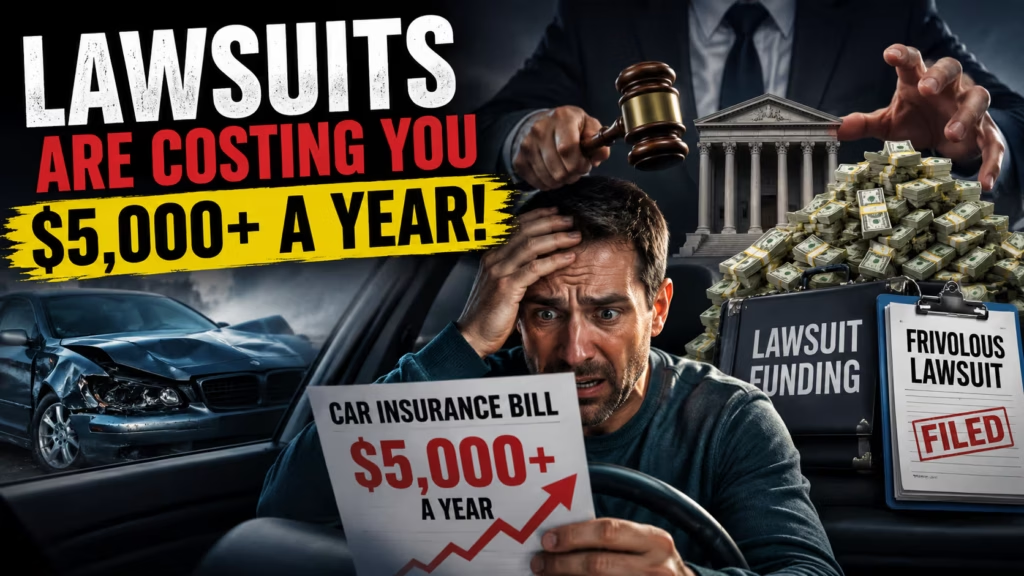
Every time you pay your car insurance premium, a significant chunk of that money isn’t going to cover accidents or repairs. It’s going to lawsuits.
Research from the Casualty Actuarial Society (CAS) and the Insurance Information Institute (Triple-I) reveals a staggering truth: legal system abuse and related litigation trends contributed to $231.6 billion to $281.2 billion in increased liability insurance losses from 2015 to 2024 — a surge that economic inflation alone cannot explain. This isn’t a rounding error. It’s a structural crisis baked into every premium you pay.
Quick Answer: Legal system abuse is costing the average American household an estimated $4,000 to $5,000+ annually in hidden “tort tax” — and it’s embedded in your car insurance bill. The single most effective defense is shopping aggressively for quotes from insurers with strong claims defense records, especially if you live in high-litigation states like Florida, Louisiana, Georgia, or New York. States that enacted tort reform (like Florida’s 2022-2023 reforms) are already seeing 8%+ rate decreases. Your state matters — and so does your carrier choice.
Here’s the part most drivers miss: this isn’t about legitimate claims. It’s about a system where third-party litigation funders, aggressive attorney advertising, and outsized jury verdicts have turned courtroom payouts into a speculative asset class. And you — the honest, paying policyholder — are the one funding it. This guide breaks down exactly what’s happening, who’s behind it, how much it’s costing you, and what you can do to fight back.
📑 What’s Inside This Guide:
- What Is Legal System Abuse?
- The Players Behind the Litigation Explosion
- The Hard Numbers: What It’s Costing You
- Real-World Impact: Uber’s $5B+ Insurance Burden
- The Worst States for Lawsuit Abuse
- Third-Party Litigation Funding: The Hidden Engine
- Tort Reform: Where It’s Working (And Where It’s Not)
- Your 5-Step Action Plan
- Frequently Asked Questions
What Is Legal System Abuse? (And Why Should You Care?)
The Triple-I defines “legal system abuse” as the exploitation of the civil justice system in ways that increase costs and undermine fairness — often by expanding liability beyond legislative intent or encouraging excessive litigation. In plain English: lawyers are filing more lawsuits, those lawsuits are driving up insurance costs, and you’re paying the bill whether you’ve ever been in an accident or not.
Here’s why this matters to you personally: insurance is a pooled risk product. When claims costs go up for any reason — including frivolous lawsuits and inflated settlements — every policyholder in that pool pays more. It doesn’t matter if you’ve never filed a claim. It doesn’t matter if you have a perfect driving record. The litigation tax hits your renewal notice all the same.
Chubb chairman and CEO Evan Greenberg put it bluntly: legal system abuse inflates liability insurance costs by 7% to 9% a year and amounts to an average “tort tax” of $4,000 annually per household. The American Property Casualty Insurance Association (APCIA) estimates the hidden cost is even higher — over $5,000 per household every year.
The Three Players Driving Your Premiums Through the Roof
Legal system abuse isn’t an accident. It’s a business model. Three key actors are fueling the litigation explosion — and every one of them profits while you pay.
1. Third-Party Litigation Funders (TPLF) — The Wall Street Shadow
This is the most dangerous player you’ve never heard of. Third-party litigation funders are hedge funds, private equity firms, and even foreign sovereign wealth funds that invest in lawsuits the way venture capitalists invest in startups. They provide cash to plaintiffs or law firms in exchange for a cut of any settlement or verdict.
Here’s the problem: these funders spent more than $380 million on online search ads alone between June 2024 and June 2025, with some engaging in brand impersonation and search engine manipulation to mislead consumers into filing claims. Greenberg called them out for helping turn “courtroom payouts into a speculative asset class.”
The TPLF market is estimated to reach $30 billion globally by 2028, with the U.S. representing the largest market. Swiss Re estimates that more than half of the $17 billion invested into litigation funding globally in 2020 was deployed in the U.S. — and returns of 25% or more are common.
2. The Trial Bar — A Growth Industry Built on Your Premium
“The trial bar is a money-making growth industry, and it continues to expand as lawyers search for new theories of liability to bring more lawsuits,” Greenberg stated. This isn’t hyperbole. Among motor accident victims surveyed, attorneys contacted 92% after their accident — including 57% who reported they were contacted by more than one attorney.
Solicitation typically occurred within a week of the incident — “before insurance can play a part in addressing someone’s concerns.” This aggressive solicitation creates a pipeline of litigation that drives up settlement demands and, ultimately, your premiums.
3. Assignment of Benefits (AOB) Abuse — The Silent Killer
In states like Florida and Louisiana, assignment of benefits abuse has been a primary driver of insurance costs. AOB allows a contractor or service provider to collect payment directly from an insurance company — and then sue the insurer if payment is disputed. This creates a perverse incentive to inflate repair costs and file lawsuits rather than negotiate.
The Hard Numbers: Your Wallet Is Taking the Hit
Let’s stop talking in abstracts. Here are the actual numbers from the CAS/Triple-I analysis — and they are staggering:
Real-World Impact: Uber’s $5 Billion+ Insurance Lesson
Uber provides the clearest real-world example of how lawsuit abuse translates directly into consumer costs. Uber reported a more than 50% increase in its ride insurance costs per trip in recent years, despite recording a lower rate of overall crashes from 2017 to 2022.
Think about that: fewer crashes, but insurance costs up 50%+. Why? Because each crash that does happen is more expensive to litigate. Passengers see these costs reflected in trip prices, with insurance accounting for roughly 10% of the average rider fare nationwide — or as high as 47% in costlier areas like Los Angeles County.
“Insurance for us is the second-highest operating cost after payment to drivers,” said Adam Blinick, Uber’s senior director of public policy. When a company of Uber’s scale can’t absorb litigation costs, what chance does the average driver have?
The Worst States for Lawsuit Abuse (And What They’re Doing About It)
Not all states are equal when it comes to legal system abuse. The American Tort Reform Association (ATRA) has identified “judicial hellholes” — jurisdictions where litigation abuses are most prevalent and insurance costs are highest.
🔴 High-Abuse States
- Florida — Historically plagued by insurance fraud, AOB abuse, and excessive litigation that drove rates to among the highest in the nation
- Louisiana — Rampant claim fraud, misuse of assignment of benefits, and TPLF abuse continue to inflate costs
- Georgia & New York — Flagged by ATRA for excessive litigation and outsized verdicts
- California — High litigation environment with significant nuclear verdict exposure
🟢 Reform Success Stories
- Florida (2022-2023) — SB 2-A and HB 837 eliminated one-way attorney fees, restricted AOB abuse, and shortened claims filing windows. Result: litigation filings down 35%+ and auto rates dropping 8% in 2026
- North Carolina — First state to ban third-party litigation funding entirely
- Georgia, Louisiana, New York — Enacted legislation establishing greater oversight of TPLF
- Federal — Legislation being considered to require litigation funding disclosure
Florida’s turnaround is the most dramatic proof that reform works. After average auto rate increases of 31.7% in 2023, the state is now seeing an 8% average decrease among top carriers in 2026 — with 42 companies filing rate decreases. Over $1 billion in auto insurance refunds have been returned to Florida drivers. This is what happens when a state decides to stop letting lawsuit abuse run unchecked.
Third-Party Litigation Funding: The Hidden Engine of Social Inflation
Social inflation is the term insurers use for rising claim costs tied to litigation behavior and outsized jury awards — costs that rise faster than general economic inflation. TPLF is one of the primary accelerants.
Here’s how the cycle works:
- A funder identifies a “winnable” case — typically personal injury with clear liability and deep-pocket defendant
- The funder provides cash — covering legal fees, medical costs, plaintiff living expenses
- The case drags on — because the funder, not the plaintiff, controls strategy and wants maximum payout
- Settlement demands inflate — reasonable offers are rejected in pursuit of nuclear verdicts
- The insurer pays more — and passes that cost to all policyholders
- The funder takes 30-50% — the plaintiff gets what’s left
Research by the Milliman actuarial firm found that in 2019, the average total loss with attorney involvement was 171 times higher than claims without attorneys, while the average cost for adjudicating a claim was 52.8 times higher. An Insurance Research Council study of 80,000 auto injury claims showed that hiring an attorney may result in lower settlement amounts, require more time to resolve, and involve more (potentially unnecessary) medical care.
Tort Reform: Where It’s Working (And Where It’s Not)
The good news: reform is happening. The bad news: it’s a long fight, and policyholders won’t see the full impact on premiums overnight.
However, Greenberg emphasized that “it will be a long fight” before policyholders begin to see the full impact on insurance premiums. The litigation industry is well-funded, well-organized, and politically powerful. Reform requires sustained pressure from consumers, businesses, and legislators.
Get Your 2026 Car Insurance Quotes
Lock in today’s best rates before lawsuit-driven increases hit your renewal. Compare quotes from insurers with strong litigation defense records in your state.
Get My Free Quotes NowYour 5-Step Action Plan: Fight Back Against Lawsuit-Driven Rate Hikes
You can’t single-handedly reform the legal system. But you can take specific, concrete actions to minimize how much lawsuit abuse costs you personally.
- Shop aggressively every 6-12 months. Insurers price litigation risk differently by state and ZIP code. In high-litigation states, the quote variance between carriers can exceed $500-$1,200 annually. Don’t auto-renew. Get at least 5 quotes.
- Carry adequate uninsured/underinsured motorist coverage. In litigation-heavy states, underinsured drivers are prime targets for lawsuits. If you’re hit by one and don’t have UM/UIM coverage, you could face personal liability exposure. Minimum coverage is not enough.
- Support tort reform in your state. Contact your state legislators about third-party litigation funding disclosure laws, one-way attorney fee reforms, and assignment of benefits restrictions. Florida proved reform works — your state can too.
- Drive defensively and document everything. The best way to avoid the litigation system is to avoid accidents. If you are in one, take photos, get a police report, collect witness statements, and notify your insurer immediately. Strong documentation reduces inflated claim exposure.
- Choose insurers with strong claims defense records. Some carriers are better at managing litigation risk than others. Look for insurers with low loss ratios, fast claim resolution times, and strong legal defense teams. A carrier that fights frivolous lawsuits keeps premiums lower for everyone.
Frequently Asked Questions About Legal System Abuse and Car Insurance
What is legal system abuse and how does it affect my car insurance?
Legal system abuse is the exploitation of the civil justice system through excessive litigation, inflated jury awards, and third-party litigation funding. According to CAS and Triple-I, it contributed to $231.6 billion to $281.2 billion in increased liability insurance losses from 2015-2024. This translates to a hidden “tort tax” of $4,000-$5,000+ per household annually, embedded directly into your car insurance premium.
What is third-party litigation funding (TPLF)?
TPLF is when outside investors (hedge funds, private equity, foreign sovereign wealth funds) provide money to finance lawsuits in exchange for a percentage of any settlement or verdict. It’s controversial because it lacks transparency, can prolong litigation, and up to 57% of settlements go to funders and attorneys rather than plaintiffs. The market is projected to reach $30 billion globally by 2028.
How much is lawsuit abuse actually costing me?
The average household pays an estimated $4,000-$5,000+ annually in hidden tort tax across all insurance and consumer products. For car insurance specifically, personal auto liability losses inflated by $91.6 billion to $102.3 billion due to legal system abuse. Your individual impact depends on your state — drivers in Florida, Louisiana, Georgia, and New York pay significantly more.
Which states have the worst lawsuit abuse for car insurance?
Florida, Louisiana, Georgia, and New York are consistently flagged as “judicial hellholes” by the American Tort Reform Association. However, Florida’s 2022-2023 reforms have driven litigation down 35%+ and auto rates are dropping 8% in 2026. North Carolina banned TPLF entirely. Reform works — but it requires political will.
Can tort reform actually lower my car insurance rates?
Yes. Florida is the proof. After enacting SB 2-A and HB 837 (eliminating one-way attorney fees, restricting AOB abuse, shortening claims windows), the state saw litigation filings drop 35%+, 42 auto insurers filed rate decreases, and the top five carrier groups averaged an 8% rate drop in 2026. Over $1 billion in refunds have been returned to Florida drivers.
What can I do personally to protect myself?
Five things: 1) Shop quotes aggressively every 6-12 months, 2) Carry adequate UM/UIM coverage, 3) Contact your state legislators about tort reform, 4) Drive defensively and document everything after any accident, and 5) Choose insurers with strong claims defense records. These actions won’t fix the system, but they will minimize your personal exposure.
Does my standard auto policy protect me from lawsuit abuse?
Not directly. Standard policies cover liability up to your limits, but they don’t prevent lawsuits. In high-litigation states, even minor accidents can trigger attorney involvement. Your best protection is adequate liability limits (at least 100/300/100), UM/UIM coverage, and an insurer with a strong legal defense team that fights inflated claims rather than settling quickly.
The Bottom Line: Don’t Let Lawsuit Abuse Empty Your Wallet
Legal system abuse is not a victimless crime. It’s a hidden tax that costs you $4,000-$5,000+ every year — and it’s embedded in every car insurance premium you pay. The $231.6 billion to $281.2 billion in excess liability losses from 2015-2024 didn’t come from thin air. It came from a system where third-party funders, aggressive attorneys, and inflated settlements have turned justice into a profit center.
But here’s what gives you power: you can vote with your wallet and your voice. Shop for better rates. Support reform. Choose insurers that fight frivolous claims. And most importantly, don’t accept the narrative that rising premiums are just “the way things are.” Florida proved they’re not. North Carolina proved they’re not. More states will follow — but only if consumers demand it.
Take the five-step action plan above. It costs nothing but 20 minutes of your time. The return on that time could be $500 or more this year — and the satisfaction of knowing you’re not subsidizing a broken system any more than you have to.
Sources: Casualty Actuarial Society & Insurance Information Institute — Increasing Inflation on Liability Insurance (2025), Triple-I — Revealing Hidden Cost to Consumers of Auto Litigation Inflation (2025), Triple-I — What Is Third-Party Litigation Funding? (2022), Greene Insurance — Florida Insurance Market Report 2026, LexisNexis — U.S. Auto Insurance Trends Report 2026, AutoInsurance.com — Auto Insurance Pricing Trends 2026, CoverLink — Third Party Litigation Funding & the Insurance Industry, Reinsurance Association of America — Litigation Funding, Chubb, APCIA, ATRA, Uber.