
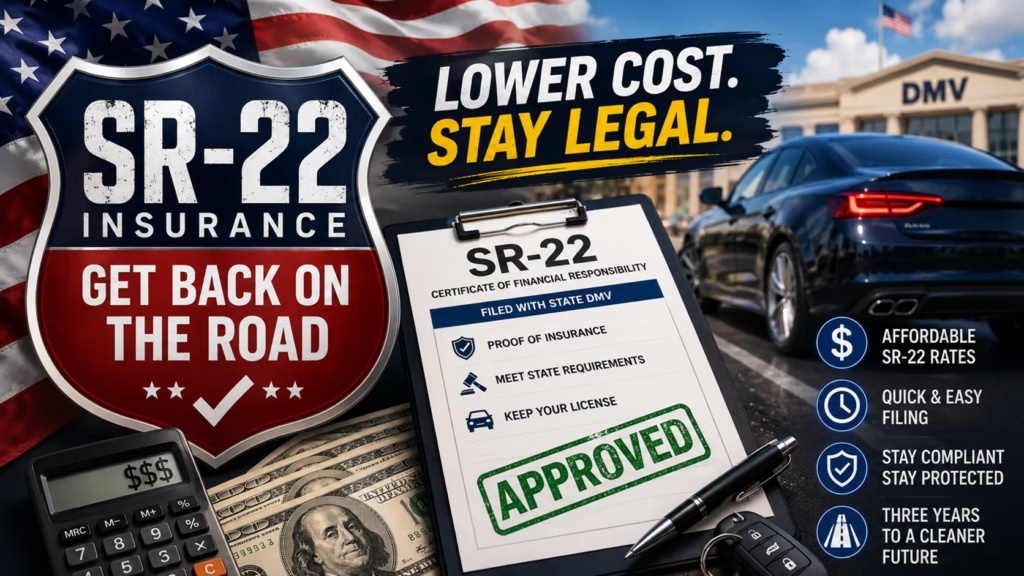
If you’ve been told you need an SR-22, you might be imagining a new, expensive type of car insurance. Here is the good news: an SR-22 is not insurance at all. It is simply a piece of paper—a certificate—your insurance company files with the state to prove you are meeting the legal minimum for liability coverage.
Quick Answer: An SR-22 is a financial responsibility certificate, not an insurance policy. The filing fee itself is cheap (usually $15 to $50), but your underlying insurance premium will spike to an average of $250 to $500 per month because you are now classified as a high-risk driver. Most states require you to maintain the SR-22 for exactly 3 years.
Drivers are usually ordered to get an SR-22 after serious violations like a DUI/DWI, driving without insurance, reckless driving, or accumulating too many points on their license. This guide breaks down the real costs, state rules, and the exact steps to get it filed as cheaply as possible in 2026.
What Exactly Does an SR-22 Do?
Think of the SR-22 as a tracking mechanism for the DMV. When your insurance company files it, they are legally promising the state that you have an active auto liability policy.
The catch: If your insurance policy lapses (even by a single day because you missed a payment), your insurer is legally required to notify the DMV. The DMV will then immediately suspend your driver’s license again, and your 3-year SR-22 clock could restart from zero.
How Much Does SR-22 Insurance Cost in 2026?
You must separate the filing fee from the insurance premium. The certificate costs almost nothing, but the violation that triggered the SR-22 (like a DUI) will drastically inflate your base insurance rate. Here is what high-risk drivers are paying in 2026:
- Standard Driver (Clean Record): $150 – $250 / month
- With SR-22 (DUI/DWI): $250 – $500+ / month
- With SR-22 (Driving Uninsured): $200 – $400 / month
- With SR-22 (Multiple Traffic Tickets): $180 – $350 / month
*Note: These are national averages. Your exact rate depends heavily on your state, age, and ZIP code.
👉 Stop guessing your new rate. Use our 30-second estimate tool to see exactly how much an SR-22 will cost in your specific ZIP code—completely anonymously.
SR-22 vs. FR-44: What’s the Difference?
While most states use the SR-22 form, a few states have their own versions with stricter requirements:
- SR-22 (Standard): Used in 48 states. Requires you to carry your state’s standard minimum liability limits (e.g., $10k in Florida, $30k in Texas).
- FR-44 (Florida & Virginia Only): Used specifically for DUI convictions in these two states. It requires double the standard liability limits (e.g., $100k/$300k in Florida), making it significantly more expensive than an SR-22.
- SR-1A (New York): New York doesn’t technically use “SR-22,” but uses an SR-1A accident report and requires an insurance filing for suspended drivers.
- States that DON’T use SR-22: Delaware, Kentucky, Minnesota, New Mexico, Oklahoma, and Pennsylvania do not require SR-22 filings, though they have their own reinstatement procedures for high-risk drivers.
How to Get an SR-22 in 5 Steps
Getting an SR-22 is easier than you think, but you have to be strategic about which company you choose.
- Do not assume your current insurer will file it. Major carriers like Geico or State Farm may flat-out drop you after a DUI, or they might refuse to file SR-22s. Call them first.
- Shop for “High-Risk” Insurance Carriers. Companies like Progressive, The General, Dairyland, Bristol West, and Safeco specialize in non-standard (high-risk) policies and file SR-22s electronically every day.
- Buy the policy and pay the filing fee. You will usually pay the $15–$50 fee upfront, plus your premium (which is often required to be paid in full for a 6-month term).
- The insurer files the certificate. In most states, this is done electronically and takes 1 to 3 business days to hit the DMV system.
- Verify with the DMV. Do not drive until you have confirmed with your local DMV that the SR-22 is active and your license is reinstated.
What if You Don’t Own a Car?
You can still get an SR-22. You need to ask your insurer for a Non-Owner SR-22 policy. This provides liability coverage when you drive someone else’s car or rent a vehicle. It is generally much cheaper than a standard policy (often $50–$100/month) and satisfies the DMV’s requirement so you can get your license back.
4 Ways to Lower Your SR-22 Premium
- Ask for a “Non-Owner” policy if applicable. As mentioned, this is the cheapest way to fulfill an SR-22 requirement.
- Pay the 6-month term in full. High-risk insurers charge exorbitant monthly installment fees (sometimes $10–$20 extra per month). Paying upfront saves you hundreds.
- Take a defensive driving course. Even with a DUI on your record, a state-approved defensive driving certificate can force the insurer to apply a discount.
- Shop around at every renewal. The “high-risk” penalty decreases over time. After 12 months of clean driving, get new quotes. You will likely find a cheaper rate.
Frequently Asked Questions About SR-22
What happens if my SR-22 insurance lapses?
Your insurer will send an SR-26 form to the DMV, canceling your certificate. The DMV will immediately suspend your license. To fix this, you usually have to buy a new policy, pay a new filing fee, pay a license reinstatement fee to the state, and potentially start your 3-year requirement all over again.
Can I switch insurance companies while I have an SR-22?
Yes. But do not cancel your old policy before the new one is active. If there is a gap in coverage, the DMV will be notified, and your license will be suspended. When buying the new policy, explicitly tell the new agent: “I need you to file an SR-22 before I cancel my old policy.”
How fast is an SR-22 filed?
With modern electronic filing, it is usually transmitted to the state DMV within 24 to 48 hours of purchasing the policy. However, it may take the DMV an additional 3 to 5 business days to update your driving record and officially reinstate your license.
Bottom Line: It’s Temporary
An SR-22 feels like a financial punishment, but it is temporary. Maintain continuous coverage, drive safely, and shop around every 6 months. Once your 3-year requirement ends, your rates will gradually drop back down to standard levels. Enter your ZIP code below to compare high-risk SR-22 quotes in your area right now.
Sources: State DMVs (FLHSMV, TDI, NYDMV), Insurance Information Institute (III), National Association of Insurance Commissioners (NAIC).