
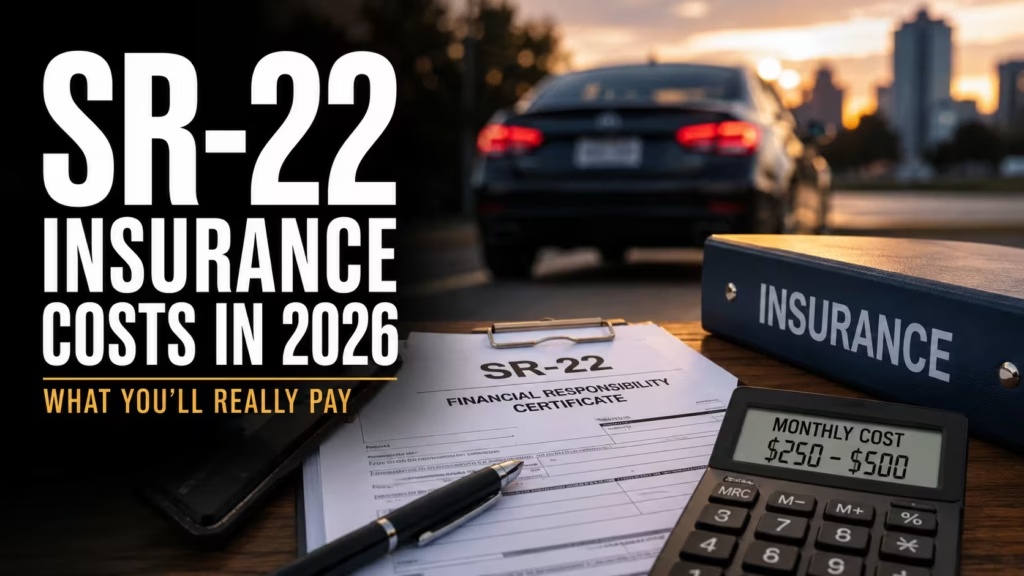
An SR-22 is not a policy — it’s a certificate your insurer files with the state proving you carry liability coverage. The form itself costs $15 to $50. What actually hurts is the underlying premium: expect $250 to $500 a month after a DUI, less for other violations, until your state’s required filing period runs out clean.
Key Takeaway: SR-22 insurance in 2026 costs $180 to $500 per month depending on the violation and state, on top of a one-time $15-$50 filing fee. Most states require three years of continuous filing, though the range runs from one to five years. Eight states — Delaware, Kentucky, Minnesota, New Mexico, New York, North Carolina, Oklahoma, and Pennsylvania — do not use the SR-22 system at all, and Florida and Virginia use a stricter, more expensive form called the FR-44 for DUI convictions. A single day of lapsed coverage resets the entire filing clock in almost every state.
I’ve filed hundreds of these certificates over the years, and the panic drivers feel when they first hear “you need an SR-22” is almost always disproportionate to the actual paperwork. The DMV isn’t asking you to buy a new product. It’s asking your existing or new insurer to promise, in writing, that you won’t drive around uninsured again after a DUI, a lapse in coverage, an at-fault accident with no policy, or too many points on your license. The real financial hit isn’t the filing — it’s the risk tier your insurer just moved you into. That’s the part worth understanding before you shop.
Navigate This Guide:
- How Much Does SR-22 Insurance Cost in 2026?
- What Is an SR-22 Certificate, Exactly?
- Who Actually Needs an SR-22?
- Which States Require SR-22 Insurance?
- How Do You Get SR-22 Insurance? Step-by-Step
- Which Companies File SR-22 the Cheapest?
- Can You Get SR-22 Insurance Without Owning a Car?
- How Long Do You Need to Keep an SR-22?
- How to Lower Your SR-22 Premium
- Frequently Asked Questions
How Much Does SR-22 Insurance Cost in 2026?
The SR-22 filing fee is small — $15 to $50, charged once by your insurer to transmit the certificate to your state’s DMV. The expense that actually shows up on your bank statement is the high-risk premium underneath it. Here’s what drivers are paying nationally in 2026, based on rate data from Quadrant Information Services:
No SR-22 Needed
Monthly Premium
Monthly Premium
Monthly Premium
Notice the spread isn’t uniform. A DUI carries the steepest surcharge because it correlates with the highest repeat-offense and bodily-injury claim severity in every carrier’s loss model. A driving-without-insurance citation, by contrast, often reflects a lapse or an affordability problem rather than reckless behavior, so the surcharge — while still real — tends to run lower. In practice, I see clients conflate these two categories and assume every SR-22 costs DUI-level money. It doesn’t. The violation behind the filing determines the price far more than the SR-22 certificate itself.
What Is an SR-22 Certificate, Exactly?
An SR-22 is a form your insurance company files electronically with your state’s Department of Motor Vehicles, certifying that you carry at least the state-minimum liability limits. It is not a separate insurance product, a type of coverage, or an add-on you purchase independently — it rides on top of a standard auto policy. If that policy cancels or lapses for any reason, your insurer is legally required to notify the DMV within days, and the notification alone is often enough to trigger an automatic license suspension.
During a claim analysis, I’ve watched drivers assume the SR-22 itself provides some kind of protection. It doesn’t. It’s purely a reporting mechanism. The insurance policy underneath it does the actual work of paying claims; the SR-22 just proves to the state that the policy exists and meets the minimum bar. Once your required filing period ends, you can ask your insurer to stop filing it, and your policy simply continues as a normal one — assuming your driving record stays clean in the meantime.
Who Actually Needs an SR-22?
Courts and DMVs order an SR-22 for a specific, limited set of violations — not for every ticket. In many states, the trigger events fall into four categories, and each one carries a different premium consequence:
A very common scenario I see: a driver gets a single at-fault accident citation, assumes it’s routine, and doesn’t realize an SR-22 order is coming until the reinstatement letter arrives. If you’ve had any of the four violations above, call your agent proactively rather than waiting for the state’s notice — it buys you time to shop instead of scrambling under a deadline.
Compare 2026 SR-22 Rates Before You Commit
See what your monthly premium would actually look like with an SR-22 filing in your ZIP code — free, anonymous, and no obligation to buy.
GET YOUR 2026 CAR INSURANCE QUOTESWhich States Require SR-22 Insurance?
Most U.S. states use the SR-22 system, but the map isn’t uniform. Eight states don’t require an SR-22 at all, and two states use a stricter, more expensive certificate instead. Knowing which category your state falls into changes both the paperwork and the price.
States Using SR-22
- Coverage Required: State-minimum liability limits only
- Typical Duration: 1 to 5 years depending on the state and violation
- Cost Range: $180-$500/month depending on the underlying violation
- Applies To: Roughly 40 states plus D.C.
Florida & Virginia (FR-44)
- Coverage Required: Far above state minimums — Florida requires 100/300/50 against a 10/20/10 baseline; Virginia requires 60/120/40 against 30/60/20
- Typical Duration: 3 years for DUI/DWI convictions
- Cost Range: Roughly 20%-40% higher than a comparable SR-22 policy
- Applies To: DUI, DWI, and breathalyzer-refusal convictions only
Eight states — Delaware, Kentucky, Minnesota, New Mexico, New York, North Carolina, Oklahoma, and Pennsylvania — do not use the SR-22 mechanism at all. That doesn’t mean a DUI or an uninsured-driving citation carries no consequence in those states; they simply enforce financial responsibility through direct license suspension, point systems, or their own state-specific filings instead of a DMV-facing certificate. If your violation happened in an SR-22 state and you later move to one of these eight, you generally still have to satisfy the original state’s filing requirement until the term expires — moving doesn’t erase the obligation.
How Do You Get SR-22 Insurance? Step-by-Step
Filing an SR-22 is mechanically simple once you know the order of operations. Here’s the process I walk clients through:
- Get the exact requirement in writing. Pull the specific liability limits, duration, and deadline from your court order or DMV notice before contacting any insurer.
- Call your current insurance company first. Not every carrier files SR-22s, and some will non-renew the policy once a DUI or major violation posts. If yours does file, staying put usually beats switching because you keep existing tenure and multi-policy discounts.
- Shop high-risk specialists if you’re declined. Companies including The General, Dairyland, Bristol West, Direct Auto, and Progressive handle SR-22 filings routinely in most states that require them and price high-risk drivers more predictably than a standard carrier forced to non-renew you.
- Pay for the policy in full or set up autopay. Many high-risk insurers require six months or a full year paid upfront, or at minimum a strict autopay arrangement, because SR-22 policies have a higher cancellation risk profile.
- Let the insurer file electronically and confirm receipt. Most carriers transmit the SR-22 to the DMV within one to three business days. Ask for written confirmation and keep it — DMV processing delays happen, and you don’t want to get pulled over with no proof the filing went through.
- Never let the policy lapse. A single missed payment can cancel the policy, trigger an automatic DMV notification, and suspend your license again — often resetting the entire required filing period back to day one.
Which Companies File SR-22 the Cheapest?
Not every insurer writes SR-22 policies, and pricing among those that do varies more than most drivers expect. Here’s how the major SR-22 carriers compare in practice:
At most insurance companies, the SR-22 filing fee itself doesn’t vary enough to matter — it’s the underlying premium that separates a good quote from an expensive one. Shop at least three of the carriers above with identical liability limits and identical terms before deciding. A $60-per-month gap between two SR-22 quotes for the same coverage is common, and over a three-year filing period that’s over $2,100 left on the table.
Can You Get SR-22 Insurance Without Owning a Car?
Yes — this is called a non-owner SR-22 policy, and it’s one of the most underused options I see drivers overlook. It provides liability coverage for driving vehicles you don’t own, such as a friend’s or family member’s car, and the insurer attaches your SR-22 filing to that policy just like it would to a standard owner policy.
Non-owner SR-22 policies typically run $28 to $45 per month for minimum liability limits, which is meaningfully cheaper than a standard owner policy because there’s no specific vehicle being insured. This matters most for drivers who lost their license after a DUI and don’t currently own a car — the state still requires proof of financial responsibility to reinstate driving privileges, and a non-owner policy satisfies that requirement without forcing you to buy or insure a vehicle you don’t need yet.
How Long Do You Need to Keep an SR-22?
Duration depends entirely on your state and the violation that triggered the order — there’s no single national standard. Here’s how it typically breaks down:
After the required period ends, contact your insurer and formally request that they stop filing the SR-22 with the DMV — it doesn’t expire automatically in every state, and an outdated filing can occasionally cause confusion at renewal. Your premium won’t drop to pre-violation levels immediately; expect the surcharge to fade gradually over another one to two years as the original violation ages further off your driving record.
How to Lower Your SR-22 Insurance Premium
An SR-22 doesn’t lock you into a fixed price for the entire filing period. There’s real room to bring the cost down while staying compliant:
- Take a state-approved defensive driving course. Many high-risk carriers, including several of the ones listed above, apply a discount even to SR-22 policyholders — check before assuming it doesn’t apply to you.
- Pay the policy in full when possible. Monthly installment fees on high-risk policies run higher than standard policies; paying six or twelve months at once commonly saves 5% to 10%.
- Ask about bundling. Some high-risk carriers still offer a renters or homeowners discount even on an SR-22 auto policy — it’s worth one phone call to find out.
- Request a rate review after six to twelve months clean. Several carriers will proactively re-rate a policy once the driver has demonstrated a violation-free window, even before the full filing period ends.
- Re-shop every six months. SR-22 pricing moves more than standard auto pricing because high-risk carriers adjust their books frequently. Staying with the same insurer out of inertia is one of the most common ways drivers overpay during this period.
A very common mistake I see: drivers accept the first SR-22 quote out of relief that a carrier said yes at all, then never revisit pricing again. High-risk insurers count on that inertia. Treat the first quote as a starting point, not a final answer.
Frequently Asked Questions About SR-22 Insurance
How much does SR-22 insurance cost per month in 2026?
The filing fee is $15 to $50, one time. The underlying policy runs $250-$500/month after a DUI, $200-$400/month for driving without insurance, and $180-$350/month for multiple violations, compared to $150-$250/month for a clean-record driver with no SR-22.
Which states require SR-22 insurance?
Most states do, with two exceptions worth knowing: eight states — Delaware, Kentucky, Minnesota, New Mexico, New York, North Carolina, Oklahoma, and Pennsylvania — don’t use SR-22 at all, and Florida and Virginia use the stricter FR-44 certificate for DUI convictions instead of a standard SR-22.
How long do you need to keep an SR-22?
Typically three years for DUI/DWI, one to three years for driving without insurance, and one to two years for multiple violations — though state rules vary and any lapse in coverage resets the clock in almost every state.
Can you get SR-22 insurance without owning a car?
Yes, through a non-owner SR-22 policy, which runs $28-$45/month and covers you when driving vehicles you don’t own. It does not cover a car registered in your name or, in most cases, one owned by someone in your household.
What’s the difference between SR-22 and FR-44 insurance?
An SR-22 certifies your state’s standard minimum liability limits. An FR-44, used only in Florida and Virginia for DUI/DWI convictions, requires far higher limits — roughly 10 times the bodily-injury minimum in Florida — and typically costs 20% to 40% more as a result.
Will my current insurance company file an SR-22 for me?
Maybe. Call and ask first, since it’s usually cheaper than switching carriers. If they decline or non-renew you, high-risk specialists like The General, Dairyland, Bristol West, Direct Auto, and Progressive routinely handle SR-22 filings.
The SR-22 Period Is Temporary — Treat It That Way
An SR-22 isn’t a punishment that follows you forever. It’s a fixed window — usually three years — during which the state wants documented proof you’re carrying insurance, nothing more. Drivers who overpay through that window are rarely the ones with the worst underlying violation. They’re the ones who accept the first quote, let the policy auto-renew without comparison, and never ask their carrier for a rate review once the record goes clean.
The math is consistent across the hundreds of SR-22 cases I’ve reviewed: a driver who shops three high-risk carriers, pays annually instead of monthly, and re-shops every six months typically pays 20% to 35% less over the filing period than a driver who does none of that with an identical violation. That gap is real money — often $1,500 or more across three years. Treat the SR-22 as what it actually is: a temporary administrative requirement with a real expiration date, not a life sentence on your insurance rate.
Sources: National Association of Insurance Commissioners (NAIC), Insurance Information Institute (Triple-I), National Highway Traffic Safety Administration (NHTSA), State DMV filing guidelines (Florida, Virginia, and additional states as cited), Quadrant Information Services 2026 Auto Insurance Rate Database, Carrier rate filings 2026.