
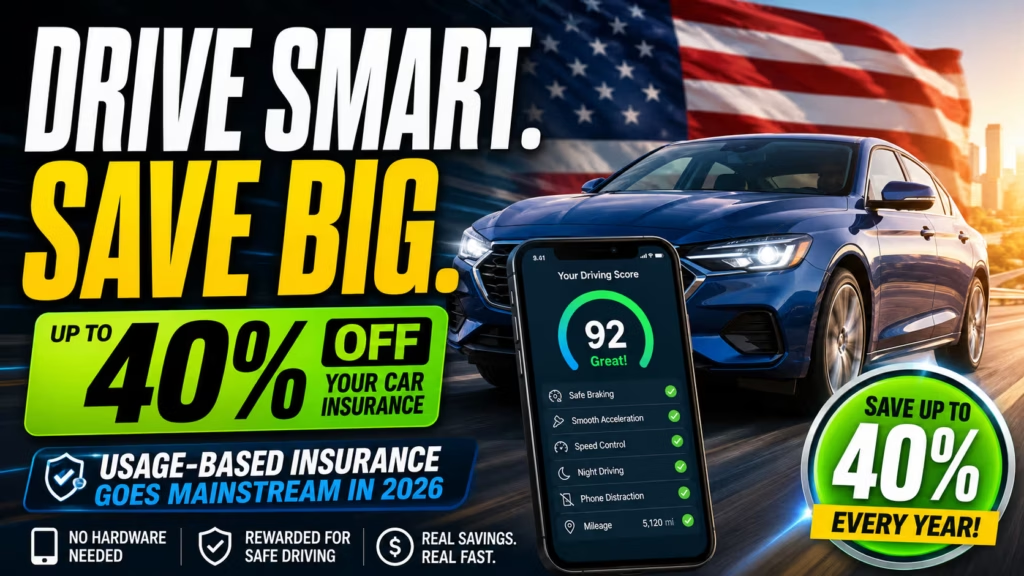
Usage-based insurance (UBI) is no longer a fringe experiment — it is the fastest-growing segment of the U.S. auto insurance market in 2026. What started as a niche product for tech-savvy drivers has exploded into a mainstream option that major insurers now position as their primary competitive weapon. If you are still paying a flat premium based on your age, ZIP code, and credit score while a telematics app could cut your bill by hundreds of dollars, you are likely overpaying.
Quick Answer: In 2026, safe drivers using usage-based insurance save a median of $324 per year, with top-tier discounts reaching up to 40%. Over 44% of insurance shoppers now consider UBI important in their buying decision. If you drive under 10,000 miles annually, avoid hard braking, and don’t use your phone behind the wheel, enrolling in a telematics program is one of the highest-ROI moves you can make — it costs nothing to try and can permanently lower your premium.
This guide breaks down exactly how UBI works in 2026, which programs offer the biggest discounts, the real privacy trade-offs, and whether telematics is right for your specific driving profile. No fluff. Just the numbers and the strategy you need to pay less.
📑 Jump to Section:
- What Is Usage-Based Insurance?
- UBI by the Numbers in 2026
- How Much Can You Really Save?
- Top UBI Programs Compared
- Pay-Per-Mile vs. Behavior-Based UBI
- Pros and Cons of Telematics
- Who Should Enroll (and Who Shouldn’t)
- Privacy: What Data Is Actually Tracked?
- How to Enroll in 3 Steps
- Frequently Asked Questions
What Is Usage-Based Insurance (UBI)?
Usage-based insurance — also called telematics insurance — replaces the traditional guessing game of car insurance pricing with real data from your actual driving. Instead of paying a premium based on broad demographic factors (your age, gender, marital status, and ZIP code), UBI uses technology to monitor how you actually behave behind the wheel and prices your policy accordingly.
There are two main types of UBI in 2026:
📱 Behavior-Based UBI
- What it tracks: Speed, hard braking, acceleration, cornering, time of day, phone use while driving, and mileage
- How it prices: Base premium + discount based on your driving score
- Best for: Safe drivers who want to be rewarded for good habits
- Top programs: Nationwide SmartRide, State Farm Drive Safe & Save, Progressive Snapshot
🚗 Pay-Per-Mile UBI
- What it tracks: Total miles driven (plus sometimes basic driving behavior)
- How it prices: Low daily/monthly base rate + per-mile fee ($0.02-$0.10/mile)
- Best for: Low-mileage drivers (under 8,000-10,000 miles/year)
- Top programs: Nationwide SmartMiles, Metromile, Allstate Milewise, Mile Auto
Most programs use a smartphone app that runs in the background and automatically detects when you’re driving. Some insurers still offer a plug-in device for your car’s OBD-II port (standard in vehicles made after 1996). A few newer programs integrate directly with your vehicle’s built-in connected systems.
UBI by the Numbers: The 2026 Landscape
The data tells a clear story: UBI has crossed the threshold from early adoption to mainstream acceptance. Here are the hard numbers driving this shift:
How Much Can You Really Save? Real 2026 Numbers
Let’s cut through the marketing hype. Here is what the actual data shows about UBI savings in 2026:
💡 Real-World Example: The Remote Worker
Sarah drives her 2019 Honda Civic 4,200 miles per year — mostly weekend errands and occasional grocery runs. Her traditional full-coverage policy costs $1,380/year.
She switches to Nationwide SmartMiles with a $48/month base rate + $0.06/mile.
Annual cost: ($48 × 12) + (4,200 × $0.06) = $576 + $252 = $828/year
She saves $552/year — a 40% reduction.
Top UBI Programs in 2026: Head-to-Head Comparison
Not all telematics programs are created equal. Some maximize your discount. Some protect you from rate hikes. Some are simply easier to use. Here is the definitive breakdown:
Pay-Per-Mile vs. Behavior-Based: Which One Fits You?
The distinction matters. Choosing the wrong type of UBI can cost you money instead of saving it.
✅ Choose Behavior-Based UBI If:
- You drive 8,000-15,000 miles per year
- You have safe driving habits (smooth braking, no speeding)
- You want a permanent discount locked in at renewal
- You don’t mind sharing driving behavior data
- You drive during daytime hours and avoid late nights
✅ Choose Pay-Per-Mile If:
- You drive under 8,000 miles per year
- You work from home or use public transit
- You have a secondary vehicle that sits mostly parked
- You’re a retiree or college student with minimal driving
- You want the biggest possible savings (30-50%)
The Real Pros and Cons of Telematics in 2026
Before you enroll, understand both sides of the telematics equation. The savings are real — but so are the trade-offs.
✅ Pros of UBI
- Significant savings potential — Up to 40% for safe drivers
- Encourages safer driving — Studies show telematics improves high-risk driver scores by 40% in 3 months
- Fair pricing — Your rate reflects your actual behavior, not stereotypes
- Free to try — Most programs cost nothing to enroll; worst case, you get a small signup discount
- Added features — Crash detection, roadside assistance, and trip summaries included
- No hardware needed — Most programs use smartphone apps only
⚠️ Cons of UBI
- Privacy concerns — Your location, speed, and driving habits are tracked and stored
- Rates can increase — Progressive Snapshot and Liberty Mutual RightTrack can raise premiums for risky driving
- Not available in all states — Some programs are restricted by state regulations
- False readings possible — Phone-based apps may misinterpret hard braking vs. potholes or being a passenger
- Late-night penalty — Driving between midnight and 5 AM can hurt your score even if you’re safe
- Data sharing anxiety — 70% of drivers express concern about personal data privacy with telematics
Who Should Enroll — And Who Should Stay Away
UBI is not for everyone. Here is the honest breakdown:
🟢 UBI Is Perfect For You If:
- You’re a safe, cautious driver who rarely speeds
- You drive under 10,000 miles per year
- You avoid late-night driving (midnight to 5 AM)
- You don’t use your phone while driving
- You have young drivers on your policy (families save a median of $245/year)
- You work from home or have a short commute
- You’re comfortable sharing driving data with your insurer
🔴 UBI May NOT Be Right If:
- You have a heavy foot or drive aggressively
- You frequently drive late at night (shift workers, night owls)
- Your commute involves heavy traffic and unavoidable hard braking
- You have strong privacy concerns about data tracking
- You drive over 15,000 miles per year (traditional policy may be cheaper)
- You live in California, Massachusetts, or Rhode Island (some programs unavailable)
Privacy in 2026: What Data Is Actually Tracked?
The #1 objection to UBI is privacy — and it’s valid. Here is exactly what insurers collect and what protections exist:
Data tracked by most UBI apps:
- GPS location — Where you drive, route taken, and destinations
- Speed — Whether you exceed posted limits consistently
- Hard braking — Frequency and intensity of sudden stops
- Rapid acceleration — How aggressively you speed up
- Cornering — How smoothly you take turns
- Time of day — Driving during high-risk hours (late night)
- Phone usage — Whether you interact with your phone while driving
- Mileage — Total miles driven per trip and per month
Privacy protections in 2026:
- Most programs now allow you to opt out of GPS location tracking and only monitor mileage and driving smoothness
- State privacy laws in California, Colorado, and Virginia require insurers to disclose exactly what data is collected and how it’s used
- Your telematics data cannot be sold to third parties without explicit consent under most state regulations
- Data is typically used only for pricing your policy — not for marketing or unrelated purposes
- You can delete your data when you cancel the program with most insurers
How to Enroll in UBI: Your 3-Step Action Plan
Get Your 2026 Car Insurance Quotes
Compare UBI, pay-per-mile, and traditional policies from top insurers. See your personalized savings in under 2 minutes — no phone calls, no spam.
Get My Free Quotes NowFrequently Asked Questions About Usage-Based Insurance
How much can I save with usage-based insurance in 2026?
Safe drivers save a median of $324 per year with telematics programs. Top-tier safe drivers with Nationwide SmartRide can save up to 40%. Families with young drivers save a median of $245 annually. Pay-per-mile programs can save low-mileage drivers 30-50% if they drive under 6,000-8,000 miles per year. The exact savings depend on your driving habits, mileage, and the specific program you choose.
Can telematics increase my car insurance rates?
Yes — but only with certain programs. Progressive Snapshot explicitly states that 2 out of 10 drivers see a rate increase. Liberty Mutual RightTrack can also raise rates for poor driving. However, programs like Nationwide SmartRide, State Farm Drive Safe & Save, and USAA SafePilot will never use telematics data to increase your premium. The worst outcome with these programs is simply no discount. Always read the fine print before enrolling.
What happens to my data if I cancel the program?
Most insurers allow you to delete your telematics data when you cancel the UBI program. Under state privacy laws in California, Colorado, and Virginia, insurers must disclose data retention policies and provide options for deletion. Your data is typically used only for pricing your policy and cannot be sold to third parties without explicit consent. If privacy is a major concern, ask your insurer for their specific data handling policy in writing before enrolling.
Is pay-per-mile insurance cheaper than behavior-based UBI?
It depends entirely on your mileage. If you drive under 8,000 miles per year, pay-per-mile is almost always cheaper — often by 30-50%. If you drive 8,000-15,000 miles per year, behavior-based UBI is usually the better deal. If you drive over 15,000 miles per year, a traditional policy may actually be your most affordable option. Use your actual annual mileage as the deciding factor.
Do I need a special device installed in my car?
No — most programs in 2026 use smartphone apps only. You simply download the insurer’s app, enable permissions, and it runs in the background automatically detecting when you’re driving. Some insurers still offer an optional plug-in device for your car’s OBD-II port (standard in vehicles made after 1996), which can provide more accurate data. A few newer programs integrate with your vehicle’s built-in connected systems if you drive a newer car.
Which UBI program has the highest customer satisfaction?
Nationwide ranked #1 in J.D. Power’s 2026 U.S. Auto Insurance Study for usage-based insurance customer satisfaction — for the third consecutive year. Nationwide scored 711 out of 1,000, well above the industry average of 643. USAA scored 679 (but is limited to military families), and Liberty Mutual RightTrack scored 661. Progressive Snapshot scored 628, and Safeco ranked lowest at 577.
Don’t Leave Money on the Table — Your Driving Habits Are Worth Something
Here is the bottom line: If you are a safe driver paying a traditional flat premium, you are subsidizing risky drivers. Usage-based insurance flips that equation. Your good habits — smooth braking, obeying speed limits, avoiding your phone, and driving during safer hours — get rewarded with real money.
In 2026, with 44% of shoppers already demanding UBI and insurers fighting for market share with record-high discounts, there has never been a better time to enroll. The app is free. The monitoring period is short. And the savings — potentially $324 to $700+ per year — are permanent.
Take 15 minutes today. Compare three UBI quotes. Download one app. Drive normally for 30-90 days. Then watch your renewal bill drop. That is not a sales pitch — that is what the data proves.
Sources: J.D. Power 2026 U.S. Auto Insurance Study, J.D. Power 2026 Insurance Industry Challenges Report, J.D. Power 2026 U.S. Insurance Digital Experience Study, Consumer Reports Car Insurance Telematics Pros and Cons, AutoInsurance.com Best Telematics Discounts 2026, Insurify 2026 Car Insurance Report, MoneyGeek Pay-Per-Mile Insurance 2026, WalletHub Pay-Per-Mile Insurance Guide.