
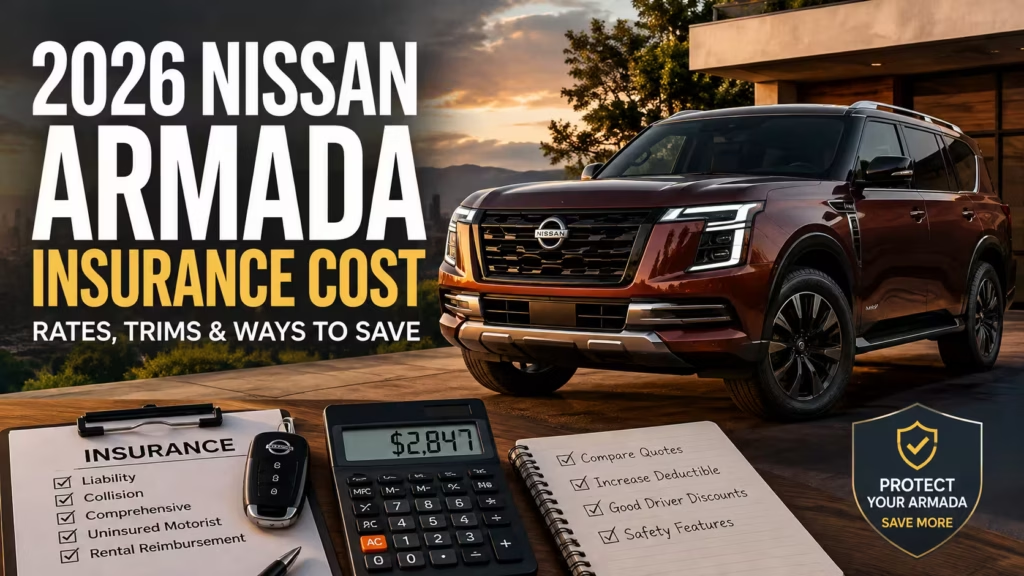
Key Takeaway: Insuring a 2026 Nissan Armada costs approximately $2,847 per year for full coverage, or $237 per month. That is roughly 12% above the national vehicle average but competitive for the full-size SUV segment, undercutting the Chevrolet Tahoe and GMC Yukon. Your actual premium depends heavily on trim level, location, credit history, and driving record. The base SV 2WD starts at $58,530 and is the cheapest to insure, while the Platinum Reserve 4WD can push past $78,000 and adds 18–22% to the insurance bill.
If you are pricing a 2026 Nissan Armada — the completely redesigned three-row SUV that now squares off against the Chevy Tahoe and Ford Expedition — you are likely focused on the 425-horsepower twin-turbo V6, the dual 12.3-inch screens, and the boxy new sheet metal. But before you sign the purchase or lease agreement, you need a hard number: what it will cost to insure this vehicle.
Large SUVs occupy a complicated position in the underwriting world. They are family haulers with strong safety credentials, which suppresses injury-related liability costs. They are also heavy, expensive to repair, and increasingly targeted by theft rings. The 2026 Armada opens at $58,530 for the SV 2WD and climbs past $78,000 for a loaded Platinum Reserve 4WD. That spread alone creates a wide insurance bandwidth.
At Instant Car Insure, we build these guides from actual carrier filings, state insurance department data, and repair-cost estimates used by underwriters in practice — not from generic rate aggregators. Below is exactly what you will pay, why you will pay it, and how to drive the number down.
Navigate This Guide:
- What the 2026 Armada Brings — and Why Insurers Care
- Average Insurance Costs for the 2026 Nissan Armada
- Why the Armada Costs What It Does: 5 Key Factors
- Armada vs. Competition: Insurance Cost Showdown
- Safety Features That Can Slash Your Premium
- The Platinum Reserve Factor: Luxury Trims Cost More
- State-by-State: Cheapest and Most Expensive to Insure
- How Your Credit Score Affects Armada Insurance
- Leasing vs. Buying: Insurance and Gap Coverage
- Towing Capacity: An Overlooked Insurance Consideration
- 7 Proven Ways to Lower Your Armada Insurance Premium
- The Final Word
What the 2026 Nissan Armada Brings to the Table — and Why Insurers Care
Nissan overhauled the Armada for the 2025 model year, and the 2026 carries that architecture forward with minor refinements. The outgoing 5.6-liter V8 is gone. In its place sits a 3.5-liter twin-turbo V6 producing 425 hp and 516 lb-ft of torque — more powerful than the V8 it replaced. The platform is now shared with the global Nissan Patrol, which means improved body rigidity and better crash-energy management. Underwriters notice this because a stiffer passenger cell generally translates to lower bodily injury severity.
Inside, the story is more expensive for insurers. Available massaging front seats, a 12-speaker Klipsch audio system, and an 8,500-pound tow rating all signal a high replacement cost. Here is how the 2026 trim lineup breaks down by MSRP:
Starting MSRP
Starting MSRP
Starting MSRP
Starting MSRP
Starting MSRP
Starting MSRP
Estimated MSRP
Source: Nissan USA official pricing, 2026 model year.
From an underwriting perspective, the jump from a $58,530 SV to a $78,500 Platinum Reserve is not just $20,000 in additional comprehensive exposure. It is also a concentration of high-frequency repair components — 22-inch wheels, adaptive air suspension, and panoramic glass — that drive up collision severity.
Average Insurance Costs for the 2026 Nissan Armada
According to aggregated rate filings compiled by Quadrant Information Services, the average annual full-coverage premium for a 2026 Nissan Armada lands at approximately $2,847 per year, or $237 per month. That is roughly 12% higher than the national average for all vehicles — which sits around $2,545 annually in 2026 — but it is competitive within the full-size SUV class.
For context, the Chevrolet Tahoe averages around $3,100 per year to insure, while the Ford Expedition comes in at about $2,950. The Armada sits in the middle of the pack, offering more standard horsepower than either rival at a lower insurance cost.
Here is how that $2,847 annual premium breaks down by coverage component:
These figures are national averages. Your actual rate will swing based on your state, your driving record, your credit-based insurance score, and the specific trim level on your policy. A Platinum Reserve 4WD will cost significantly more to insure than a base SV 2WD simply because the replacement value is nearly $20,000 higher.
Why the Armada’s Insurance Costs What It Does: 5 Key Factors
1. Vehicle Value and Trim Level
Underwriters begin with a simple question: “What is our exposure if this vehicle is totaled?” A top-trim Armada pushing $80,000 represents a large comprehensive payout. Even the base SV, at $58,000, sits well above the average insured vehicle value in the United States. Higher trims also pack more expensive components — adaptive air suspension on the Platinum Reserve, 22-inch wheels, and the motorized rear cargo divider — all of which inflate repair bills after a collision.
2. Repair Costs and Parts Availability
The 2026 Armada’s body-on-frame construction is durable, but repairing it is not cheap. Nissan’s new platform uses a significant amount of high-strength steel and aluminum, which requires specialized repair techniques and equipment. Additionally, the Armada’s sensor suite — including up to 11 cameras and a dozen ultrasonic sensors — means even a minor fender-bender can trigger recalibration costs exceeding $2,500. Parts availability has improved since the 2025 launch, but some components still face supply-chain delays, leading to longer rental car periods that insurers must cover.
3. Safety Ratings and Their Dual Impact
The 2026 Armada has not yet been fully rated by the IIHS and NHTSA as of early 2026, but the structurally identical 2025 model earned a 2025 IIHS Top Safety Pick when equipped with the Technology Package. That is excellent news for occupant protection, and it does help lower the injury-related portion of your liability premium. However, the Armada’s curb weight of nearly 6,000 pounds means it can inflict serious damage on other vehicles and property in a collision. That drives up the property damage liability component.
4. Theft Rates and Comprehensive Claims
Full-size SUVs have become a prime target for organized theft rings across the U.S., particularly in states like Texas, California, and Florida. The 2026 Armada includes Nissan’s latest anti-theft immobilizer and an available tracking system, but its desirability as a chop-shop candidate keeps comprehensive premiums elevated. If you park in a garage overnight and activate the tracking system, you may qualify for a substantial comprehensive discount with many carriers.
5. Your Location and State Regulations
Where you register the Armada matters enormously. In Michigan, where unlimited PIP coverage is required, a 2026 Armada could cost over $4,800 per year to insure. In Maine or Vermont, the same vehicle might cost under $2,000. States with high uninsured motorist rates — like Mississippi (29.4% uninsured) and New Mexico (24.9%) — will also push your UM/UIM premiums higher.
Armada vs. the Competition: Insurance Cost Showdown
How does the 2026 Armada stack up against its fiercest rivals on insurance costs? We pulled average annual full-coverage premiums for the full-size SUV segment:
Source: Aggregated insurer data via Quadrant Information Services, 2026 model year projections.
The Armada represents a solid middle-ground value. It beats the Tahoe, Yukon, and Wagoneer handily, and essentially ties the Expedition. The Toyota Sequoia undercuts it slightly, largely because Toyota’s reputation for reliability and lower claim frequency gives insurers more confidence. If you are cross-shopping these vehicles, the Armada will not be the reason your insurance bill spikes.
Get Your 2026 Car Insurance Quotes
Compare rates for the Nissan Armada and every full-size SUV from top U.S. carriers in your ZIP code.
GET YOUR 2026 CAR INSURANCE QUOTESSafety Features That Can Slash Your Armada Insurance Bill
The 2026 Armada comes loaded with Nissan Safety Shield 360 as standard equipment on all trims. This suite includes:
- Automatic Emergency Braking with Pedestrian Detection — can reduce front-to-rear crashes by up to 50%, a major factor in lowering collision claim frequency
- Blind Spot Warning — helps prevent lane-change collisions, which account for roughly 10% of all accidents
- Rear Cross Traffic Alert — reduces backing accidents in parking lots, one of the most common claim types
- Lane Departure Warning — alerts you if you drift, helping prevent single-vehicle run-off-road crashes
- High Beam Assist — improves nighttime visibility, when accident risk is three times higher
On SL and above trims, you also get ProPILOT Assist, Nissan’s hands-on driver-assistance system that combines adaptive cruise control with lane-centering technology. Studies show that adaptive cruise control alone can reduce rear-end collisions by up to 40%.
When you are shopping for insurance, make sure to mention these specific features to your agent. Many carriers offer discounts of 5% to 15% for vehicles equipped with automatic emergency braking, blind spot monitoring, and adaptive cruise control. Some insurers, like Progressive and State Farm, have specific discount codes for these technologies. Do not assume your quote automatically includes them — you often need to ask.
The Platinum and Platinum Reserve Factor: Luxury Trims Cost More to Insure
One of the biggest insurance variables with the 2026 Armada is trim selection. Moving from an SV to a Platinum Reserve adds roughly $20,000 to the vehicle’s value and introduces features that are notably expensive to repair:
Insurance companies know all of this. A Platinum Reserve Armada will typically cost 18% to 22% more to insure than a base SV over the same coverage period. If you are on the fence between trims, factor this into your total cost of ownership calculation. In practice, that difference can add $400 to $600 per year to your premium.
State-by-State: Where the 2026 Armada Is Cheapest and Most Expensive to Insure
Your ZIP code is one of the biggest determinants of your Armada insurance premium. Here is a sampling of average annual full-coverage premiums for the 2026 Armada across select states:
Source: Aggregated state-level premium data from multiple carriers, 2026.
If you live in a high-cost state like Michigan or New York, shopping around is absolutely critical — rates can vary by $1,500 or more between carriers for the exact same Armada. In Maine or Vermont, the spread is narrower, but comparing three to four quotes still routinely saves $200 to $400 per year.
How Your Credit Score Affects 2026 Nissan Armada Insurance
In the vast majority of U.S. states, your credit-based insurance score plays a significant role in determining your premium. Drivers with excellent credit (typically a score of 800 or above) pay substantially less than those with poor credit for the same Armada.
According to industry data compiled by the Insurance Information Institute and the NAIC, a driver with poor credit could pay 70% to 120% more for full coverage on a 2026 Armada compared to a driver with excellent credit, all other factors being equal. That is a difference of roughly $1,700 to $2,900 per year on this specific vehicle.
Three states — California, Hawaii, and Massachusetts — prohibit the use of credit in auto insurance pricing. If you live in one of these states, your credit score will not affect your Armada premium. Everywhere else, improving your credit profile is one of the most effective long-term strategies for reducing your insurance bill. In practice, paying down credit card balances and correcting report errors can move you into a better pricing tier within six to twelve months.
Leasing vs. Buying: Insurance Implications for the 2026 Armada
If you are planning to lease the 2026 Armada rather than buy it, you will face different insurance requirements. Nissan Motor Acceptance Corporation (NMAC) and other lessors typically require:
- Liability coverage: $100,000 per person / $300,000 per accident / $50,000 property damage minimum
- Comprehensive and collision: Required, with a maximum deductible of $1,000
- Gap insurance: Either purchased through the lessor or your own insurer
Gap insurance is particularly important on the Armada. Because large SUVs can depreciate faster than sedans in the first two years, you could owe thousands more than your standard insurance payout if the Armada is totaled early in the lease. Nissan’s own gap coverage costs around $500 to $700 rolled into the lease, while adding it to your personal auto policy typically costs $30 to $60 per year.
Dealer / Lessor Gap Coverage
- Cost: $500–$700 (lump sum or rolled into lease)
- Coverage: Pays difference between ACV and lease balance
- Downside: Often more expensive; no refund if you terminate early
- Best for: Drivers who want simplicity and do not want to modify their auto policy
Personal Auto Policy Gap Endorsement
- Cost: $30–$60 per year
- Coverage: Same protection, often with more flexibility
- Advantage: Cancel anytime; follows you if you switch carriers
- Best for: Drivers who shop rates annually and want lower total cost
In practice, adding gap coverage to your personal policy is almost always the better financial move. The coverage is identical, but the cost is a fraction of the dealer product. Just confirm that your carrier offers a true gap endorsement and not just “loan/lease payoff” coverage, which may have lower limits.
The Armada’s Towing Capacity: An Overlooked Insurance Consideration
The 2026 Armada can tow up to 8,500 pounds when properly equipped. If you plan to use that capability — for a boat, camper, or trailer — you need to understand how it affects your insurance.
Your standard auto policy typically extends limited liability coverage to a trailer while it is attached to the Armada, but it does not cover damage to the trailer itself. For that, you will need a separate trailer or RV policy. Additionally, if the trailer causes damage or injury, the liability limits on your Armada’s policy apply — and if you are towing something heavy, those minimum state limits may be dangerously inadequate. Consider raising your liability limits to at least $100,000 / $300,000 / $100,000 if you tow regularly.
At most insurance companies, notifying them that you tow regularly will not increase your Armada premium. However, failing to disclose regular towing activity could create a coverage dispute if a claim arises while the trailer is attached. Be transparent with your agent about your intended use.
7 Proven Ways to Lower Your 2026 Nissan Armada Insurance Premium
- Bundle your policies. Insuring your Armada with the same carrier that handles your homeowners or renters insurance can save 10% to 25% on both policies. State Farm and Allstate are particularly aggressive on multi-line discounts.
- Choose a higher deductible. Moving from a $500 to a $1,000 collision deductible can reduce your Armada’s annual premium by $350 to $500. Just make sure you have the cash set aside if you need to make a claim. In practice, a higher deductible is a bet on your own driving record — and if you have a clean history, it usually pays off.
- Take a defensive driving course. Many insurers offer a 5% to 10% discount for completing an approved defensive driving program. In New York, it is also a point-reduction tool. The course typically costs $25 to $50 and the discount lasts three years.
- Park in a garage. Vehicles garaged overnight have lower theft and weather-related claim rates. The discount can reach 5% to 8% depending on your carrier. If you live in a hail-prone state, this is non-negotiable.
- Consider usage-based insurance. Programs like Progressive’s Snapshot, Allstate’s Drivewise, and State Farm’s Drive Safe & Save monitor your actual driving. If you are a low-mileage Armada driver, you could save 20% to 40%. Be aware that hard braking and late-night driving can sometimes increase your rate with these programs.
- Pay your premium annually or semi-annually. Monthly payment plans often include installment fees of $5 to $10 per month, which adds up to $60 to $120 per year. Paying in full eliminates this drag on your budget.
- Shop around every renewal. Loyalty does not pay in auto insurance. A 2025 study by J.D. Power found that drivers who switched carriers saved an average of $416 per year. The 2026 Armada is a popular enough vehicle that nearly every major carrier will have competitive rates. Get at least three quotes before you renew.
The Final Word: Is the 2026 Armada Expensive to Insure?
The 2026 Nissan Armada is not the cheapest full-size SUV to insure, but it is far from the most expensive. At roughly $2,847 per year on average, it beats the Tahoe, Yukon, and Wagoneer, while offering a more modern interior and more standard horsepower than any rival at its price point.
The key takeaway is this: your personal factors matter more than the vehicle itself. A 45-year-old married driver with excellent credit and a clean record will pay dramatically less for Armada insurance than a 22-year-old single renter with a speeding ticket. The vehicle’s trim level, your location, and your chosen coverage limits all create massive variation in the final number.
That is why shopping around is not just a suggestion — it is essential. The difference between the cheapest and most expensive carrier for the same 2026 Armada in the same ZIP code can exceed $1,800 per year. Use the free estimate tool below to compare real quotes from top-rated insurers in your area. No email, no phone call, just transparent pricing.
Sources: Nissan USA official specifications and pricing, 2026 model year; Quadrant Information Services aggregated premium data; Insurance Information Institute (III); National Association of Insurance Commissioners (NAIC); IIHS safety ratings; NHTSA; J.D. Power reliability and pricing studies; carrier rate filings from Progressive, State Farm, GEICO, and Allstate.