
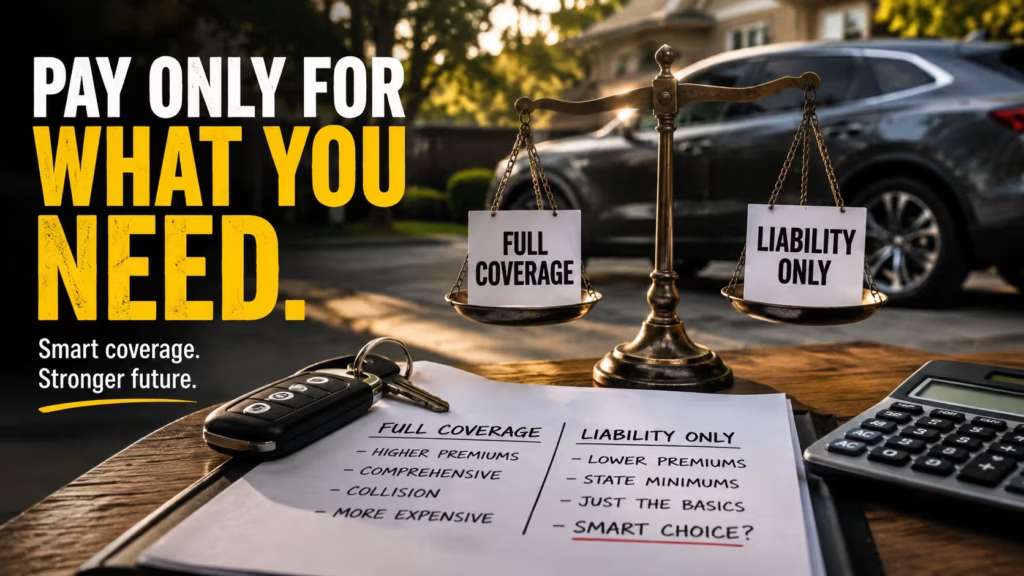
You are staring at your car insurance renewal notice. The premium climbed again. You scroll past the declarations page, pause at the line item for comprehensive and collision, and do the mental math: “Am I paying $1,900 a year to protect a car worth less than my laptop?”
This is not a theoretical question. In 2026, the national average for full coverage car insurance sits between $2,697 and $2,926 per year — roughly $1,900 more than the average liability-only policy at $736 to $799 annually. For a household running two vehicles, that gap can exceed $3,800 before a single claim is filed.
Key Takeaway: Full coverage costs approximately $1,900 more per year than liability-only insurance in 2026. The 10% rule — comparing your annual premium plus deductible against 10% of your car’s actual cash value — provides the clearest framework for deciding when to drop comprehensive and collision coverage. If you carry a loan or lease, you have no choice: the lender requires full coverage until you hold the title.
The wrong decision here is expensive in both directions. Carry full coverage on a depreciated vehicle and you are prepaying for repairs you will never file. Drop it too early on a financed car and your lender force-places insurance at triple the market rate. In practice, the decision requires three inputs: your vehicle’s actual cash value, your liquid savings, and the contractual obligations attached to your title.
Navigate This Guide:
- How Much More Does Full Coverage Cost in 2026?
- What Does Liability-Only Insurance Actually Cover?
- What Is Full Coverage Car Insurance?
- Full Coverage vs Liability Only: Side-by-Side Comparison
- What Is the 10% Rule for Dropping Full Coverage?
- Can You Drop Full Coverage With a Car Loan or Lease?
- Real-World Scenarios: Keep It or Drop It?
- Why State Minimum Liability Limits Are Dangerous
- Do You Need Uninsured Motorist Coverage With Liability Only?
- Step-by-Step Decision Framework
- Frequently Asked Questions
How Much More Does Full Coverage Cost Than Liability Only in 2026?
The pricing gap is not marginal. According to 2026 rate filings aggregated by the National Association of Insurance Commissioners (NAIC) and market data from Quadrant Information Services, the spread between minimum coverage and full coverage has widened to historic levels:
Full Coverage / Year
Liability Only / Year
Premium Difference
Cost for Full Coverage
Liability-Only Premium
High-Cost States
That $1,900 differential is a national median. In Michigan, Florida, and Louisiana — where no-fault laws, litigation environments, and weather exposure inflate comprehensive and collision premiums — the gap can exceed $2,400 annually. In Vermont, Ohio, and Idaho, where base rates are lower, the spread might narrow to $1,200. The point is not the exact dollar figure. The point is that full coverage is a material budget line item, not a rounding error.
Mark Friedlander, director of corporate communications at the Insurance Information Institute (Triple-I), notes that “comprehensive and collision coverage typically represents 60% to 70% of a full coverage premium. For older vehicles, that ratio can climb even higher relative to the car’s value, creating a structural mismatch between cost and protection.”
What Does Liability-Only Insurance Actually Cover?
Liability coverage is the statutory floor. Every state except New Hampshire and Virginia requires it, and even those two states impose financial responsibility laws that effectively mandate equivalent protection. Liability insurance does not protect you. It protects everyone else from the financial consequences of your driving errors.
The Two Components of Liability Coverage
Every liability policy contains two distinct coverages, expressed as three numbers on your declarations page — for example, 25/50/25 or 100/300/100:
What Liability-Only Does NOT Cover
This is where drivers get blindsided. If you cause an accident and carry only liability coverage, the following losses are entirely your financial responsibility:
- Your own vehicle repairs — Collision damage, body work, frame repair, total loss
- Your own medical bills — Unless your state mandates Personal Injury Protection (PIP) or you carry MedPay separately
- Theft of your vehicle — Stolen cars are not recovered by liability coverage
- Vandalism and glass damage — Keyed panels, broken windows, slashed tires
- Weather and natural disaster damage — Hail, flood, falling trees, wildfire
- Animal strikes — Deer collisions, which cause over $1.5 billion in U.S. vehicle damage annually per the Insurance Institute for Highway Safety (IIHS)
In practice, a liability-only policy is a bet that you will not damage your own car, that no one will steal it, and that no act of nature will total it. For some drivers, that is a rational bet. For others, it is financial Russian roulette.
What Is Full Coverage Car Insurance?
Here is the first thing every agent learns in licensing school: “Full coverage” is not an insurance term of art. It appears nowhere in standard policy forms filed with state regulators. It is a colloquialism that generally means a policy combining liability + collision + comprehensive coverage. Some agents also bundle uninsured motorist, medical payments, or roadside assistance into the phrase. Others do not. The ambiguity creates confusion at claim time.
Collision Coverage
Collision pays to repair or replace your vehicle after an accident, regardless of fault. This includes striking another car, hitting a stationary object, or single-vehicle rollovers. You pay a deductible — typically $500 or $1,000 — and the insurer pays the remaining repair cost up to the actual cash value of the vehicle.
At most insurance companies, collision premiums are priced based on vehicle value, repair cost severity, and your driving history. A 2024 Ford F-150 with aluminum body panels costs more to insure for collision than a 2018 Toyota Camry because body shop labor and parts pricing are structurally higher. Telematics programs like Progressive Snapshot or State Farm Drive Safe & Save can offset collision premiums by 10% to 30% for drivers who demonstrate low-risk behavior.
Comprehensive Coverage
Comprehensive — sometimes called “other than collision” — covers non-accident perils: theft, vandalism, fire, hail, flood, falling objects, and animal strikes. Like collision, it carries a deductible and pays up to actual cash value minus that deductible.
In many states, comprehensive claims do not impact your future premiums the way at-fault collision claims do. A hail damage comprehensive claim in Texas or Colorado typically does not trigger a surcharge. A rear-end collision claim almost always does. This asymmetry matters when deciding whether to file small claims.
Additional Coverages Often Bundled
Get Your 2026 Car Insurance Quotes
Compare full coverage and liability-only rates from top U.S. carriers. See exactly how much you could save in under two minutes.
GET YOUR 2026 CAR INSURANCE QUOTESFull Coverage vs Liability Only: What Is Actually Protected?
Most comparison articles bury the answer in paragraphs. Here is the direct mapping of what each policy type covers when a specific event occurs:
✅ Liability Only Covers
- Other driver’s vehicle repairs when you are at fault
- Other driver’s medical bills and lost wages
- Property damage to structures, fences, or signage
- Your legal defense if sued by the other party
❌ Liability Only Excludes
- Repairs to your own vehicle after any accident
- Replacement cost if your car is stolen
- Weather damage: hail, flood, falling trees
- Vandalism, fire, and glass breakage
- Animal strikes and collision with debris
- Your own medical bills (without PIP/MedPay)
✅ Full Coverage Adds
- Your vehicle repairs after at-fault accidents (collision)
- Your vehicle repairs after no-fault incidents (comprehensive)
- Total loss payout up to actual cash value minus deductible
- Theft recovery and vandalism repair
- Weather and natural disaster damage
- Animal strike damage (deer, elk, livestock)
⚠️ Full Coverage Still Excludes
- Mechanical breakdowns and wear-and-tear
- Custom equipment without additional rider
- Personal belongings stolen from inside the car
- Rideshare activity without commercial endorsement
- Intentional damage or criminal use
The critical distinction: liability coverage is a legal obligation to society. Full coverage is a financial hedge for your own asset. One is mandated. The other is a calculated risk transfer.
What Is the 10% Rule for Dropping Full Coverage?
Insurance professionals do not guess at this. They use a formula that removes emotion from the decision. The 10% rule, endorsed by the Insurance Information Institute and taught in certified financial planner coursework, provides a quantitative threshold.
The Formula
Annual Comprehensive + Collision Premium + Deductible ≤ 10% of Vehicle Actual Cash Value
If the left side of that equation exceeds the right side, you are overpaying for protection relative to the asset’s worth. If it is equal or less, full coverage remains economically rational.
Worked Example: 2015 Honda Accord
Annual Collision Premium: $380
Annual Comprehensive Premium: $220
Deductible: $500
Total Protected Cost: $380 + $220 + $500 = $1,100
10% of ACV: $520
Verdict: $1,100 > $520 — Drop full coverage
Worked Example: 2020 Toyota RAV4
Annual Collision Premium: $620
Annual Comprehensive Premium: $340
Deductible: $500
Total Protected Cost: $620 + $340 + $500 = $1,460
10% of ACV: $1,840
Verdict: $1,460 ≤ $1,840 — Keep full coverage
A simpler heuristic used by underwriters at GEICO and Progressive: if your vehicle is worth less than $4,000 to $6,000, liability-only is typically the smarter structural choice, assuming you hold clear title and maintain emergency savings. Above $8,000, the math almost always favors retention of comprehensive and collision.
Can You Drop Full Coverage if You Have a Car Loan or Lease?
No. This is non-negotiable.
When you finance or lease a vehicle, the lender or lessor holds a security interest in the asset. Your loan agreement and lease contract explicitly require comprehensive and collision coverage with deductibles typically capped at $500 to $1,000. This is not an insurance recommendation. It is a contractual covenant written into your promissory note.
If you drop full coverage unilaterally, three consequences follow immediately:
- Force-placed insurance — Your lender purchases a policy on your behalf and adds the premium to your monthly payment. These policies cost 2x to 4x market rate and protect only the lender’s interest, not yours. You receive zero coverage for your own liability or injuries.
- Default acceleration — Most auto loan contracts classify insurance cancellation as an event of default, allowing the lender to demand immediate full repayment.
- Credit damage — A defaulted auto loan reports to all three credit bureaus and can suppress your credit-based insurance score for years, raising future premiums across all lines.
Only when you receive the clear title — the physical certificate of title with no lienholder listed — does the decision become yours. Until that moment, the bank owns the risk calculus, not you.
Real-World Scenarios: Should You Keep or Drop Full Coverage?
Theory collapses without application. Here are three profiles drawn from actual claim files and underwriting guidelines used by major carriers:
Why Carrying State Minimum Liability Limits Is a Mistake
Even if you drop full coverage, never drop liability limits to the state minimum. This is where drivers save pennies and lose fortunes.
The Insurance Information Institute explicitly warns: “Accidents cost more than the minimum limits. If you are found legally responsible for bills that exceed your insurance coverage, you will have to pay the difference out of your own pocket. These costs could wipe you out.”
Consider the arithmetic of a serious accident:
- Emergency room visit + ambulance: $3,000–$8,000
- Overnight hospital stay: $2,500–$5,000 per night
- Surgery (orthopedic or internal): $25,000–$80,000
- Physical therapy (6-month course): $8,000–$15,000
- Lost wages (white-collar, 3 months): $15,000–$40,000
- Pain and suffering award: $50,000–$250,000+
A single at-fault accident with moderate injuries can generate $200,000 in damages. If you carry Florida’s minimum of 10/20/10, your insurer pays $10,000 for bodily injury per person, $20,000 total, and $10,000 for property damage. The remaining $170,000 becomes a personal judgment against your assets, wages, and future earnings. In most states, judgments accrue interest and remain enforceable for 10 to 20 years.
Do You Need Uninsured Motorist Coverage With Liability Only?
Yes. Absolutely. Without exception.
The Insurance Research Council estimates that 14% of U.S. drivers are uninsured at any given moment. In Mississippi, Florida, New Mexico, and Tennessee, that figure exceeds 20%. When an uninsured driver runs a red light and T-bones your vehicle, your liability policy covers nothing for your own damages. You become an unsecured creditor of a likely judgment-proof defendant.
Uninsured/underinsured motorist (UM/UIM) coverage solves this. It functions as a substitute liability policy carried on your own behalf. If the at-fault driver carries no insurance, your UM coverage pays your medical bills, lost wages, and — depending on state law — vehicle damage. If they carry only $25,000 and your damages total $75,000, your UIM coverage fills the $50,000 gap.
UM/UIM is mandatory in some states (e.g., Maryland, Minnesota, North Carolina, South Carolina, Vermont, Virginia, West Virginia, Wisconsin) and optional in others. Even where optional, the NAIC recommends matching your UM/UIM limits to your bodily injury liability limits. The incremental premium is modest — typically $75 to $150 annually — and the protection is disproportionately valuable.
In practice, UM/UIM claims are among the most litigated in personal auto. Carriers scrutinize them heavily because they involve phantom vehicles, hit-and-runs, and disputed fault. Document every accident scene with photos, police reports, and witness statements. A well-documented UM claim settles in 45 to 90 days. A poorly documented one can drag on for 18 months.
How to Decide: A Step-by-Step Framework
During a claim analysis at most insurance companies, adjusters evaluate coverage decisions using a standardized risk matrix. You can replicate that logic at your kitchen table:
- Check your title status. Is there a lienholder? If yes, stop here. You must maintain full coverage until the lien is released.
- Determine actual cash value. Use Kelley Blue Book, NADA Guides, or Edmunds. Use the private party sale value, not dealer retail or trade-in. That is what your insurer will pay.
- Apply the 10% rule. Add your annual comprehensive premium, collision premium, and deductible. Compare to 10% of ACV. If the sum exceeds the threshold, dropping full coverage is mathematically justified.
- Stress-test your savings. If your car were totaled tonight, could you write a check for a replacement tomorrow? If the answer requires borrowing, credit cards, or payment plans, keep full coverage regardless of the 10% rule.
- Evaluate your risk environment. Do you park on the street in a high-theft ZIP code? Do you commute on an interstate with heavy deer activity? Do you live in Tornado Alley or Hail Alley? Environmental risk can override pure math.
- Compare quotes across coverage levels. Request identical liability limits from three carriers for both full coverage and liability-only. Pricing dispersion often exceeds $600 annually for the same driver profile.
- Never cut liability limits to compensate. If dropping full coverage frees $1,200 annually, resist the temptation to pocket it by slashing liability from 100/300/100 to 25/50/25. That trade transfers mechanical risk to existential financial risk.
A very common scenario I see in practice: a driver drops full coverage on a $6,000 vehicle, saves $900 per year, and redirects $300 of that into increasing liability limits and adding UM/UIM. The net savings is $600, but the financial protection is structurally superior to the original full coverage policy with minimum liability.
Frequently Asked Questions
How much more does full coverage cost than liability-only insurance in 2026?
Full coverage averages $2,697 to $2,926 per year nationally, while liability-only coverage costs approximately $736 to $799 annually. The median difference is $1,898 per year, or roughly $158 per month. In high-cost states like Michigan and Florida, the gap can exceed $2,400 annually.
What is the 10% rule for dropping full coverage?
The 10% rule states that if your annual comprehensive and collision premiums plus your deductible exceed 10% of your vehicle’s actual cash value, you should consider dropping full coverage. For example, on a $5,000 car, if your premium plus deductible totals $1,100, you are paying 22% of the car’s value for protection — making liability-only the rational choice.
Does liability-only insurance cover my car if I cause an accident?
No. Liability-only insurance covers damage and injuries you cause to others. It does not pay for repairs to your own vehicle, theft, weather damage, vandalism, or your medical bills. Without collision and comprehensive coverage, all losses to your own vehicle are paid out of pocket.
Can I drop full coverage if I have a car loan or lease?
No. Lenders and lessors contractually require comprehensive and collision coverage until the loan is paid off or the lease ends. Dropping coverage triggers force-placed insurance at 2x to 4x market rates, potential loan default, and credit damage. You regain decision rights only after receiving the clear title.
What liability limits should I carry if I drop full coverage?
Industry professionals recommend at least 100/300/100 — $100,000 bodily injury per person, $300,000 per accident, and $100,000 property damage. State minimums such as 25/50/25 or 10/20/10 are widely considered inadequate, as a single serious accident can generate damages far exceeding those thresholds and expose you to personal judgments.
Is uninsured motorist coverage necessary with liability-only insurance?
Yes. With 14% of U.S. drivers uninsured — and over 20% in states like Florida and Mississippi — UM/UIM coverage protects you when an at-fault driver lacks insurance. Without it, your liability policy covers nothing for your own injuries or vehicle damage. The NAIC recommends matching UM/UIM limits to your bodily injury liability limits.
At what car value should I switch to liability-only insurance?
Most professionals recommend evaluating a switch when your vehicle’s actual cash value falls between $4,000 and $6,000. However, apply the 10% rule using your specific premium and deductible rather than relying on a generic threshold. A driver with $50,000 in savings can justify dropping coverage at higher values than someone living paycheck to paycheck.
Will dropping full coverage lower my insurance premium?
Yes. Removing comprehensive and collision coverage typically reduces your premium by 60% to 70%. On a $2,800 full coverage policy, dropping to liability-only often saves $1,600 to $2,000 annually. However, you assume all risk for damage to your own vehicle. The savings only make sense if you can absorb a total loss without financial distress.
The $1,900 Question: Make the Decision With Data, Not Fear
The choice between full coverage and liability-only is not a moral judgment. It is a capital allocation decision. You are deciding whether to pay an insurer $1,900 per year to assume the risk of your vehicle’s depreciation, or whether to retain that risk yourself and pocket the premium difference.
If your vehicle is financed, the bank has already made the decision for you. If you hold clear title, the 10% rule provides an objective starting point. But the final answer depends on your liquidity, your risk environment, and your capacity to absorb a sudden $5,000 to $15,000 loss without derailing your finances.
Do not let an insurance agent upsell you into full coverage on a $4,000 sedan. Do not let frugality tempt you into liability-only on an $18,000 SUV with $800 in savings. The right choice is the one that aligns the cost of protection with the value of the asset being protected — and with your personal financial resilience.
Use the framework above. Run the numbers. Get quotes. Then decide like the asset manager you are.
Sources: Insurance Information Institute (Triple-I), National Association of Insurance Commissioners (NAIC), Insurance Research Council, Insurance Institute for Highway Safety (IIHS), National Highway Traffic Safety Administration (NHTSA), Quadrant Information Services, Kelley Blue Book, NADA Guides, Edmunds.