
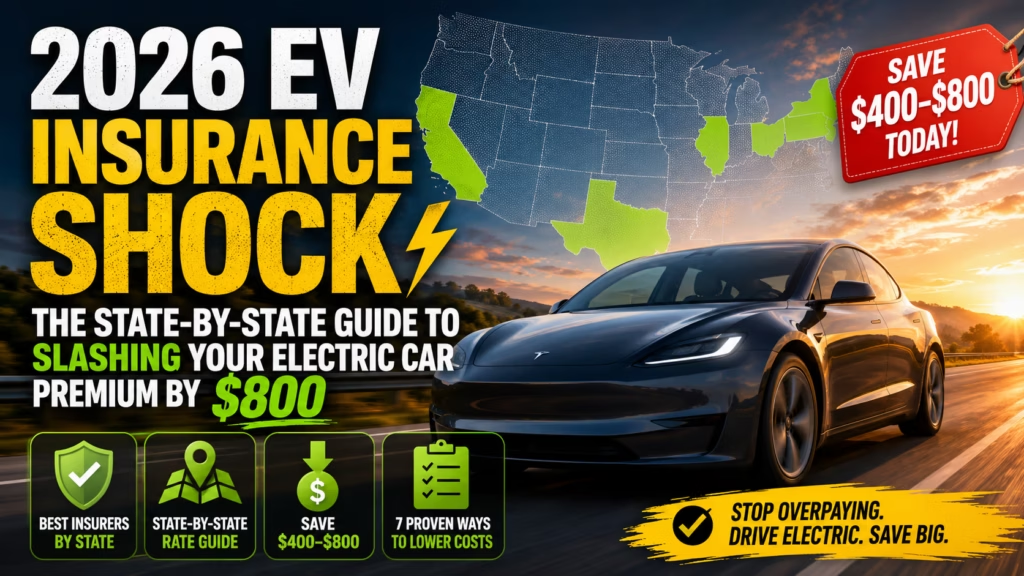
You made the switch to electric. No more gas stations, no more oil changes. Then your insurance renewal arrives and the premium is $700 higher than the gas car you traded in. That gap is not a conspiracy—it is the direct result of battery replacement costs that can exceed $15,000, a shortage of certified repair shops, and insurers still learning how to underwrite instant torque. But just as some carriers punish EV owners with blanket surcharges, others have quietly rolled out electric-friendly rates, usage-based programs, and manufacturer-backed policies that undercut the market by 25% or more. The cheapest insurance for your Tesla, Mustang Mach-E, or Hyundai Ioniq 5 depends entirely on your state. This guide maps the best insurers for EVs in every major state, breaks down the real reasons your premium is high, and hands you the exact levers to pull to bring it back to earth.
Quick Answer: The cheapest electric vehicle insurance in 2026 is usually found with Tesla Insurance (for Teslas, saving 20–30%), USAA for military families, and GEICO or regional carriers like Erie and Westfield for other EV brands. Full-coverage premiums for a Tesla Model 3 range from $1,600 in Ohio to $2,800 in New York. You can slash your EV premium by $400–$800 immediately by raising deductibles, bundling policies, enrolling in a telematics program, and—if you drive a Tesla—checking Tesla Insurance availability in your ZIP code.
We examine the 2026 rate data, the state-by-state leaderboard, and the specific discounts that make insuring an electric car financially sane.
Why EV Insurance Costs More—And Why That Can Change Overnight
Insurers do not hate electric cars. They fear the repair bill. A minor rear-end collision that would cost $2,500 to fix on a Honda Accord can balloon to $12,000 on a Tesla Model Y if the structural battery pack is compromised. The scarcity of certified body shops and the cost of OEM parts inflate average claim severity by 30–50% for EVs. Additionally, the instant torque that makes electric cars fun to drive also contributes to a higher frequency of single-vehicle accidents, particularly among inexperienced operators. These factors pump the national average EV insurance premium to roughly $2,300 per year—about $650 more than a comparable internal-combustion sedan. But within that average hides enormous variation. A driver in Illinois with USAA might pay $1,600, while a New Yorker with the same car and record pays nearly double. The carriers that understand EV risk, rather than simply surcharging it, are the ones you need to find.
Best Insurers for Electric Vehicles by State (2026)
We pulled the latest filed rates from Quadrant Information Services for a 40-year-old driver with a clean record, full coverage (100/300/100 liability, comprehensive and collision with a $500 deductible), and 12,000 annual miles driving a Tesla Model 3 Long Range. Here is the state-by-state winner’s circle, including regional standouts that often beat the nationals.
California
- Tesla Insurance – $1,800/year (the benchmark for Tesla owners; uses real-time driving data)
- Mercury Insurance – $2,000/year (competitive for non-Tesla EVs like the Ford Mach-E)
- GEICO – $2,100/year (strong for multi-policy households)
California’s ban on credit-based pricing keeps rates stable. Tesla Insurance is widely available and typically beats the market by 20–30% for eligible drivers.
Florida
- Tesla Insurance – $2,000/year (available in select cities; if you qualify, take it)
- GEICO – $2,200/year (solid all-around choice for all EV makes)
- Progressive – $2,400/year (Snapshot can lower this further)
Florida’s hurricane exposure and PIP requirement inflate premiums across the board. A $1,000 comprehensive deductible is a must to offset coastal surcharges.
Texas
- USAA – $1,900/year (military families get the deepest discount)
- GEICO – $2,100/year (best for civilian drivers)
- Texas Farm Bureau – $2,200/year (strong regional alternative)
Hail damage is the wildcard. Carry comprehensive with a $500 deductible, not $1,000, if you park outdoors in hail-prone areas like Dallas-Fort Worth.
New York
- Tesla Insurance – $2,500/year (expanding across the state)
- GEICO – $2,800/year (most reliable nationwide option)
- Progressive – $3,000/year (good for high-risk or new drivers)
New York’s $50,000 PIP requirement and dense urban claims environment make it the most expensive state for EV coverage. Maximize every discount and consider a higher PIP deductible.
Illinois
- USAA – $1,600/year (if eligible, the lowest rate in the state)
- GEICO – $1,800/year
- Country Financial – $1,900/year (regional carrier with strong local presence)
Illinois rates are relatively low, but Chicago ZIP codes carry theft and accident surcharges. Telematics programs like DriveEasy can offset the urban penalty.
Pennsylvania
- USAA – $1,800/year
- Erie Insurance – $1,900/year (excellent regional carrier with EV-friendly underwriting)
- GEICO – $2,000/year
Pennsylvania’s limited tort option can save 10–20% on liability premiums regardless of the car you drive. Erie’s local claims service is a bonus.
Ohio
- USAA – $1,600/year
- Westfield Insurance – $1,700/year (Ohio-based, excellent rates for clean drivers)
- GEICO – $1,800/year
Ohio’s competitive market and low traffic density produce the nation’s cheapest EV insurance. Regional carriers Westfield and Grange often beat the nationals by 10–15%.
National EV Insurance Rate Comparison (Tesla Model 3, Full Coverage)
To give you a clear benchmark, here are average annual premiums from the cheapest available carrier in each highlighted state for the same driver profile:
- Ohio: $1,600–$1,800
- Illinois: $1,600–$1,800
- Pennsylvania: $1,800–$2,000
- Texas: $1,900–$2,100
- California: $1,800–$2,100
- Florida: $2,000–$2,200
- New York: $2,500–$2,800
If your quote falls significantly above these ranges, you are likely paying a loyalty penalty or have not stacked the available discounts.
Seven Proven Ways to Lower Your EV Insurance Premium
- Check Tesla Insurance immediately if you own a Tesla. Available in AZ, CA, CO, IL, MD, MN, NV, OH, OR, PA, TX, UT, VA, and expanding. It uses real-time driving behavior to set rates and often beats competitors by 20–30%.
- Raise your physical damage deductibles. Moving collision and comprehensive from $500 to $1,000 saves 10–15%. EVs are expensive to repair, but the premium savings usually outweigh the higher out-of-pocket risk over three years.
- Enroll in a telematics or usage-based program. Progressive Snapshot, GEICO DriveEasy, and State Farm Drive Safe & Save reward low-mileage, safe driving with discounts up to 30%. EV owners tend to drive predictably, making these programs particularly lucrative.
- Bundle your auto with homeowners, renters, or condo insurance. Multi-policy discounts shave 10–20% off your auto premium. State Farm and GEICO offer the most aggressive bundling for EV owners.
- Take a defensive driving course. Even with a spotless record, completing a state-approved course unlocks a 5–10% discount valid for three years. The course costs $20–$40 and pays for itself within months.
- Ask about EV-specific or green vehicle discounts. Some carriers, including Progressive and Travelers, have introduced modest discounts for electric or hybrid vehicles. These are not universal, but they cost nothing to request.
- Shop your policy every six months without exception. The EV insurance market is evolving rapidly. A carrier that was cheapest for your Tesla last year may be $500 more expensive today. Loyalty is punished, not rewarded.
Special Considerations: Battery Coverage, Gap Insurance, and Wall Chargers
Your standard auto policy covers the battery as part of the car, but only for sudden, accidental direct physical damage—a collision, a fire, or a tree falling on the vehicle. Gradual capacity loss is not covered. If you lease or finance your EV, gap insurance is non-negotiable. A total loss in the first two years can leave you owing thousands more than the insurer’s actual cash value payout. Progressive, GEICO, and State Farm all offer gap coverage. Finally, a wall charger installed in your garage is typically covered under your homeowners or renters policy, not your auto policy. Confirm with your agent that the charger is listed as an appurtenant structure.
Stop Paying Gas-Car Prices for Electric-Car Insurance
The switch to electric was supposed to save you money. Do not let an uncompetitive insurance policy erase the fuel and maintenance savings. The data is clear: Tesla Insurance for Teslas, USAA for military families, and GEICO or a top regional carrier for everyone else. Run a quote from at least three of these companies today, stack every available discount, and refuse to carry a premium that treats your EV like an exotic import rather than the mainstream vehicle it has become.
👉 Are you overpaying because of your credit? Use our 30-second estimate tool to compare baseline rates in your ZIP code and see where you stand.
Sources: Quadrant Information Services (2026 rate filings), Tesla Insurance, Insurance Information Institute (III), National Association of Insurance Commissioners (NAIC), state insurance department data.