
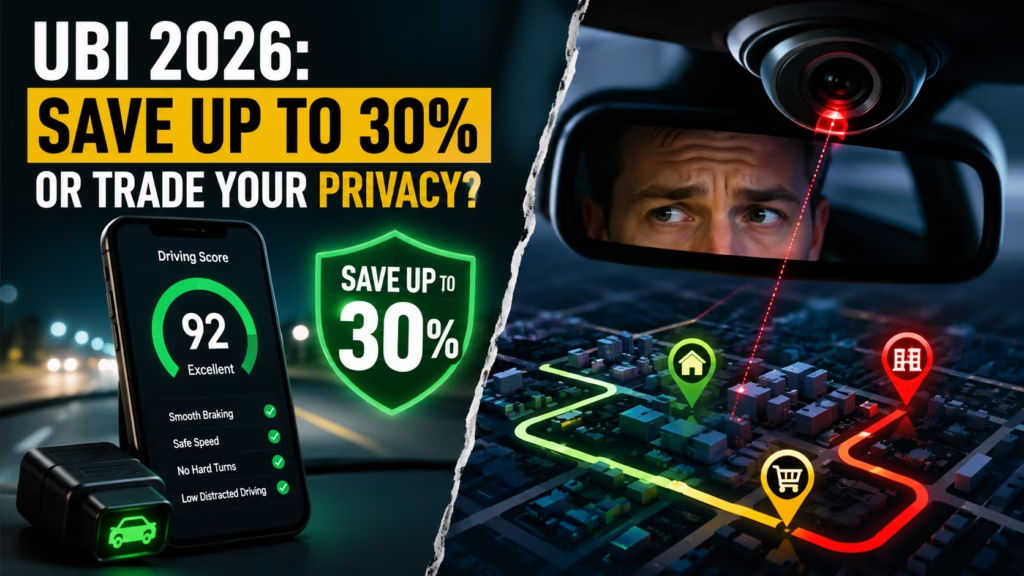
Would you let your insurance company track every mile you drive, every hard brake, and every late-night trip — if it meant slashing your premium by up to 30%? For 82% of U.S. drivers in 2026, the answer is a resounding yes. Usage-based insurance (UBI) has moved from an experimental niche to a mainstream money-saving tool, and those who ignore it are leaving hundreds of dollars on the table.
Quick Answer: In 2026, usage-based insurance can save safe drivers up to 30% on premiums — that’s an average of $400–$600 per year. The top programs are Progressive Snapshot (up to 30% off), State Farm Drive Safe & Save (up to 30%), and Nationwide SmartRide (guaranteed 10% off just for enrolling). The trade-off? Your insurer tracks your speed, braking, mileage, and phone habits. But for most clean drivers, the savings far outweigh the privacy cost.
Yet despite the surge in adoption, a critical question still haunts the industry: Is the discount worth the data? Insurers promise you’ll save, but what happens if your driving score isn’t perfect? Can your rates actually go up? And who else gets access to your driving patterns?
This 2026 guide cuts through the hype. You’ll discover exactly how UBI programs calculate your discount, which insurers offer the most generous savings, what privacy risks you’re really accepting, and a proven step-by-step method to test telematics without committing long-term. By the end, you’ll know with certainty whether telematics is your ticket to a cheaper premium — or a privacy headache you don’t need.
📑 Jump to Section:
What Exactly Is Usage-Based Insurance (UBI)?
Usage-based insurance (UBI) replaces the traditional pricing model — where your premium is based on demographics and historical claims data — with real-time driving behavior. Instead of being lumped into a risk pool with drivers your age, gender, or ZIP code, your rate reflects how you actually drive.
The technology comes in two forms:
- Mobile App: You download your insurer’s app, and it uses your smartphone’s sensors (GPS, accelerometer, gyroscope) to monitor driving. This is now the dominant method — no hardware to plug in.
- Plug-in Device: A small dongle plugs into your car’s OBD-II port (usually under the steering wheel). It tracks vehicle data directly and is still used by some programs for higher accuracy.
Both methods measure the same core metrics: speed, braking intensity, cornering smoothness, time of day, mileage, and phone distraction. Some programs add acceleration patterns and even seat belt usage. The aggregated data generates a driving score (typically 1–100), and your renewal discount is based on that score.
Are You Actually a Good Fit for Telematics? (Honest Self-Test)
Before you hand over your driving data, answer these questions honestly. If you answer “yes” to 4 or more, UBI will likely save you serious money. If you answer “no” to most, telematics could backfire.
- Do you drive fewer than 12,000 miles per year? Low mileage is the single strongest predictor of UBI savings.
- Do you avoid driving between midnight and 4 a.m.? Late-night driving spikes risk scores.
- Do you brake gradually and smoothly? Hard braking is the #1 negative factor in most scoring models.
- Do you stay within 5 mph of the speed limit? Consistent speeding destroys your score fast.
- Do you never (or rarely) touch your phone while driving? Phone distraction tracking is now nearly universal in UBI apps.
- Is your daily commute on calm roads, not aggressive highways? Frequent high-speed merging and lane changes hurt scores.
According to 2026 data from the IoT Insurance Observatory, 60% of drivers who try UBI save money, but the remaining 40% either break even or see a small increase at renewal. The difference is almost entirely explained by the factors above.
Best UBI Programs of 2026: Rankings & Real Savings
Not all telematics programs are created equal. Some offer massive potential discounts but are strict on scoring. Others give a guaranteed enrollment discount but cap the upside. Here are the top 5 UBI programs in 2026, ranked by savings potential, user experience, and transparency.
*Discounts represent maximum potential savings; actual results vary by driving behavior and state availability. Some programs not available in all states.
The Privacy Trade-Off: What Insurers Actually Track — and What They Do With Your Data
This is the elephant in the room. You’re handing over a detailed log of everywhere you drive, how fast, how hard you brake, and whether you pick up your phone. What happens to that data?
According to 2026 policy documents from major insurers and the IoT Insurance Observatory, here’s what they track and what they claim to do with it:
- Location data: GPS records your routes, including home, work, and frequently visited locations. Insurers state they use this to calculate mileage and time-of-day patterns, not to sell to third parties.
- Driving behavior: Speed, braking force, cornering g-forces, and phone interaction. This is the core scoring data.
- Crash detection: Many apps now include automatic crash response. This requires continuous accelerometer monitoring — a feature 43% of drivers actually request.
- Data sharing: Insurers universally claim they do not sell your personal driving data to third parties. However, aggregated, anonymized data may be used for industry research or shared with reinsurers.
- Data retention: Driving data is typically retained for the life of your policy plus 3–7 years, depending on state regulations.
For drivers deeply concerned about GPS tracking, Nationwide SmartRide and similar plug-in device programs tend to collect less granular location data than app-based programs. The device knows the vehicle is moving but doesn’t always log exact coordinates with the same fidelity as a smartphone.
Pros and Cons of Usage-Based Insurance (No Hype, Just Facts)
✅ Pros of Telematics
- Real savings: Average discount is 10%–30% for safe drivers — worth $200–$600/year.
- Fair pricing: Your rate reflects your actual driving, not your age, gender, or credit score.
- Safer habits: Real-time feedback reduces hard braking and speeding incidents by up to 20%.
- Extra features: Many apps include crash detection, roadside assistance, and theft tracking at no extra cost.
- No commitment: Most programs let you opt out at any time without penalty.
❌ Cons of Telematics
- Privacy loss: Insurer knows where, when, and how you drive — always.
- Potential rate increases: Some programs can raise rates at renewal for consistently poor scores.
- Battery drain: GPS-intensive apps can consume 5%–10% of your phone battery daily.
- Not always accurate: Hard braking can be falsely recorded if you swerve to avoid an animal.
- Family complications: If multiple drivers share a car, one aggressive driver ruins everyone’s score.
Enter your ZIP code below to instantly compare UBI-eligible policies and traditional policies side-by-side — see the exact savings you’re eligible for before you commit.
Get Your Personalized UBI vs. Traditional Quote Comparison
Enter your ZIP code below to see exactly how much you can save with telematics insurance in 2026 — based on your location, vehicle, and driving profile.
Get My ZIP Code Estimate NowHow to Maximize Your UBI Discount (Without Driving Like a Grandma)
Enrolling is easy. Getting the maximum discount requires strategy. Here are 6 real-world tips from drivers who’ve achieved 25%–30% savings:
- Enroll during a low-mileage period. If your driving seasonally drops (winter, summer vacation), start the program then. Your initial score sets the baseline.
- Accelerate and decelerate like you have a cup of hot coffee on the dash. Smoothness is the #1 scoring factor. Anticipate stops, coast when possible, and avoid jackrabbit starts.
- Use cruise control on highways. Maintaining steady speed reduces minor fluctuations that can trigger “speeding” flags.
- Put your phone in the glove box. Even touching your phone at a red light can register as “phone distraction.” Most programs penalize any screen interaction while the vehicle is moving.
- Plan errands before 10 p.m. Trips between midnight and 4 a.m. are rated as high-risk by virtually every program. Consolidate late drives.
- Check your score weekly. All major apps show a running score. If it dips, adjust immediately — don’t wait until renewal to discover you earned only a 5% discount.
Frequently Asked Questions About Usage-Based Insurance 2026
What is usage-based insurance (UBI)?
Usage-based insurance uses a mobile app or plug-in device to monitor your actual driving behavior — speed, braking, mileage, cornering, time of day, and phone usage. Insurers calculate a personalized discount or premium based on this data. Safe, low-mileage drivers can save up to 30%, while risky driving may result in a smaller discount or, with some programs, a rate increase at renewal.
How much can I really save with telematics?
In 2026, top programs advertise savings up to 30%. The average real-world discount is 10%–15% ($150–$300/year). The safest drivers — those with low mileage, no hard braking, and no late-night trips — can reach the 25%–30% tier. Nationwide SmartRide guarantees a 10% discount just for participating, making it the only no-risk entry point.
Will my rate go up if I drive poorly?
It depends on the insurer. Progressive Snapshot and Nationwide SmartRide do not increase rates based on telematics data — you simply earn a smaller discount. Other programs, including some versions of State Farm Drive Safe & Save, reserve the right to raise rates at renewal if your driving score indicates higher risk. Always read the program’s “no penalty” guarantee before enrolling.
Is my privacy at risk with telematics?
Major insurers state they do not sell your personal driving data to third parties. However, they do store it and use it internally for pricing. The data could potentially be accessed via a data breach, legal subpoena, or law enforcement warrant. If privacy is a top concern, choose a program with minimal data collection, like Nationwide SmartRide (plug-in device, no phone tracking), and carefully review the privacy policy.
Can I opt out of UBI after enrolling?
Yes. All major programs allow you to cancel at any time. You’ll retain any discounts already earned up to that point, but you’ll lose the UBI discount at your next renewal. There is no penalty for leaving — your policy simply reverts to traditional pricing.
Which is the best UBI program for low-mileage drivers?
State Farm Drive Safe & Save is specifically designed to reward low mileage, offering the highest potential discount for those driving under 8,000 miles/year. Progressive Snapshot also heavily weights mileage. If you drive fewer than 5,000 miles/year, also explore true pay-per-mile policies from insurers like Metromile or Nationwide’s SmartMiles.
Does telematics drain my phone battery?
Yes, GPS and accelerometer tracking consume battery. Most apps use 5%–10% of battery per day. Using a plug-in device instead of a phone app eliminates this issue, and it’s a reason some drivers prefer device-based programs like Nationwide SmartRide.
Final Verdict: Is Telematics Worth It in 2026?
For the majority of drivers — anyone with a clean record, low to moderate mileage, and safe daytime habits — telematics is absolutely worth it. The average $200–$400 annual savings requires nothing more than driving as you already do. The privacy trade-off is real but, for most people, the financial benefit outweighs the risk of data exposure.
Here’s your 5-step action plan:
- Honestly assess your driving using the self-test above. If you’re a safe, low-mileage daytime driver, you’ll likely save 15% or more.
- Choose a “no penalty” program first — Progressive Snapshot or Nationwide SmartRide — to test telematics risk-free.
- Compare UBI quotes against traditional quotes using the ZIP code tool below. The gap may surprise you.
- Drive smoothly for the first 30 days to lock in a high initial score. Then maintain it.
- Re-evaluate at renewal. If your discount is under 10%, consider switching insurers or opting out of telematics.
Sources: IoT Insurance Observatory, Arity, J.D. Power 2026 U.S. Auto Insurance Study, Progressive, State Farm, Allstate, Nationwide, GEICO, Insurance Information Institute (III), National Association of Insurance Commissioners (NAIC).