
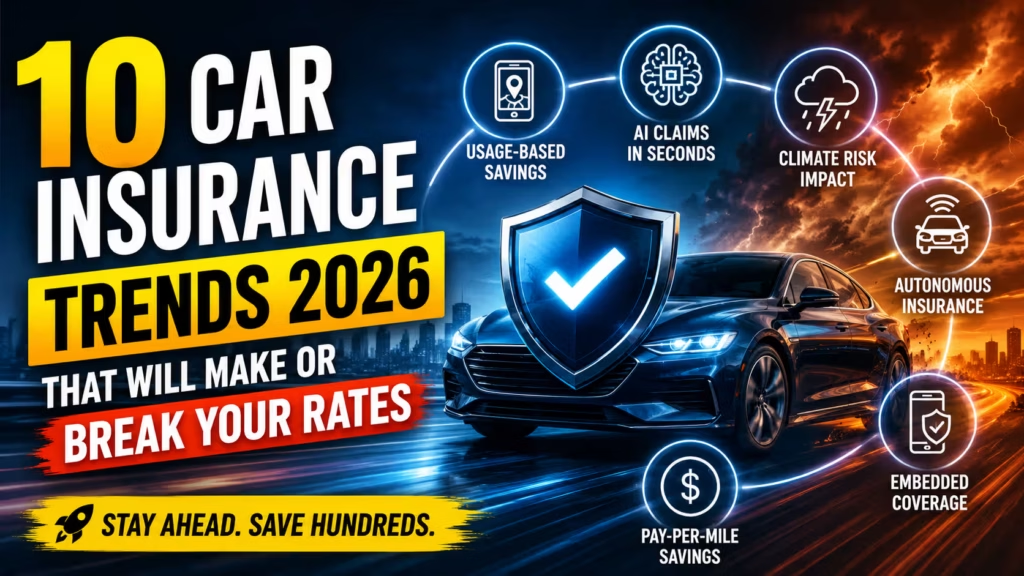
The car insurance industry is in the middle of the fastest transformation in its history. In 2026, the policy you bought two years ago is likely already outdated — and leaving money on the table. Telematics devices now sit in millions of vehicles, adjusting premiums in real time. Artificial intelligence is paying claims in seconds, not weeks. Climate change is redrawing the map of insurable addresses. And embedded insurance means you can buy a policy at the exact moment you sign a lease or rent a car — but often at a premium you don’t need to pay.
Quick Answer: The 10 biggest car insurance trends for 2026 can either save the average driver $400–$900 per year — or cost them the same amount by sticking with an outdated policy. The single most profitable move right now is switching to usage-based or pay-per-mile insurance if you drive fewer than 8,000 miles annually. Telematics discounts have matured, data privacy safeguards have improved, and the savings gap between traditional and behavior-based policies has never been wider. The second biggest factor: climate risk. If you live in a wildfire, hurricane, or flood-prone state, comprehensive premiums are being repriced aggressively. You must shop quotes harder than ever before.
This is not a distant future. These trends are live, active, and already showing up on renewal notices across all 50 states. The drivers who act on them now lock in lower rates. The ones who ignore them get hit with surcharges they never saw coming. Here is exactly what is changing — and exactly what to do about each one.
📑 Explore the 10 Trends Reshaping Your Premium:
- 1. Telematics & Usage-Based Insurance Go Mainstream
- 2. AI Claims Processing: Settled in Seconds
- 3. Climate Change Surcharges Hit Comprehensive
- 4. Pay-Per-Mile Insurance Explodes
- 5. Personalized Pricing via Big Data
- 6. Autonomous Vehicle Liability Shift
- 7. Cybersecurity Coverage for Connected Cars
- 8. Embedded Insurance at Point of Sale
- 9. Mobility-as-a-Service (MaaS) Insurance
- 10. Regulatory & Privacy Changes
- Your 2026 Trend Action Plan
- Frequently Asked Questions
1. Telematics & Usage-Based Insurance (UBI) Become the Default
In 2022, telematics was an option. In 2026, it is the baseline expectation for competitive rates. Over 82% of U.S. policyholders now view telematics-based insurance positively, according to J.D. Power’s 2026 U.S. Auto Insurance Study. More critically, 62% of drivers say they are actively willing to switch insurers to get a usage-based policy.
Programs like Progressive Snapshot, GEICO DriveEasy, State Farm Drive Safe & Save, and Allstate Drivewise have matured. The monitoring period has shrunk from 6 months to as little as 30 days on some products. The data tracked — mileage, hard braking, phone usage while driving, time of day — feeds directly into a discount that now averages 22% for safe drivers, with top performers saving over 40%.
The objection most drivers have — “I don’t want my insurer spying on me” — has been substantially addressed in 2026. Most programs now let you opt out of GPS location tracking and only monitor mileage and driving smoothness. And with state-level privacy laws in California, Colorado, and Virginia setting the standard, your data cannot be sold without explicit consent. The privacy cost is dropping. The financial cost of not using telematics is rising.
2. AI Claims Processing: Settled in Seconds, Not Weeks
Artificial intelligence has moved from experimental pilots to live production at every major insurer. In 2026, over 35% of auto claims are touchless — submitted via photo upload, assessed by computer vision AI, and paid out within minutes for straightforward cases. Companies like Lemonade and Root built their entire model on this; now GEICO, Progressive, and State Farm have deployed competing AI claims platforms.
✅ AI Claims Benefits
- Speed: Average settlement time drops from 12 days to under 2 hours for minor damage
- Accuracy: AI damage estimates are within 3% of final repair costs vs 12% for human adjusters
- Fraud detection: Pattern recognition flags suspicious claims instantly, keeping honest premiums lower
- Convenience: No adjuster visit, no phone call — upload photos, receive payment
⚠️ What to Watch For
- Algorithmic bias: Some systems have been found to undervalue claims in certain ZIP codes
- Denial speed: AI can reject claims faster than ever — always appeal with additional evidence
- Human recourse: Ensure your insurer has a clear process for human review of AI decisions
Bottom line: When shopping for insurance in 2026, ask each company directly: “What percentage of claims are processed by AI, and what is your average settlement time?” A fast, transparent AI claims process is now a major competitive advantage — and it directly impacts how quickly you get back on the road after an accident.
3. Climate Change Surcharges Are Here — Check Your ZIP Code
This is the trend costing drivers money without them realizing why. Comprehensive coverage premiums are being repriced neighborhood by neighborhood based on climate risk models. If you live in a county with elevated wildfire, hurricane, or flood risk, your comprehensive premium may have risen 15-30% in the last two years — even if you’ve never filed a claim.
Insurers are using data from firms like CoreLogic and RMS to map perils at the hyper-local level. In Florida, some carriers have stopped writing new policies entirely in certain coastal counties. In California, insurers are non-renewing policies in wildfire-interface zones. Louisiana and Texas are seeing similar pullbacks after consecutive hurricane and freeze events.
Also, if you park in a garage and have a home security system, explicitly mention this when getting quotes. Some insurers offer mitigation discounts that can partially offset climate surcharges, but you must ask.
4. Pay-Per-Mile Insurance Hits the Mainstream
With remote and hybrid work now permanent for tens of millions of Americans, pay-per-mile insurance has evolved from a niche product to a standard option at major carriers. Nationwide SmartMiles, Metromile (now part of Lemonade), and Allstate Milewise all offer base rates plus a per-mile charge. If you drive under 6,000 miles per year, the savings are dramatic — often 30-50% versus a traditional policy.
A typical pay-per-mile policy structure in 2026: a low daily base rate (often $1.50–$3.00 per day) plus $0.04–$0.07 per mile driven. A driver covering 5,000 miles annually might pay $500–$700 total, versus $1,100+ for a standard policy. The math is simple: if your mileage is low, your premium should be low. Pay-per-mile ensures it is.
5. Personalized Pricing: Your Data Is Your Discount
Beyond telematics, insurers are layering in data from a widening array of sources — with consumer consent — to personalize premiums more aggressively. Homeownership, education level, profession, even smart home sensor data that verifies garage parking are being used to refine risk profiles.
The trend is controversial. Consumer advocates warn against “surveillance pricing” that penalizes people for factors outside their control. Regulators in multiple states are scrutinizing the practice. But in the 2026 market, the reality is that voluntarily sharing more verified data points often unlocks discounts. A driver who can demonstrate they park in a secure garage, have a college degree, and drive a vehicle with ADAS safety features can stack multiple discounts that a driver providing minimal data cannot access.
Strategic approach: Share data points that genuinely indicate lower risk (garaged vehicle, low mileage, professional occupation) but avoid programs that monitor real-time behavior beyond driving smoothness if privacy is a concern. You can often secure 70% of the available discount while sharing only 30% of the possible data.
6. Autonomous Vehicle Liability: The Gray Area No One Talks About
Vehicles with Level 3 autonomy — capable of full self-driving under specific conditions — are on the road in 2026. Tesla’s Full Self-Driving (Supervised), Mercedes-Benz Drive Pilot, and emerging systems from Ford and GM mean that for stretches of a drive, the car is in control. When it crashes, who pays?
The answer in 2026 is uncomfortably messy. Most personal auto policies still assume a human driver is always responsible. If a self-driving feature malfunctions, the manufacturer may be liable — but proving that requires a legal fight that can take months. Some insurers are adding autonomous operation exclusions to standard policies, while manufacturers are launching their own insurance products (Tesla Insurance, for example) that cover both human and autonomous operation.
7. Cybersecurity Coverage for Connected Cars
Modern vehicles are computers on wheels. They have cellular connections, Wi-Fi, Bluetooth, and dozens of electronic control units. In 2026, cyber attacks on individual vehicles are no longer theoretical. There have been documented cases of remote unlocking, GPS spoofing, and even engine immobilization via hacked telematics systems.
Standard auto policies were never designed for cyber risk. In response, insurers are beginning to offer standalone cyber endorsements for personal auto — covering losses from ransomware that locks your car, identity theft via vehicle infotainment systems, and data breach notification costs. Premiums are modest ($30–$60/year) but the coverage is currently a patchwork.
Ask your insurer if a cyber endorsement is available. For most drivers of 2020+ vehicles with connected features, this is a sensible, low-cost addition that closes a genuine coverage gap.
8. Embedded Insurance: Buy Coverage at Checkout
When you buy a car from Carvana or lease through a manufacturer’s app, you are now offered instant, one-click insurance embedded directly into the transaction. The same goes for rental platforms like Turo. This seamless experience is convenient — but it comes at a cost.
Embedded insurance products, powered by insurtech APIs, are priced for convenience, not value. A policy purchased at the dealership checkout may carry a 15-25% premium over a standalone policy you could obtain by spending 10 minutes on a comparison site. The embedded option banks on you valuing speed over savings.
Rule of thumb: Use embedded insurance quotes as a baseline, not a final decision. If you’re at a dealership, accept temporary coverage to drive the car off the lot legally, then immediately shop standalone quotes. You can cancel and switch within days without penalty in most states.
9. Mobility-as-a-Service (MaaS) Insurance Products Multiply
Rideshare, car-sharing, and subscription services like Zipcar, Turo, and manufacturer subscription programs (Porsche Drive, Volvo Care) are creating a new class of driver: the multi-platform mobility user who does not fit neatly into “owns a car and insures it” or “doesn’t own a car at all.”
Insurers are responding with portable, driver-centric policies that follow the person across vehicles and platforms. These policies cover you whether you’re driving your own car, a borrowed car, or a rental. They are currently available from a handful of specialty insurers and cost roughly 20% more than a standard auto policy — but for someone who regularly uses multiple mobility platforms, the simplicity and continuous coverage are worth the premium.
If you drive for Uber or Lyft, or regularly use Turo or Getaround, ask about rideshare gap coverage and personal mobility policies. Standard personal auto policies exclude commercial activity — and the gap between your personal policy and the platform’s coverage can leave you exposed.
10. Regulatory Shifts: Privacy Laws and Rate Transparency
States are reacting to the speed of industry change with new regulations in 2026. Key developments to watch:
- Telematics data privacy laws: Following California’s lead, multiple states now require insurers to disclose exactly what telematics data is collected, how it’s used, and provide a one-click opt-out.
- Rate transparency mandates: Regulators in several states are requiring insurers to publish the specific factors affecting rate changes, so consumers can see exactly why their premium increased.
- Autonomous vehicle insurance frameworks: States like Nevada, Arizona, and Michigan are creating legal frameworks to clarify manufacturer vs. driver liability for autonomous vehicle crashes.
These changes are generally pro-consumer. Take advantage of transparency rules by requesting a detailed breakdown of your rate factors at renewal. If your insurer cannot justify a price increase with specific, documented reasons, shop elsewhere.
Your 2026 Trend Action Plan (Profit From Every Shift)
- Switch to usage-based or pay-per-mile insurance if eligible. If you drive under 8,000 miles per year or have safe driving habits, you are leaving $300–$600 on the table every year. Get quotes from three telematics programs this week.
- Audit your comprehensive premium for climate surcharges. Compare your current comp line to quotes from AI-native or specialty insurers that price risk differently. A 15-minute quote check can save you $200+.
- Verify autonomous and cyber coverage. If your car has any self-driving capability, confirm in writing that your policy covers autonomous-mode accidents. Add cyber endorsement if your vehicle is connected.
Get Your 2026 Car Insurance Quotes
Lock in today’s best rates before the next wave of trend-driven price changes. Compare telematics, pay-per-mile, and traditional policies in one step.
Get My Free Quotes NowFrequently Asked Questions About 2026 Car Insurance Trends
What are the biggest car insurance trends for 2026?
The five biggest trends are: 1) Mainstream telematics adoption with 60%+ of drivers willing to switch for usage-based insurance, 2) AI claims processing settling straightforward claims in under two hours, 3) Climate change surcharges driving comprehensive premiums up 15-30% in high-risk states, 4) Embedded insurance offered seamlessly at car purchase or rental checkout, and 5) Pay-per-mile insurance becoming a standard product at major carriers for low-mileage drivers.
How much can telematics insurance save me?
The average safe driver saves 22% with a telematics program in 2026, with top-tier drivers saving over 40%. This translates to $300–$700 annually for most policyholders. The exact savings depend on your mileage, braking habits, phone usage while driving, and time-of-day driving patterns. Most programs offer a risk-free trial period: you install the app, drive normally for 30-90 days, and receive a permanent discount based on your actual habits.
Is climate change really affecting my car insurance bill?
Yes, and it is likely already baked into your current premium without being labeled as a “climate surcharge.” In wildfire-prone California counties, hurricane-exposed Florida coasts, and flood-vulnerable Louisiana parishes, comprehensive premiums have risen 15-30% in two years. The best response is to shop aggressively — insurers use different risk models, and the quote variance in high-risk ZIP codes is wider than ever, often exceeding $500 per year between carriers.
Should I use embedded insurance when I buy or lease a car?
Use it as temporary coverage to legally drive off the lot, but not as your permanent policy. Embedded insurance is priced 15-25% higher than standalone policies you can find by spending 10 minutes on a comparison site. Accept the embedded offer for immediate coverage, then shop standalone quotes within the cancellation window. You can switch without penalty in most states.
Does my standard auto policy cover autonomous driving features?
Not necessarily. In 2026, many standard policies contain exclusions or ambiguous language regarding autonomous operation. If your vehicle has Level 2 or Level 3 autonomous features (Tesla Autopilot/FSD, GM Super Cruise, Ford BlueCruise), call your insurer and ask directly: “Am I covered in an accident that occurs while the vehicle is in autonomous mode?” Get the answer in writing. If coverage is unclear or excluded, shop for a policy that explicitly covers autonomous operation or consider manufacturer-offered insurance.
These Trends Are Not Waiting — Neither Should You
Every six months you renew an outdated policy is a half-year of overpayment you’ll never get back. The trends reshaping car insurance in 2026 are, in almost every case, creating winners and losers among drivers. The winners are the ones who switch to behavior-based pricing, shop climate-adjusted quotes, and close coverage gaps before an accident exposes them. The losers are the ones who auto-renew without looking.
Take the three-step action plan above. It costs nothing but 15 minutes of your time. The return on that time could be $500 or more this year — and the peace of mind that your policy actually covers what you think it covers in a rapidly shifting landscape.