
Cars lose value the second you drive them off the lot. In 2026, with the average new vehicle price hovering around $48,000, that depreciation happens shockingly fast. If you get into a bad accident and your car is totaled, your standard insurance will only pay what the car is worth *today*—not what you owe the bank. That difference can leave you thousands of dollars in debt for a car you no longer own.
Quick Answer: Gap insurance (Guaranteed Asset Protection) covers the “upside-down” difference between your car’s actual cash value and your remaining loan balance if the car is totaled or stolen. It is an absolute must-have if you financed a car with less than a 20% down payment, took out a 60+ month loan, or leased the vehicle. Buying it through your auto insurer costs about $40 a year, but buying it at a dealership can cost upwards of $800.
Gap insurance is the one policy you buy hoping you never have to use it. Here is exactly how the math works, the biggest dealership scam to avoid, and how to know when you can safely cancel it.
The “Upside Down” Trap: How Depreciation Works
Being “upside down” (or having negative equity) means you owe more on your auto loan than the car is actually worth. Because new vehicles depreciate by roughly 20% to 30% in the first year alone, almost everyone who finances a car with a small down payment is instantly upside down.
Standard auto insurance policies only pay the Actual Cash Value (ACV) of your vehicle at the time of the total loss. They do not care what you owe the bank.
The Real-World Math: Why You Need It
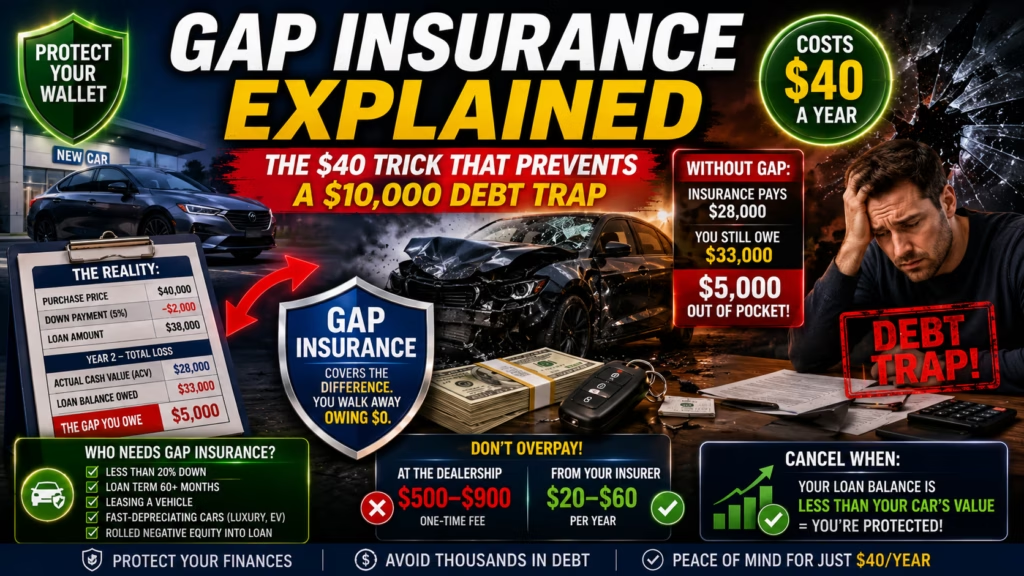
Imagine you buy a new car for $40,000. You put $2,000 down and finance $38,000.
- Year 2: You get T-boned at an intersection, and the car is totaled. Due to depreciation, the insurance adjuster values your car at an ACV of $28,000.
- The Problem: Your standard collision insurance cuts a check for $28,000. But you still owe the bank $33,000 on your loan.
- The Disaster: You are now left with a $5,000 bill for a car that is sitting in a junkyard. Worse, you no longer have a car to drive, meaning you have to take out a *new* loan to buy a replacement vehicle while still paying off the old one.
- The Fix: If you had Gap insurance, that $5,000 difference is wiped out. You walk away owing $0.
The Biggest Dealership Scam: Never Buy Gap There
This is where thousands of drivers get ripped off every year. When you sit in the finance office at a dealership, they will inevitably ask if you want to “protect your investment” with Gap coverage. They will roll the cost into your loan.
- Cost at a Dealership: $500 to $900 (one-time fee, which you pay interest on since it’s rolled into the loan).
- Cost from Your Auto Insurer (Geico, Progressive, State Farm): $20 to $60 per year (usually around $2 to $5 added to your monthly bill).
Dealerships mark up Gap insurance by as much as 1,000%. Always, always decline Gap insurance at the dealership. Call your auto insurance agent the next day and add it to your policy for pennies on the dollar.
Who Absolutely NEEDS Gap Insurance?
You should add Gap coverage to your policy if any of these apply to your vehicle purchase:
- Your down payment was less than 20%. If you put 0% to 10% down, you are guaranteed to be upside down for at least the first two years of the loan.
- Your loan term is 60 months or longer. Long loans stretch out your principal payments, meaning you pay off the depreciation very slowly.
- You are leasing the vehicle. Almost all lease contracts legally require you to carry Gap insurance (dealerships often bake this into the lease cost, but verify).
- You bought a fast-depreciating vehicle. Luxury cars (BMW, Mercedes) and Electric Vehicles (Tesla, Rivian) depreciate incredibly fast in their first 3 years.
- You rolled negative equity from your old car into your new loan. If you traded in a car that you owed $5,000 on, that $5,000 was added to your new loan. You are severely upside down from day one.
When Can You Safely SKIP Gap Insurance?
- You paid cash for the car. No loan means no gap.
- You put 20% or more down on a standard car. A 20% down payment usually outpaces standard depreciation, keeping you in positive equity.
- You own the car outright. If there is no lienholder, there is no gap to cover.
The Golden Rule: Cancel It When You Cross the Break-Even Point
Gap insurance is not meant to be kept forever. It is a temporary safety net. Every year, check your loan balance against your car’s Kelly Blue Book value. The moment your loan balance drops *below* what the car is worth, you are in “positive equity.” At that exact moment, call your insurer and cancel the Gap coverage. They will prorate a refund for the remaining months. Most drivers only need Gap insurance for the first 2 to 3 years of a 60-month loan.
Frequently Asked Questions
Does gap insurance cover my $500 deductible?
Usually, no. Standard gap insurance only covers the difference between the ACV payout and the loan balance. You still have to pay your collision or comprehensive deductible out of pocket. However, some specific “Gap Waiver” policies sold at dealerships *do* cover the deductible—read the fine print carefully before signing at the dealer.
Is gap insurance required by law?
No federal or state law requires private consumers to carry gap insurance. The only time it is “required” is if your lease contract explicitly mandates it, or if your specific lender requires it as a condition of the auto loan (common with subprime loans).
Can I buy gap insurance after I buy the car?
Yes. You do not have to buy it on the day of purchase. You can call your auto insurance company 3 months or even a year after buying the car and add it, as long as you still have an active loan on the vehicle. Just don’t wait until *after* the car is totaled to try and buy it—insurers won’t sell it retroactively.
Don’t Pay the Dealer’s Tax
Gap insurance is one of the smartest, cheapest policies you can buy to protect your finances—but only if you buy it from the right place. Protect yourself from the depreciation trap for a few dollars a month. Enter your ZIP code below to check your current base rate and see exactly how little it costs to add Gap coverage to your policy today.
Sources: Insurance Information Institute (III), Federal Trade Commission (FTC) “Gap Insurance” Consumer Guide, Kelley Blue Book (KBB) Depreciation Data, National Association of Insurance Commissioners (NAIC).