
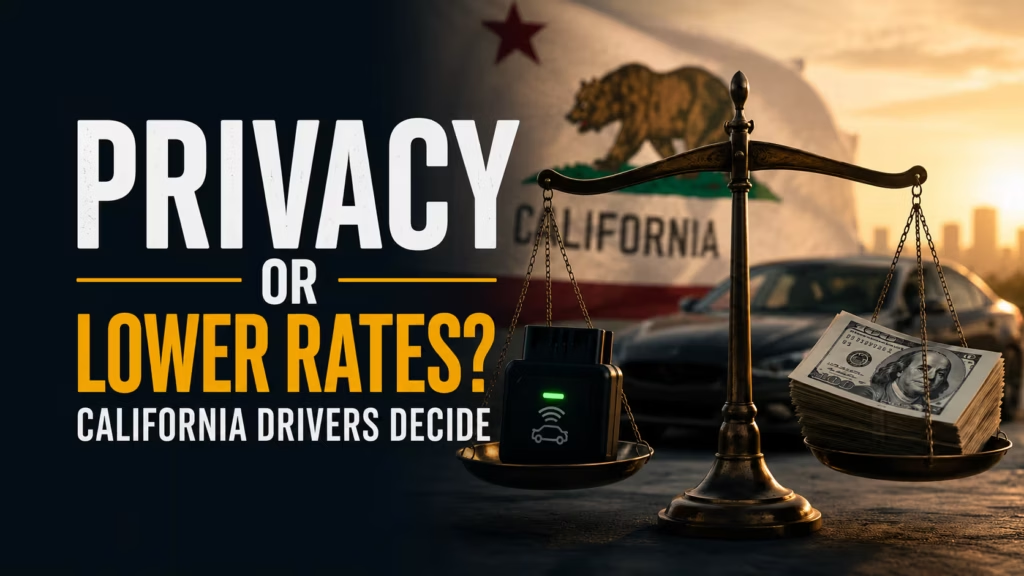
California is the only state in the nation that does not allow insurers to use telematics—technology that tracks speed, braking, phone use, and location—when setting auto insurance rates. That could change in 2026[reference:0].
Key Takeaway: Assembly Bill 311, the Consumer Driving Data Protection Act of 2026, would let California auto insurers track driving habits through smartphones and other devices, promising lower premiums for drivers who opt in and prove safer habits over time[reference:1]. The bill would reshape rates for 27 million California drivers but faces fierce resistance from state regulators, privacy advocates, and consumer groups[reference:2]. If passed, drivers would have a choice: share your data for potential savings, or keep your privacy and stick with the current system. But critics warn that even a “voluntary” program creates a coercive dynamic where opting out could mean paying more[reference:3].
If you’re a California driver, this debate isn’t academic—it’s about your wallet and your privacy. Here’s exactly what AB 311 would do, the arguments on both sides, and what it means for you.
📑 Navigate This Guide:
What Is Assembly Bill 311?
Authored by Assemblymember Tina McKinnor (D-Inglewood), AB 311—the Consumer Driving Data Protection Act of 2026—would amend California’s bedrock insurance law, Proposition 103, to allow insurers to use telematics in setting rates for drivers who voluntarily opt in to being tracked[reference:4].
Currently, a driver’s safety record is determined by the Department of Motor Vehicles’ point system, which considers moving violations and accidents[reference:5]. That system would remain in place for those who don’t want insurers tracking them[reference:6].
Under AB 311, drivers who choose to participate would have their telematics data used to establish their driving records in addition to what their DMV records show[reference:7]. Insurers would collect data such as:
The data would be collected over approximately six months and used to quote premiums for the next six-month period[reference:9]. Drivers would be allowed to dispute the data collected[reference:10].
The bill has been moving through committees and is currently in the Senate Committee on Privacy, Digital Technologies, and Consumer Protection[reference:11].
Why California Is the Last Holdout
California is the only state in the nation that does not allow insurers to use telematics in setting rates[reference:12]. This is because of Proposition 103, a voter-approved law from 1988 that requires insurance rates to be based primarily on three main factors[reference:13]:
- Driving record – Your history of accidents and violations
- Miles driven annually – How much you drive
- Years of driving experience – How long you’ve been driving
Prop. 103 also requires insurance companies to obtain approval from the state’s elected insurance commissioner before raising premiums and gives the public the ability to object to proposed rate increases[reference:14].
Consumer groups credit Prop. 103 with saving California drivers over $150 billion in auto insurance rates since its passage. The law was written at a time when insurance rates were skyrocketing and people living in some parts of California’s inner cities often could not get insurance at any price.
The Case FOR Telematics: Safer Roads and Lower Rates
Supporters of AB 311 argue that telematics is a more accurate way to determine how likely motorists are to get into a collision—and a method to encourage better driving[reference:16].
Assemblymember Tina McKinnor, who has lost three friends in vehicle crashes in recent years, said the bill would “incentivize safer, good driving behavior”[reference:17]. “For me, this is a way to incentivize to slow people down,” McKinnor said. “If 10 people opt in and slow down, and if we could save 10 lives, that will make me extremely happy”[reference:18].
Kellie Montalvo, a parent whose son died after being hit by a distracted driver, testified before the Senate Standing Committee on Insurance[reference:19]. Her son Benjamin, 21, was riding his bike in 2020 when he was hit by a driver who had been texting while driving[reference:20]. The driver had a record of “speeding tickets, prior crashes and this was her fourth hit-and-run,” Montalvo said[reference:21]. “I spend many sleepless nights wondering if she had been stopped at any point prior to that horrific night, would my beautiful son be here today,” Montalvo said, her voice breaking[reference:22]. She urged lawmakers to pass the bill, saying it will save lives[reference:23].
Allison Adey, a legislative advocate for the Personal Insurance Federation of California, said telematics could allow drivers to clear their driving record if they become safer drivers. “It is reasonable for people to be able to control what information is on their driving record,” Adey said. “Seven years is a really long time; there’s a big difference between a 22-year-old and a 29-year-old in terms of what their typical risk behaviors are.”
Safety advocates also point out that the systems provide real-time feedback on driving, helping drivers improve their habits immediately rather than waiting for a ticket or accident[reference:24].
who opt into telematics see
no change or a rate decrease
Maryland’s telematics program
in the same program
in their premiums
Source: Maryland Insurance Administration telematics data[reference:25]
The Case AGAINST Telematics: Privacy, Bias, and the “Choice” Trap
Opponents of AB 311—including the California Department of Insurance, Consumer Watchdog, and other privacy and consumer groups—say the bill forces motorists to choose between data protection and affordable coverage[reference:26][reference:27].
Carmen Balber, executive director of Consumer Watchdog, said the bill “forces Californians to choose between their privacy and affordable auto insurance”[reference:28]. “Prop. 103 was written at a time when insurance rates were skyrocketing across the state,” Balber said. “Voters banned insurance redlining with Prop. 103 by requiring insurance rates to be based on how you drive, not who you are.”
Balber warned that the approach could create a rating system that drivers may not fully understand[reference:29]. “So, we’re essentially talking about a score that would rate you on factors you might not even be aware of and change your auto insurance premium,” Balber said[reference:30]. “And we have real problems turning over your insurance rate, which is supposed to be fair and currently is in California, to an unregulated algorithm or AI prediction“[reference:31].
Balber also raised concerns about data privacy, noting that insurance companies could sell the data they collect from drivers to third-party vendors[reference:32]. “Insurance companies want a piece of the data broker action. And that’s part of the reason why they’re pushing this legislation that would allow them to collect so much information in your car,” Balber said.
Jamie Court, president of Consumer Watchdog, added: “We can’t look behind the algorithm and see what weight it’s giving to different criteria, which is a big problem. Auto insurance, otherwise, is transparent. This is why the Department of Insurance is opposed, because of the lack of transparency in the algorithm”[reference:33].
California residents have also expressed privacy concerns. “Yeah, it’s just that thing where it’s like it’s creeping. Our privacy just keeps getting taken and taken and taken. I don’t think it’s something that should keep moving forward,” said one Bakersfield local. Another said, “It’s a privacy issue. I don’t want them having access to all my information.”
The California Department of Insurance has also expressed concerns about privacy, transparency, and bias in insurance pricing[reference:35].
California’s Auto Insurance Market in 2026
California’s car insurance rates have been rising for the past couple of years and are projected to increase 1% this year. The average cost of full coverage in California is approximately $155 per month or $1,861 per year, ranking the state 46th out of 51 for full coverage affordability—meaning only five states cost more.
Despite being one of the most expensive states, California offers a Low Cost Auto Insurance Program for eligible low-income drivers, providing affordable liability coverage options.
Source: Quadrant Information Services, 2026, based on a 30-year-old male driver with a clean record.
California’s Minimum Coverage Requirements (2026)
As of 2026, California law requires minimum coverage of 30/60/15:
- Bodily injury per person: $30,000
- Bodily injury per accident: $60,000
- Property damage: $15,000
These minimums are higher than the previous 15/30/5 limits, reflecting the state’s effort to ensure drivers have adequate protection.
What This Means for You
If AB 311 passes, California drivers would have a choice: share your driving data in exchange for potentially lower rates, or keep your privacy and stick with the current system[reference:36].
Here’s what to consider:
- If you’re a safe driver: Telematics could save you money by proving you’re a low-risk driver beyond what your DMV record shows
- If you value privacy: You can opt out and keep your current rates based on DMV records[reference:37]
- If you have a poor driving record: Telematics could help you “clear” your record by demonstrating safer driving habits over time
- If you’re concerned about bias: The bill would create consent and privacy requirements and prohibit using telematics data for purposes other than rating auto insurance[reference:38]
Get Your 2026 Car Insurance Quotes
Compare rates from top U.S. carriers. Whether you choose traditional coverage or opt into telematics, it pays to shop around.
GET YOUR 2026 CAR INSURANCE QUOTESFrequently Asked Questions About California Telematics
What is AB 311 in California?
AB 311, the Consumer Driving Data Protection Act of 2026, is a California bill that would allow auto insurers to use telematics—technology that tracks speed, braking, phone use, and location—to set rates for drivers who voluntarily opt in[reference:40]. The bill would amend Proposition 103, the state’s 1988 insurance law that currently bans telematics for pricing[reference:41].
Is telematics legal in California?
Currently, no. California is the only state in the U.S. that does not allow insurers to use behavior-based telematics in setting auto insurance rates[reference:42]. This prohibition stems from Proposition 103, a voter-approved law from 1988 that requires rates to be based primarily on driving record, miles driven, and years of experience[reference:43].
Will California drivers be forced to use telematics?
No. Under AB 311, telematics would be strictly voluntary—drivers would have to opt in to be tracked[reference:44]. Those who decline would continue to be rated based on their DMV records[reference:45]. However, consumer advocates argue that even a “voluntary” program creates a coercive choice between privacy and affordability, as opt-out drivers may end up paying higher rates[reference:46].
How much can telematics save on car insurance in California?
Savings vary widely. Data from the Maryland Insurance Administration, which has a mature telematics program, shows that 31% of drivers who opted in saw a rate drop, 24% saw an increase, and 45% saw no change[reference:47]. In other states, safe drivers typically save 10-30% with telematics programs, but results depend on the insurer’s scoring model and individual driving behavior.
Why is California banning telematics for car insurance?
California’s ban on telematics comes from Proposition 103, passed by voters in 1988[reference:48]. The law was designed to protect consumers from discriminatory pricing and insurance redlining. It requires insurers to base rates primarily on three objective factors: driving safety record, annual miles driven, and years of driving experience[reference:49]. Telematics was not explicitly banned, but regulators have interpreted Prop 103 to prohibit its use[reference:50].
What happens if AB 311 doesn’t pass?
If AB 311 fails, California will remain the only state that prohibits behavior-based telematics for insurance pricing. Drivers would continue to be rated based on DMV records, miles driven, and experience. However, a separate ballot initiative is seeking to repeal Proposition 103 entirely, which would fundamentally change how auto insurance is regulated in California—allowing insurers to use factors like credit score, employment status, and other variables currently prohibited.
How does telematics differ from pay-per-mile insurance?
Pay-per-mile insurance tracks only mileage—how many miles you drive. Telematics programs track driving behavior—speed, braking, acceleration, phone use, and sometimes location. California already allows mileage-based programs. AB 311 would allow behavior-based telematics for the first time[reference:51].
The Bottom Line
California is at a crossroads. The state’s unique insurance system—built on Prop. 103’s consumer protections—is being challenged from both sides. AB 311 would allow telematics for drivers who opt in, potentially lowering rates for safe drivers while raising privacy concerns. Meanwhile, a separate ballot initiative seeks to repeal Prop. 103 entirely, which would open the door to even more factors in insurance pricing.
Whether AB 311 passes, the debate over telematics and privacy is reshaping how Californians think about car insurance. The best defense is to stay informed, understand your options, and shop around—whether you choose traditional coverage or opt into telematics, it pays to compare rates.
Ready to Compare Rates?
Enter your California ZIP code and compare quotes from top insurers. No email or phone required.
GET YOUR 2026 CAR INSURANCE QUOTES