
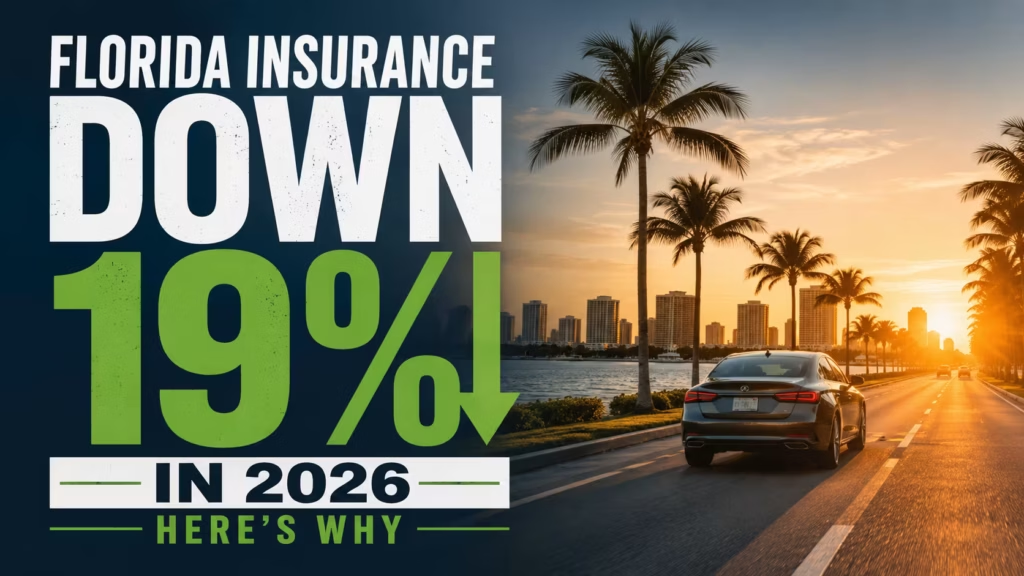
For nearly a decade, Florida has punished its drivers with the highest auto insurance premiums in the continental United States. Average annual full coverage costs hovered around $3,200 — nearly double the national average — while residents of Miami-Dade, Broward, and Palm Beach counties routinely paid upwards of $4,500 for standard policies. The causes were structural, not cyclical: a broken no-fault system, an uninsured motorist rate exceeding 20%, aggressive litigation financing, and hurricane exposure that made comprehensive coverage a nightmare to price.
Key Takeaway: Florida auto insurance premiums dropped 19% year-over-year in 2026, the largest decline of any U.S. state, with a median annual reduction of $353.50. The reversal is driven by improved insurer profitability, moderating claims frequency, stabilized repair costs, and intense legislative pressure including House Bill 769, which proposes repealing the state’s no-fault law entirely. Florida remains the most expensive state for car insurance, but drivers who shop aggressively during this window can capture savings unavailable since 2018.
Then 2026 delivered something the market had stopped expecting: relief. A comprehensive analysis by personal lines broker Freeway Insurance confirmed that Florida posted a 19% year-over-year decrease in average auto insurance premiums — the steepest drop recorded in any state. The median Florida driver is now paying roughly $30 less per month than twelve months ago, with top carrier groups filing for an average 8% rate reduction. For a state where rate increases had become as predictable as afternoon thunderstorms, this reversal is not merely news. It is a structural signal that the market has shifted — and a narrow window of opportunity for drivers who understand how to exploit it.
Navigate This Guide:
- How Much Did Florida Rates Actually Drop?
- Why Florida Was America’s Most Expensive Insurance Market
- What Is Driving the 2026 Rate Decline?
- How Florida’s No-Fault System Shapes Your Premium
- The 2026 Governor’s Race: Three Competing Reform Visions
- How Florida Compares to Other States
- Florida’s Minimum Coverage Requirements
- Which Companies Offer the Cheapest Rates in Florida?
- How Florida Drivers Can Lock In Lower Rates Now
- Frequently Asked Questions
How Much Did Florida Car Insurance Rates Drop in 2026?
The headline figure — 19% — is not a marketing projection. It is a measured year-over-year decline in average monthly premiums across Florida’s personal auto market, derived from rate filings submitted to the Florida Office of Insurance Regulation (OIR) and aggregated policy data. Here is what the numbers actually mean for your wallet:
Premium Decrease
Premium Reduction
Premium Drop
by Top 5 Writers
Coverage Premium
State in the U.S.
Context matters. A 19% decline from $3,200 still leaves Florida roughly $900 above the national average full coverage premium of approximately $2,300. This is not a victory lap for affordability. It is a market correction that creates leverage for informed consumers. The drivers who benefit most are those who refuse to auto-renew and instead treat this shift as a signal to re-shop aggressively.
Mark Friedlander, director of corporate communications at the Insurance Information Institute, notes that while the decline is genuine, “Florida’s auto insurance market remains structurally challenged. Rate decreases reflect improved carrier profitability and competitive pressure, not a resolution of the underlying cost drivers that made Florida expensive in the first place.” Translation: shop now, because the forces that created the crisis are only in remission, not cured.
Why Was Florida the Most Expensive State for Auto Insurance?
To understand why a 19% drop matters, you must first grasp why Florida became a premium graveyard. The state’s auto insurance market did not stumble into high prices by accident. Five structural forces — each reinforcing the others — built a pricing environment that made Florida an outlier even compared to Louisiana, its only rival for the dubious top spot.
What Is Driving Florida’s Auto Insurance Rate Decline in 2026?
A 19% decline does not happen in a vacuum. Five converging factors — some cyclical, some political — have forced Florida carriers to retreat from the rate increases that defined 2022 through 2025:
Improved Insurer Profitability
After years of combined ratios exceeding 105% in Florida personal auto, carriers are finally seeing underwriting profitability improve. The 2024-2025 rate increases — some exceeding 25% — were so aggressive that they outpaced loss cost inflation, creating margin. When carriers achieve target returns, competitive pressure forces them to pass a portion of that margin back to policyholders to retain market share. This is classic insurance cycle behavior, and Florida is currently on the favorable side of the curve.
Intensifying Price Competition
Strong profit margins attract capital. New market entrants and existing carriers with expanded capacity are undercutting incumbents to capture volume. In 2026, Florida’s Office of Insurance Regulation approved rate filings from several carriers seeking to reduce rates to gain market share. This competitive dynamic is most visible in the standard personal auto segment, where direct writers like GEICO and Progressive are engaged in aggressive price wars.
Moderating Claims Frequency
Post-pandemic driving patterns have stabilized. Vehicle miles traveled in Florida have normalized after the 2021-2022 surge, and accident frequency has declined modestly. Telematics adoption — now exceeding 35% of new policies in Florida — has also contributed to safer driving behavior among enrolled drivers, reducing the overall pool’s loss cost.
Stabilization in Repair Cost Inflation
While vehicle repair costs remain elevated due to ADAS complexity, the rate of increase has moderated. Supply chain constraints that drove parts shortages in 2022 and 2023 have largely resolved. Body shop labor rates, while still high, are no longer accelerating at double-digit annual rates. This gives carriers confidence that severity growth will not immediately erase the gains from frequency improvement.
Legislative Pressure Ahead of the 2026 Election
Insurance affordability has become a defining issue in Florida’s 2026 gubernatorial race. With House Bill 769 threatening to repeal the no-fault system entirely, carriers are preemptively moderating rates to avoid becoming a political target. The optics of filing for double-digit increases during an election where candidates are promising 60-70% premium cuts would be catastrophic for industry lobbying efforts. Political risk has become a pricing constraint.
How Does Florida’s No-Fault System Affect Your Premium?
Florida’s no-fault architecture is the single most misunderstood element of the state’s auto insurance market. Drivers see the $10,000 PIP requirement as a minor line item. In reality, it is the structural backbone that supports an ecosystem of fraud, litigation, and inflated medical billing that touches every other coverage component.
Under Florida Statute 627.736, PIP covers 80% of reasonable medical expenses and 60% of lost wages up to the $10,000 limit, regardless of fault. The statute requires carriers to pay claims within 30 days and limits the ability to dispute medical necessity until after payment. This creates a pipeline where fraudulent clinics submit inflated bills, carriers pay under statutory pressure, and the cost is distributed across every policyholder in the state.
Current No-Fault Structure
- Required Coverage: $10,000 PIP per person
- Required Coverage: $10,000 Property Damage Liability (PDL)
- Not Required: Bodily Injury Liability (BIL)
- Claim Path: Driver files against own PIP first
- Litigation Threshold: Severe injury required to sue
- Fraud Exposure: High — staged accidents, phantom clinics
Proposed Tort System (HB 769)
- Eliminated: PIP requirement entirely
- Required Coverage: Bodily Injury Liability (BIL)
- Required Coverage: Property Damage Liability (PDL)
- Claim Path: At-fault driver pays through liability
- Litigation Threshold: Standard negligence rules apply
- Fraud Exposure: Reduced — no PIP pipeline to exploit
In practice, the no-fault repeal would fundamentally alter how Florida drivers shop for coverage. Currently, a driver can legally operate with only PIP and PDL — no bodily injury coverage at all. This leaves accident victims dependent on their own PIP or uninsured motorist coverage. HB 769 would mandate BIL, bringing Florida in line with 48 other states, but would also eliminate the $10,000 PIP charge that currently inflates every base premium. For drivers with employer-provided health insurance, the savings could be substantial, as PIP duplicates coverage they already carry.
How Do the 2026 Governor Candidates Plan to Fix Florida Insurance?
The 2026 Florida gubernatorial election has placed auto insurance affordability at the center of the policy debate. Three leading candidates have proposed radically different approaches, and the outcome will shape the market for the next decade:
Frank Russo (Independent) — The Consumer Bill of Rights
Russo, a 30-year insurance industry veteran, has proposed a Florida Insurance Consumer Bill of Rights that would guarantee transparency in rate-setting, a right to appeal premium increases, and mandatory plain-language policy documents. On auto insurance specifically, Russo targets duplicate mandatory coverages — arguing that drivers with qualifying health insurance should not be forced to carry full PIP benefits. His proposal also strengthens consumer appeal rights for non-renewals, which have become increasingly common as carriers shed unprofitable accounts. Russo’s approach is market-oriented but consumer-protective, seeking to reduce costs through elimination of redundant coverage rather than price controls.
Byron Donalds (Republican) — The Insurer Scorecard
Representative Byron Donalds, the Trump-endorsed frontrunner, has proposed an Insurer Scorecard — a public dashboard combining pricing data with carrier performance metrics including claims approval rates, time-to-payment, and complaint ratios. The theory is that transparency drives competition: if consumers can see which carriers deny claims at higher rates or delay payments, market pressure will force operational improvement and price discipline. Donalds argues that Florida’s problem is not merely high premiums but poor value per premium dollar, and that a scorecard would align carrier incentives with consumer satisfaction. Industry groups have expressed concern that the scorecard could be gamed or oversimplified, but the proposal has gained traction among voters frustrated with claim disputes.
David Jolly (Democrat) — The State Catastrophic Fund
Former congressman David Jolly has proposed the most structurally radical reform: a state catastrophic fund that would remove hurricane and natural disaster exposure from private auto insurance balance sheets entirely. Under Jolly’s plan, private insurers would cover conventional perils — collision, theft, liability — while the state fund would assume hurricane, flood, and storm-related comprehensive losses. Jolly claims this could cut private premiums by 60% to 70%, citing the elimination of catastrophic reserves from carrier pricing models. The Insurance Information Institute has pushed back, citing the National Flood Insurance Program’s $20+ billion federal debt as evidence that government-run catastrophe programs tend toward underpricing and fiscal instability. Jolly counters that Florida’s fund would be pre-funded through a dedicated assessment rather than post-event borrowing, but actuarial skeptics remain.
The divergence between these three visions — market transparency, consumer rights, and state assumption of risk — reflects a broader uncertainty about whether Florida’s insurance crisis can be solved through regulation, competition, or structural reorganization. For drivers, the practical implication is that the regulatory landscape may shift dramatically in 2027, making long-term policy commitments risky and short-term shopping essential.
Get Your 2026 Car Insurance Quotes
Compare Florida auto insurance rates from top U.S. carriers. Lock in your savings while the market is down.
GET YOUR 2026 CAR INSURANCE QUOTESWhich States Are Seeing the Biggest Auto Insurance Rate Drops?
Florida’s 19% decline is the headline, but it is part of a broader national trend toward rate moderation in 2026. According to Freeway Insurance’s comprehensive market analysis, the following states posted the largest year-over-year decreases in average monthly premiums:
Nationally, the trend is clear: the post-pandemic rate surge has peaked. Carriers that filed for emergency increases in 2022 and 2023 are now facing competitive pressure to roll back excess margin. The states benefiting most are those where regulators permitted the largest prior increases — Florida being the extreme example — creating the most room for reversal.
What Are Florida’s Minimum Car Insurance Requirements?
Florida’s current statutory minimums are among the lowest in the nation, which partially explains why so many drivers are underinsured:
- Personal Injury Protection (PIP): $10,000 minimum per person
- Property Damage Liability (PDL): $10,000 minimum per accident
Notably, Florida does not require Bodily Injury Liability (BIL) coverage. This is a critical gap. If you cause an accident that injures another driver and you carry only the state minimum, your PIP covers your own injuries, your PDL covers the other driver’s vehicle damage, but nothing in your policy automatically covers their medical bills. The injured party can sue you personally for damages, and if you lack assets or umbrella coverage, a judgment can follow you for twenty years under Florida law.
Industry professionals — including the Insurance Information Institute and the National Association of Insurance Commissioners — recommend that Florida drivers carry at least 100/300/100 coverage ($100,000 bodily injury per person, $300,000 per accident, $100,000 property damage) plus uninsured motorist coverage matching those limits. In Miami-Dade, Broward, and Palm Beach counties, where jury verdicts routinely exceed $100,000 for moderate injuries, 250/500/100 is increasingly considered the prudent minimum.
Which Companies Offer the Cheapest Car Insurance in Florida in 2026?
Carrier pricing in Florida is hyper-local. A quote that is cheapest in Tampa may be third-cheapest in Jacksonville. That said, 2026 rate filings and market data reveal clear leaders across major driver segments:
The key to capturing these rates is comparison shopping with identical coverage limits. A GEICO quote at 50/100/50 is not comparable to a State Farm quote at 100/300/100. Standardize your request for quotes at 100/300/100 with $500 deductibles, then adjust downward if your risk tolerance and budget allow.
How Can Florida Drivers Lock In Lower Rates Right Now?
The 19% market decline creates a rare buyer’s advantage, but that advantage is perishable. Carriers will not maintain competitive pricing indefinitely, and legislative uncertainty around HB 769 could trigger volatility in 2027. Here is the action plan that insurance professionals are deploying for their own families:
1. Shop Immediately — Do Not Wait for Renewal
Most Florida drivers auto-renew without questioning their declaration page. In a declining market, this is financial malpractice. Your current carrier has no obligation to pass market-wide reductions to your specific policy. The difference between a loyal customer’s renewal premium and a new customer’s acquisition rate can exceed $800 annually. Request quotes from at least four carriers within the next 14 days.
2. Verify Your Renewal Reflects the Market
When your renewal arrives, compare the new premium to your prior term. If the decrease is less than 10%, your carrier is retaining margin at your expense. This is your signal to switch. In 2026, any Florida renewal that is flat or increasing is a red flag requiring immediate shopping.
3. Demand Every Available Discount
Competitive markets expand discount portfolios. Ask specifically about: paid-in-full discounts (typically 5-10%), automatic payment discounts (2-5%), paperless billing (2-3%), defensive driving courses (5-15% for three years), affinity group memberships (2-8%), and telematics enrollment (10-20% for safe drivers). A single overlooked discount can offset a credit-based pricing penalty.
4. Optimize Your Coverage Structure
If you carry health insurance through your employer or the ACA marketplace, you may be over-insured on PIP medical benefits. Consider electing the PIP deductible option — Florida allows up to a $2,000 PIP deductible, which can reduce premiums by 15-25% if you have emergency savings to cover the gap. Also evaluate whether rental reimbursement and roadside assistance are cost-effective; many drivers carry these coverages for years without using them, effectively prepaying for services at a premium.
5. Monitor Legislative Changes Quarterly
HB 769, the gubernatorial election outcome, and potential OIR regulatory shifts could reshape requirements before year-end. Set calendar reminders to re-shop rates every 90 days until the legislative landscape stabilizes. Early movers in shifting markets consistently capture pricing 12-18% below those who wait for renewal notices.
Frequently Asked Questions About Florida’s Auto Insurance Rate Drop
How much did Florida car insurance rates drop in 2026?
Florida auto insurance premiums dropped 19% year-over-year in 2026, representing the largest decline of any U.S. state. The median premium reduction was $353.50 annually, with average monthly premiums falling by more than $30. Despite this decrease, Florida remains the most expensive state for car insurance with average full coverage premiums around $3,200 per year.
Why was Florida the most expensive state for auto insurance before 2026?
Florida consistently ranked as America’s most expensive auto insurance market due to five structural factors: mandatory Personal Injury Protection (PIP) under the no-fault system, an uninsured motorist rate exceeding 20%, widespread litigation abuse and staged accident fraud, severe weather and hurricane exposure driving comprehensive claims, and extreme population density in Miami, Orlando, Tampa, and Jacksonville increasing accident frequency.
What is driving Florida’s auto insurance rate decline in 2026?
Florida’s 2026 rate decline is driven by improved insurer profitability with combined ratios normalizing, increased capital deployment intensifying price competition, moderating claims frequency, stabilization in vehicle repair cost inflation, and intense legislative pressure ahead of the 2026 gubernatorial election. House Bill 769, which proposes repealing Florida’s no-fault law entirely, has created additional downward pressure on rates as carriers anticipate structural reform.
How does Florida’s no-fault system affect car insurance premiums?
Florida’s no-fault system requires every driver to carry $10,000 in Personal Injury Protection (PIP), which covers their own medical expenses regardless of fault. While designed to reduce litigation, PIP has become a primary cost driver due to fraudulent medical billing, staged accidents, and excessive utilization. House Bill 769 proposes repealing the no-fault law and shifting Florida to a tort-based system, which could eliminate mandatory PIP and reduce base premiums significantly.
How can Florida drivers lock in lower car insurance rates right now?
Florida drivers should shop for quotes immediately, as the 19% market-wide decline creates a rare buyer’s advantage. Request new discounts from current carriers, verify that renewal notices reflect the market decrease, review coverage limits to ensure they match current needs, and compare at least three quotes from carriers like GEICO, Progressive, State Farm, and USAA. Drivers should also monitor HB 769 and other legislative changes that could unlock additional savings through coverage restructuring.
Which companies offer the cheapest car insurance in Florida in 2026?
Based on 2026 rate filings and market data, GEICO offers the most competitive rates for the majority of Florida drivers. USAA provides the lowest premiums for military families and veterans. Progressive excels for high-risk drivers with prior violations or accidents. State Farm delivers strong value for drivers who bundle auto with homeowners or renters insurance. Rates vary significantly by ZIP code, age, and driving record, so comparison shopping remains essential.
What happens if Florida repeals the no-fault law?
If House Bill 769 passes and Florida repeals its no-fault law, drivers would no longer be required to carry $10,000 in PIP coverage. The state would shift to a tort-based system where at-fault drivers are responsible for bodily injury damages through liability coverage. This would likely require Florida to mandate bodily injury liability coverage for the first time. Premiums could decrease for drivers who currently over-utilize PIP, but rates for at-fault drivers could rise due to increased exposure to bodily injury lawsuits.
Is now the best time to shop for car insurance in Florida?
Yes. The convergence of a 19% market-wide decline, intensifying carrier competition, and pre-election pricing discipline has created the most favorable shopping environment in Florida since 2018. Drivers who shop now can capture rates that may not be available once legislative uncertainty resolves and carriers recalibrate their models. Waiting for renewal is likely to cost money; proactive shopping is likely to save it.
The Window Is Open, But It Will Not Stay Open Forever
Florida’s 19% rate decline is real, measurable, and historically significant. It is also fragile. The structural forces that made Florida expensive — PIP fraud, litigation financing, hurricane exposure, and uninsured motorists — have not been resolved. They have merely been temporarily offset by improved carrier profitability, competitive pressure, and political caution.
For Florida drivers, this creates a tactical opportunity. The carriers are fighting for market share. The regulators are sensitive to election-year optics. The market is softening. But insurance cycles turn quickly. A major hurricane, a court ruling expanding bad faith liability, or a legislative stalemate on HB 769 could reverse the trend within a single filing season.
The drivers who benefit permanently from this decline will be those who shop aggressively now, lock in multi-year terms where available, optimize their coverage structures, and maintain the discipline to re-shop quarterly until the regulatory landscape stabilizes. Passivity is expensive in Florida. In 2026, for the first time in years, action is profitable.
Sources: Insurance Information Institute (Triple-I), Florida Office of Insurance Regulation (OIR), Florida Senate — House Bill 769, National Association of Insurance Commissioners (NAIC), Florida Department of Highway Safety and Motor Vehicles, American Tort Reform Association, Insurance Research Council, Freeway Insurance Auto Insurance Market Report (July 2026), Carrier Management, Dynamic Insurance Solutions, Insurance Business Magazine.