
New York drivers have been paying a fraud and litigation tax for decades. The average Empire State premium runs 32% above the national average, with many policyholders shelling out north of $4,000 annually for standard full coverage. While drivers in Ohio or Virginia complain about $1,200 bills, New Yorkers in the Bronx, Brooklyn, and parts of Long Island routinely face renewal notices that look more like mortgage payments.
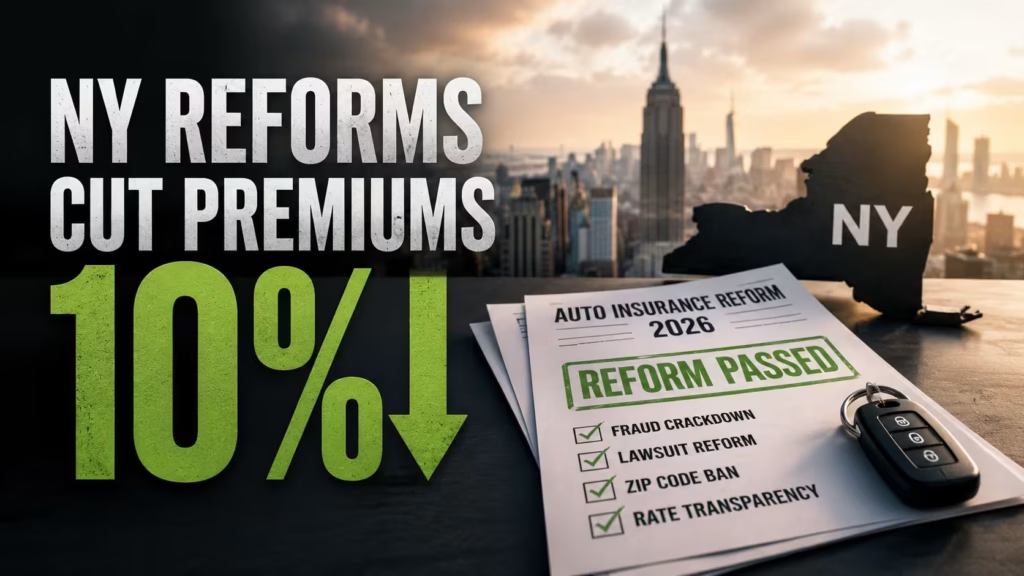
That dynamic shifted on May 27, 2026, when Governor Kathy Hochul signed the most consequential auto insurance reform package in a generation. Embedded in the state’s $268.5 billion FY2027 budget, these changes repeal the litigation-friendly 90/180 rule, criminalize staged-accident orchestration, cap pain-and-suffering awards for drivers committing crimes, ban ZIP-code-based pricing, and eliminate flex rating that let carriers hike rates without regulatory scrutiny. The Citizens Budget Commission projects a 10% premium reduction statewide—roughly $200 to $300 per policyholder—if insurers pass through the full savings.
Key Takeaway: New York’s 2026 auto insurance reforms repeal the 90/180 serious injury threshold, cap non-economic damages at $100,000 for uninsured and impaired drivers, ban ZIP-code rating, and eliminate flex rating for increases. The Citizens Budget Commission projects 10% premium reductions. Savings will phase in as insurers refile rates by August 31, 2026. Drivers should shop quotes between September and December 2026 when reform-adjusted pricing first hits the market.
In practice, this is not a single bill with a single effective date. It is a structural recalibration of how claims are litigated, how rates are approved, and how carriers are allowed to segment risk. If you are a New York driver—whether you commute from Westchester, rideshare in Manhattan, or run a delivery route on Long Island—understanding the mechanics of these reforms determines whether you capture the savings or watch your carrier pocket them as margin recovery.
Navigate This Guide:
- Why New York Auto Insurance Costs 32% More Than the National Average
- The 8 Reforms Changing New York Auto Insurance in 2026
- How Much Will You Actually Save?
- Which Insurers Offer the Cheapest Rates in NY (2026)
- New York’s Minimum Coverage Requirements
- What Trial Lawyers and Consumer Groups Are Saying
- Your Action Plan: What to Do Before Your Next Renewal
- Frequently Asked Questions
Why Does New York Auto Insurance Cost So Much More Than Everywhere Else?
The premium gap is not accidental. It is the product of five structural forces that have compounded over two decades, creating a market where insurers lose money on liability lines even while charging the highest rates in the continental United States.
The Fraud Ecosystem
Staged accidents in New York are not random crimes. They are organized enterprises. Unscrupulous attorneys recruit participants, direct them to specific intersections known for low-speed collisions, and steer them to medical providers who bill PIP at inflated rates. Governor Hochul described it publicly as a “whole racket where you get lawyers, unscrupulous lawyers, who are finding individuals to play the victim, who literally cause a car accident or collision with an MTA bus or another vehicle or a delivery truck.” The NICB and NYDFS have documented rings operating in Queens, Brooklyn, and the Bronx that generate millions in fraudulent PIP claims annually.
Previously, prosecutors could only charge the driver behind the wheel. The orchestrator—the lawyer or recruiter who organized the scheme—walked away. That changes under the 2026 reforms.
Runaway Litigation and the Judicial Hellhole Dynamic
New York’s no-fault system was designed to reduce litigation by guaranteeing $50,000 in medical coverage regardless of fault. Instead, it created a parallel litigation economy. Because drivers who meet the “serious injury” threshold can sue for pain and suffering on top of PIP, plaintiff attorneys have every incentive to push marginal claims across that threshold. The 90/180 rule—allowing recovery based on temporary activity limitations—became the on-ramp.
In 2023, New York auto insurers lost 17% on liability claims after expenses, according to the Citizens Budget Commission. Those losses do not disappear; they are priced into the next cycle of premiums. Mike Zwas, president of The Insurance Marketplace, put it directly: “In New York, one of our key drivers is fraud and litigation issues, frivolous litigation, lawsuit abuse. And those are unique to New York state. We’re an outlier compared to most other states.”
The Highest PIP Minimum in America
New York mandates $50,000 in Personal Injury Protection—the highest floor in the nation. Florida requires $10,000. New Jersey requires $15,000. Massachusetts requires $8,000. That $50,000 floor means every policy carries a substantial medical component before liability coverage even enters the equation. When fraudulent providers bill against that $50,000 pool aggressively, the cost spreads across every policyholder in the state.
Repair Cost Geography
New York ranks third nationally in average repair costs per insurance claim. Labor rates at New York City body shops routinely exceed $100 per hour. OEM parts for European and Asian imports—disproportionately common in the metro area—carry premium pricing. ADAS recalibration after windshield replacement adds $300-$600 per incident. These are not theoretical costs; they are embedded in every comprehensive and collision premium written in the state.
Weather and Density
Nor’easters, tropical storm remnants, and freeze-thaw cycles create pothole damage, flooding, and multi-car pileups that drive physical damage frequency. Urban density in the five boroughs and surrounding counties produces higher accident frequency per mile driven than rural or suburban markets. Insurers price territory aggressively, and until the 2026 reforms, ZIP code was one of the heaviest weights in the rating algorithm.
The 8 Reforms Reshaping New York Auto Insurance
The FY2027 budget agreement, reached after weeks of negotiation past the April 1 deadline, contains eight specific insurance provisions. Each targets a different cost driver. Together, they represent the most significant statutory overhaul since New York adopted no-fault in the 1970s.
How Much Will New York Drivers Actually Save?
The Citizens Budget Commission, a nonpartisan fiscal watchdog, modeled the reform package and concluded that New York drivers should see premiums fall by approximately 10%. For a policyholder currently paying $2,400 annually, that is $240 back in their pocket. For someone paying $4,000—common in the five boroughs and Nassau County—the savings approach $400.
Tom Stebbins, executive director of the Lawsuit Reform Alliance of New York State, estimated the per-policyholder reduction at $200 to $300 annually. These are not marginal numbers in a state where rates climbed over 50% between 2021 and 2025.
However, the timing matters. The New York State Department of Financial Services issued guidance requiring insurers to incorporate anticipated reform savings into all pending and future rate filings by August 31, 2026. Carriers with filings already in the pipeline must amend them. Carriers preparing new filings must build the reform impact into their loss-cost trends and rate-level indications.
In practice, this means:
- If your renewal is before September 2026, you are likely still on pre-reform pricing.
- If your renewal falls between September and December 2026, you are shopping at the optimal moment when reform-adjusted rates first enter the market.
- If your renewal is in 2027, you should see the full 10% reduction baked into your carrier’s approved rate level—assuming the carrier passes through the savings rather than retaining them as profit recovery.
Which Car Insurance Companies Are Cheapest in New York (2026)?
With ZIP code no longer a primary rating factor, the competitive landscape is shifting. Carriers that previously priced aggressively in suburban markets while retreating from urban ZIP codes must now rebalance their algorithms. The carriers below currently offer the most competitive rates for a 30-year-old male driver with a clean record and standard coverage limits, based on 2026 quoting data:
Source: SoFi/Quadrant Information Services, 2026. Rates reflect a 30-year-old male driver with a clean MVR, driving a 2022 Honda Accord, with New York minimum plus $100k/$300k bodily injury liability and $50k property damage.
What Are New York’s Minimum Auto Insurance Requirements?
New York’s statutory minimums are among the highest in the nation. You cannot register a vehicle without proof of the following coverage:
These are floors, not recommendations. If you own a home, have significant savings, or operate a business, minimum limits leave you exposed to personal liability beyond what your policy pays. An umbrella policy layered over adequate primary limits is the standard risk-management approach for middle-income and affluent New Yorkers.
Get Your 2026 Car Insurance Quotes
Compare rates from top New York carriers and lock in reform-adjusted pricing before your next renewal.
GET YOUR 2026 CAR INSURANCE QUOTESWhat Trial Lawyers and Consumer Advocates Are Saying Against the Reforms
No major insurance reform passes without opposition, and Hochul’s package faced fierce resistance from the New York State Trial Lawyers Association (NYSTLA) and consumer groups like Citizens Action. Understanding their objections is critical because it reveals where the reforms might fall short of promised savings—and where litigation will simply shift to new theories.
Andrew Finkelstein, president of NYSTLA, framed the fight as a wealth transfer: “Insurance profits must not come at the expense of justice, accountability, or the rights of injured New Yorkers.” The trial bar’s core argument is that capping damages and raising the serious injury threshold does not lower rates; it simply reduces what injured people recover. If insurers keep the savings as profit rather than passing them through, drivers see no benefit while crash victims bear the cost.
Citizens Action cited a Weiss Ratings study finding that large auto insurers in New York “closed nearly half of liability claims in 2025 without paying a dime to policyholders.” The same report noted that since 2015, major carriers generated $42.3 billion in investment and other income, exceeding their $27.9 billion in net underwriting gains. The implication: insurers are not struggling; they are simply reluctant to pay claims.
There is merit to both sides. In practice, insurance markets do not operate on pure charity. If carriers face lower loss costs from reduced litigation and fraud, competitive pressure should force some pass-through. But in a concentrated market where six carriers dominate, oligopolistic pricing behavior can delay or dilute savings. The excess-profit provision is Hochul’s answer to this concern, but as noted earlier, its three-year lookback creates a lag.
What this means for you: do not wait for your carrier to lower your bill out of goodwill. The reform savings are real, but they will flow to drivers who shop, compare, and force carriers to compete on price. Passive renewal is the single most expensive mistake you can make in 2026.
Your 2026 Action Plan: Capture the Savings Before Your Carrier Does
The following steps are not generic advice. They are the specific actions that licensed brokers and underwriters in the New York market recommend to clients who want to lock in reform-adjusted pricing:
1. Request a Written Premium Explanation Now
Under Reform 6, your carrier must explain any increase over 10% and respond to explanation requests within 20 days. If your renewal jumped 15% or more, send a written request asking for the specific rating factors driving the increase. Check whether ZIP code, occupation, education, or homeownership status were used. If they were, you may have grounds to challenge the filing or at least negotiate.
2. Shop Five Quotes Between September and December 2026
The DFS amendment deadline is August 31, 2026. Carriers that move fastest to adopt reform-adjusted pricing will have competitive advantages in Q4. Progressive, GEICO, and NYCM have publicly signaled they are recalibrating algorithms. Obtain quotes from at least five carriers, including one regional option (NYCM or Erie) and one direct writer (Progressive or GEICO). The pricing dispersion in New York routinely exceeds $1,500 for identical risk profiles.
3. Verify Your Liability Limits Post-Reform
The modified comparative negligence rule changes your exposure. If you previously carried minimum limits because you assumed any judgment would be reduced proportionally, that assumption no longer holds in the same way. A 40%-at-fault defendant can now be hit with 100% of non-economic damages if the plaintiff is barred from recovery. Higher primary limits—and an umbrella policy—are more important than ever.
4. Document Every Discount Eligibility
With ZIP code removed, carriers will lean harder on driving behavior, vehicle safety features, and mileage. Pull your New York DMV driving record. Compile documentation of anti-theft devices, ADAS features (AEB, lane-keeping, blind-spot monitoring), and garage parking. If you drive fewer than 7,500 miles annually, ask about low-mileage discounts. These factors will carry more weight in 2027 filings than they did in 2025.
5. Time Your Shopping to the Amendment Cycle
If your renewal is January 2027, start shopping in October 2026. If your renewal is April 2027, start in January. Early shopping gives underwriters time to assess your risk properly and offer competitive terms. Last-minute shopping forces you into whatever rate is available, which is almost never the best rate.
Frequently Asked Questions About New York’s 2026 Auto Insurance Reforms
How much will New York auto insurance decrease in 2026?
The Citizens Budget Commission projects that New York’s 2026 auto insurance reforms will reduce premiums by approximately 10%, translating to roughly $200-$300 in annual savings per driver. However, savings will not appear immediately. The New York State Department of Financial Services requires insurers to incorporate anticipated reform savings into all pending and future rate filings, with amendments due by August 31, 2026. Drivers should see gradual reductions as carriers refile rates under the new regulatory framework.
What is the 90/180 rule and why was it repealed?
The 90/180 rule previously allowed New York drivers to meet the serious injury threshold for suing beyond no-fault benefits simply by proving they were unable to perform daily activities for 90 out of 180 days after an accident. The 2026 reforms repealed this provision because it created a litigation loophole where plaintiffs with minor or temporary injuries could recover pain and suffering damages. Now, claimants must provide objective evidence of serious injury, reserving non-economic damages for those with demonstrably severe and permanent conditions.
Can insurers still use my ZIP code to set car insurance rates in New York?
No. Beginning with the 2026 reforms, New York prohibits auto insurers from using ZIP code, homeownership status, occupation, or education level as the primary basis for setting personal auto insurance rates. There are limited exceptions for business-use classification, mass marketing programs, and approved discounts. This change is significant because previously, drivers in high-claim neighborhoods like the Bronx or Brooklyn paid substantially more than identical drivers in suburban or rural ZIP codes purely based on geography.
What happens to uninsured or drunk drivers under the new damage cap?
Under New York’s 2026 reforms, drivers who are uninsured, impaired by drugs or alcohol, or committing a felony at the time of an accident face a $100,000 cap on non-economic damages (pain and suffering). They may still receive no-fault PIP benefits for medical expenses, but their ability to recover large pain and suffering awards is now limited. This prevents drivers who break the law from receiving outsized financial recoveries at the expense of law-abiding policyholders whose premiums fund those settlements.
How does modified comparative negligence work in New York after 2026?
New York replaced pure comparative negligence with a modified comparative negligence standard. Under the new rule, a claimant is barred from recovering non-economic damages (pain and suffering) if their share of fault exceeds the combined fault of all defendants. For example, if a plaintiff is found 60% at fault and the defendant 40% at fault, the plaintiff cannot recover pain and suffering damages, though they still receive no-fault PIP benefits. This aligns New York with most other states and reduces incentives for plaintiffs to pursue marginal liability claims.
Which car insurance companies are cheapest in New York in 2026?
Based on 2026 rate data for a 30-year-old male driver with a clean record, the cheapest car insurance companies in New York are: Progressive at approximately $1,323 annually ($110/month), GEICO at $1,881 annually ($157/month), USAA at $2,067 annually ($172/month) for eligible military members and families, NYCM at $2,538 annually ($212/month), Erie Insurance at $3,001 annually ($250/month), and State Farm at $3,048 annually ($254/month). Actual rates vary significantly by driving record, vehicle, coverage limits, and now—under the 2026 reforms—factors other than ZIP code.
What are New York’s minimum auto insurance requirements?
New York mandates the following minimum auto insurance coverage: Bodily Injury Liability of $25,000 per person and $50,000 per accident; Property Damage Liability of $10,000; Personal Injury Protection (PIP) of $50,000 minimum—the highest PIP requirement in the nation; and Uninsured Motorist coverage of $25,000 per person and $50,000 per accident. These minimums are among the highest in the country and contribute to New York’s premium levels. Drivers with assets to protect should carry limits well above these statutory minimums.
When do New York insurers need approval for rate increases?
Under the 2026 reforms, New York eliminated “flex rating” for personal auto insurance increases. Insurers can no longer implement rate hikes without prior regulatory approval. Rate decreases of up to 5% may still proceed without prior approval. Additionally, insurers must provide policyholders with clear explanations for any auto or home premium increase exceeding 10%, including the dollar amount and primary rating factors driving the increase. Policyholders have the right to request an explanation for any increase, and insurers must respond within 20 days.
Will the reforms actually lower rates, or will insurers keep the savings?
The reforms include an excess-profit provision requiring carriers to return underwriting gains exceeding 5% of earned premiums over a three-year period. Florida implemented a similar law, and Progressive returned nearly $1 billion to Florida policyholders last year. However, the three-year lookback creates a lag. Competitive pressure and regulatory scrutiny should force most savings through to policyholders, but drivers who shop aggressively and compare multiple quotes will capture the benefits faster than those who auto-renew.
The Reforms Are Real. Your Savings Depend on What You Do Next.
New York’s auto insurance market has been broken for a long time. Drivers paid the highest premiums in the continental United States while insurers lost money on liability claims and staged-accident rings operated with near-impunity. The 2026 reforms do not fix every problem—joint and several liability remains untouched, PIP minimums stay at $50,000, and repair costs in the five boroughs are not going down—but they remove the most abusive litigation and pricing practices that inflated premiums year after year.
The 10% projected savings are achievable, but they are not automatic. Carriers will not hand them over willingly. The excess-profit clawback has a three-year lag. Flex rating is gone, but that only means carriers must ask permission to raise rates; it does not force them to lower existing ones. The drivers who benefit most will be those who treat this moment as an active shopping opportunity, not a passive windfall.
If your renewal falls between September 2026 and March 2027, you are in the sweet spot. Request your premium explanation. Pull your DMV record. Document your vehicle safety features. Quote five carriers. And do not accept the first number you see. In a market this expensive, even a 10% reduction is worth fighting for.
Sources: New York State Department of Financial Services (NYDFS), Office of Governor Kathy Hochul, Citizens Budget Commission, Insurance Journal, Insurance Information Institute (Triple-I), National Insurance Crime Bureau (NICB), American Property Casualty Insurance Association (APCIA), New York State Trial Lawyers Association, Weiss Ratings, SoFi/Quadrant Information Services.