
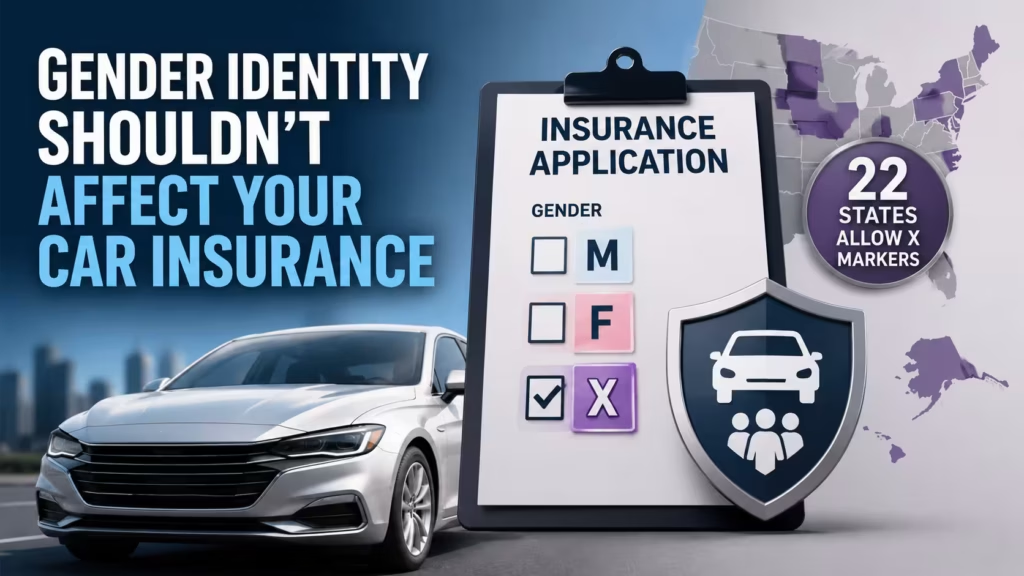
For decades, car insurance companies have treated gender as a crystal ball. Young male drivers have historically paid the steepest premiums in America because actuarial tables link gender to accident frequency — especially for drivers under 25. But in 2026, that long-standing practice is facing its most serious legal and cultural challenge yet. Twenty-two states now allow an “X” gender marker on state IDs and driver’s licenses, representing 44% of the country and forcing insurers to rewrite rules they have relied on for generations.
Quick Answer: Gender still legally affects car insurance rates in 43 U.S. states. A 17-year-old male pays an average of $9,607 per year versus $8,583 for a 17-year-old female — a gap of over $1,000 annually. However, seven states have banned gender-based pricing entirely, and 22 states now issue non-binary “X” markers. If you are non-binary, transgender, or simply questioning whether your insurer is charging a fair rate, your most profitable move is to verify your state’s laws, update your license marker if eligible, and force your insurer to disclose exactly which gender rate they are applying. In gender-neutral states, you could save hundreds simply by living in the right ZIP code.
This guide breaks down exactly how gender identity interacts with auto insurance pricing in 2026, which states protect you from gender-based surcharges, and what practical steps non-binary and transgender drivers can take to lock in the best possible premium — regardless of how an insurer views gender.
📑 Navigate This Guide:
- How Gender Shapes Your Premium (2026 Data)
- The 7 States That Banned Gender-Based Pricing
- What the ‘X’ Gender Marker Means for Insurance
- Is It Legal to Charge Different Rates by Gender?
- How Much More Do Young Male Drivers Pay?
- Can I Change My Gender on My Insurance Policy?
- What If My Insurer Refuses to Honor My ‘X’ Marker?
- Real U.S. Scenarios: How Drivers Navigate the System
- The Future of Gender in Auto Insurance
- Your 4-Step Action Plan
- Frequently Asked Questions
How Gender Shapes Your Car Insurance Premium in 2026
Insurance actuaries have used gender as a proxy for risk since the 1960s. The logic is simple: statistically, young men file more high-dollar claims than young women. But the gap narrows with age and widens dramatically for teen drivers. Here is what the 2026 national data looks like, compiled from Experian and industry quoting platforms:
At the national average level, the gender gap appears modest — just $34 per year. But peel back the layer for young drivers and the picture changes drastically. A 16-year-old male pays an average of $752 per month, compared to just $187 for a 60-year-old female. That is a 300% cost explosion driven primarily by age, but gender acts as a multiplier on top of it.
Insurers defend the practice by citing NAIC loss data showing males under 25 are involved in fatal crashes at nearly three times the rate of females the same age. Consumer advocates counter that the practice is discriminatory, particularly as gender identity becomes more fluid and state-issued IDs evolve to reflect that reality.
The 7 States That Banned Gender-Based Car Insurance Pricing
If you live in one of the following states, your gender — whether male, female, or X — cannot legally be used to set your premium. These states have determined that gender is not a fair or necessary predictor of driving risk when other factors (driving record, mileage, credit history) are already accounted for:
Oregon operates as a unique hybrid. Gender-based pricing is still technically permitted, but state law requires insurers to provide rates to any driver who selects the gender-neutral “X” option on their Oregon driver’s license. This creates a de facto gender-neutral option without an outright ban.
Get Your 2026 Car Insurance Quotes
See exactly how much you can save by comparing gender-neutral and traditional policies side by side. No email required.
GET YOUR 2026 CAR INSURANCE QUOTESWhat the ‘X’ Gender Marker Means for Your Auto Insurance
As of mid-2026, 22 states and Washington D.C. allow residents to select “X” as a gender marker on driver’s licenses and state-issued IDs. This represents 44% of the U.S. population and marks a seismic shift in how government documentation reflects identity — which directly impacts insurance, banking, and healthcare systems built on binary data fields.
For auto insurance specifically, the “X” marker creates a rating ambiguity that many insurers are unprepared to handle. Legacy underwriting systems were built decades ago with only “M” and “F” fields. When a driver presents an “X” marker, carriers face three possible responses:
- Default to the higher-risk male rate — the most common fallback for outdated systems, which can unfairly inflate premiums.
- Default to the lower-risk female rate — a rare but documented practice among smaller regional carriers.
- Create a unisex “X” tier — the most equitable approach, adopted by forward-thinking insurtechs and carriers with modern policy administration systems.
The Insurance Information Institute (Triple-I) has noted that state policies are changing rapidly and vary widely by jurisdiction. Some insurers are proactively updating their systems; others are waiting for regulatory mandates. As a consumer, your leverage is your ability to switch carriers.
Is It Legal for Insurance Companies to Charge Different Rates Based on Gender?
Yes — in 43 states, it remains perfectly legal. The National Association of Insurance Commissioners (NAIC) allows states to set their own rating factor rules, and the vast majority have not prohibited gender. Insurers argue that actuarial data supports the practice, particularly for drivers under 25. Critics argue that it amounts to discrimination by demographic proxy.
The legal landscape is shifting, however. Delaware recently passed legislation prohibiting the use of gender, gender identity, or sex as a rating factor in personal automobile insurance policies. Illinois has introduced the “Motor Vehicle Insurance Fairness Act,” which would add the state to the growing list of gender-neutral jurisdictions. If you believe your state should join the seven that have already banned the practice, contact your state representative and reference the NAIC’s ongoing review of non-discriminatory rating standards.
How Much More Do Young Male Drivers Really Pay?
The numbers are stark. For a 17-year-old driver with a clean record, the average annual premium breaks down as follows:
This is not merely a gender gap — it is an age-gender intersection. By age 30, the premium difference between men and women narrows to roughly $5–$15 per month nationally. By age 50, it often disappears entirely. The gender surcharge is therefore a youth tax on male drivers, one that some states have decided is unjustified in an era of telematics and behavior-based pricing.
Can I Change My Gender on My Car Insurance Policy?
Yes, but the process varies by carrier and state. Here is the standard pathway:
- Update your government-issued ID first. Visit your state’s DMV with the required documentation. As of 2026, 22 states allow self-attestation for “X” markers, meaning no medical documentation is required.
- Contact your insurance company or agent. Provide a copy of your updated license and request a policy update. Ask for written confirmation of your new rate.
- Compare the new quote to your old one. If the rate increases unfairly (for example, your insurer defaults to a high-risk male tier despite your clean record), request a review or switch carriers.
- File a complaint if necessary. If you believe an insurer is discriminating against your gender identity, file a formal complaint with your state’s Department of Insurance. Most states now include gender identity in their anti-discrimination consumer protection frameworks.
What If My Insurer Refuses to Honor My ‘X’ Marker?
This is the reality for many non-binary drivers in 2026. Some legacy carriers still operate on binary systems that cannot process an “X” marker, forcing agents to select “M” or “F” arbitrarily. If this happens to you:
- Document everything. Save emails, record call dates, and keep notes of what the agent told you.
- Ask for a supervisor. Front-line agents may not have authority to override system limitations. Escalate to a manager who can request a manual underwriting review.
- Shop modern carriers. Insurtech companies like Root, Lemonade, and newer digital divisions of legacy carriers (Progressive Online, GEICO Digital) typically have updated systems that accept non-binary markers without issue.
- Report the incident. Even if you switch carriers, reporting the refusal helps state regulators identify which companies are lagging on compliance.
Real U.S. Scenarios: How Non-Binary and Transgender Drivers Navigate Rates
Understanding the law is one thing. Seeing how it plays out in real American lives is where true information gain happens. Here are four common scenarios in 2026:
The Future of Gender Identity in Auto Insurance Pricing
The trend is unmistakable: gender is becoming a less relevant rating factor. Even in states that have not banned it, the rise of usage-based insurance (UBI) and telematics is making actual driving behavior more predictive than demographic assumptions. A 19-year-old male who brakes gently, avoids late-night driving, and covers fewer than 8,000 miles per year can now secure a lower rate than a 40-year-old female with a history of speeding tickets — if the insurer uses telematics.
Legislatively, the momentum is accelerating:
- Delaware passed a comprehensive bill in 2026 prohibiting gender, gender identity, and sex as rating factors.
- Illinois introduced the Motor Vehicle Insurance Fairness Act, which would ban gender-based pricing and require insurers to justify all rate factors with actuarial data.
- Consumer Federation of America and LGBTQ+ advocacy groups are lobbying the NAIC to adopt a model law discouraging gender as a rating factor nationwide.
Meanwhile, a California court recently upheld a policy allowing insurers to charge unmarried drivers more than married drivers — a reminder that the fight over which personal characteristics are “fair” to use in pricing is far from settled. Marriage status, education level, and homeownership remain contentious rating factors alongside gender.
Your 4-Step Action Plan to Lock in the Best Rate
- Verify your state’s gender rating laws. If you live in CA, HI, MA, MI, MT, NC, or PA, your rate is already gender-neutral. If not, gender may still be silently inflating your bill.
- Update your driver’s license gender marker if eligible. Twenty-two states now allow “X.” Even if you identify as male or female, ensuring your state ID matches your identity prevents administrative errors that can delay claims or trigger audits.
- Request explicit written confirmation of your gender rating. Call your insurer and ask: “Which gender rate is applied to my policy, and how do you handle ‘X’ markers?” If the answer is evasive, escalate or switch.
- Compare at least three quotes — including a telematics option. Behavior-based pricing is the great equalizer. A safe driving score can override any demographic surcharge and save you 20–40% regardless of gender identity.
Get Your 2026 Car Insurance Quotes
Lock in gender-fair rates today. Compare traditional, telematics, and pay-per-mile policies from top U.S. insurers in one step.
GET YOUR 2026 CAR INSURANCE QUOTESFrequently Asked Questions About Gender Identity and Car Insurance
Does gender identity affect car insurance rates in 2026?
Yes, in 43 states gender remains a legal rating factor. Nationally, women pay an average of $2,258 annually while men pay $2,292 — but for teen drivers, the gap exceeds $1,000 per year. Seven states have banned gender-based pricing entirely, and 22 states now allow “X” markers, which is pressuring the industry toward neutrality.
Which states ban gender-based car insurance pricing?
California, Hawaii, Massachusetts, Michigan, Montana, North Carolina, and Pennsylvania prohibit insurers from using gender to set auto insurance rates. Oregon requires insurers to honor “X” markers without banning gender pricing outright. Additional states are considering legislation in 2026.
How do I change my gender marker for insurance purposes?
First, update your driver’s license at your state DMV. Then contact your insurance company with a copy of your updated ID and request a policy revision. Ask for written confirmation of your new rate. If your insurer’s system cannot process an “X” marker, shop for a carrier with modern digital underwriting.
Will an ‘X’ gender marker raise or lower my car insurance premium?
It depends on your state and insurer. In gender-neutral states, there is no impact. In other states, some carriers default to higher male rates, others create a unisex tier, and a few may apply lower female rates. The only way to know is to request a personalized quote after updating your license and compare multiple carriers.
Do transgender drivers pay more for car insurance?
Not inherently. A transgender woman updating from “M” to “F” in a state that allows gender pricing may see lower rates, particularly if under 25. A transgender man may see a slight increase. In the seven states with bans, transition has no direct premium impact. The dominant factors remain driving history, credit, mileage, and vehicle safety features.
Your Identity Should Not Cost You at the Checkout
In 2026, car insurance is caught between actuarial tradition and social progress. Gender has been a rating factor for over half a century, but the data is clear: it is becoming less relevant as behavior-based pricing, state legislation, and consumer advocacy reshape the market. Whether you are non-binary, transgender, cisgender, or simply a driver who believes rates should reflect actual risk — not demographic assumptions — your power lies in information and comparison.
The seven states that have banned gender-based pricing prove that a fair market is possible. The 22 states with “X” markers prove that identity is evolving faster than insurance code. Your job is to exploit that gap: update your documents, demand transparency from your insurer, and never auto-renew without comparing three quotes. The savings are real. The fairness is overdue. And the quote you need is one click away.
Sources: Insurance Information Institute (Triple-I), National Association of Insurance Commissioners (NAIC), NAIC Consumer Resources, Experian Auto Insurance Data 2026, Delaware State Legislature, Illinois General Assembly, Consumer Federation of America, State DMV Policy Trackers, Forbes Advisor Auto Insurance Analysis, The Zebra Insurance Comparison Engine.