
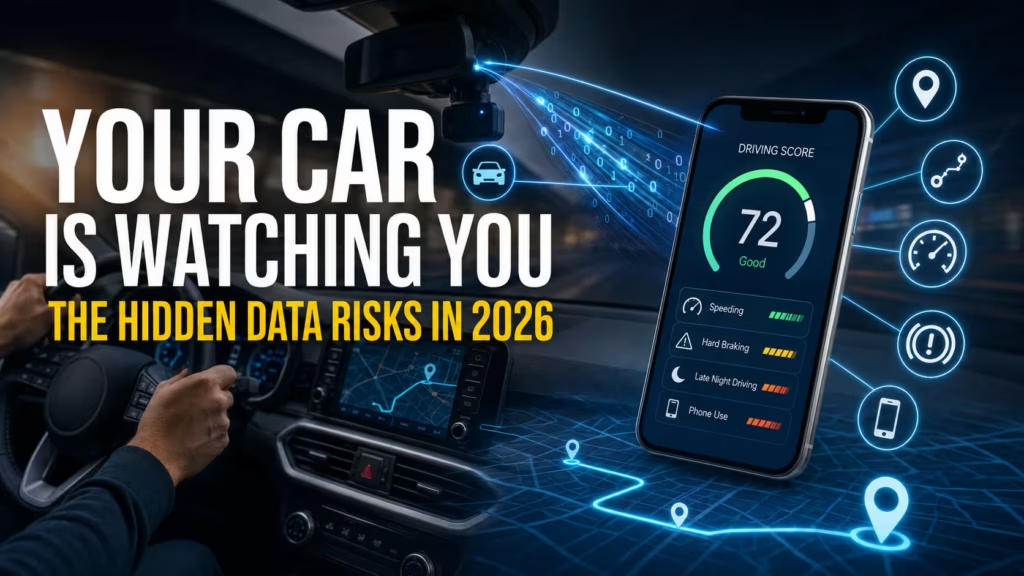
Your car knows where you sleep, where you work, and whether you brake too hard on Tuesday nights. In 2026, over 60 million American vehicles are transmitting this data to insurance companies through telematics programs like Progressive Snapshot, State Farm Drive Safe & Save, and Allstate Drivewise. Most drivers signed up for the discount — typically 15-25% off — without reading the fine print. That fine print is now costing people claims, privacy, and in some cases, personal safety.
Quick Answer: Telematics insurance collects real-time speed, GPS location, braking events, phone usage, and trip times. In 2026, this data is increasingly used to deny claims, assign fault in lawsuits, and profile drivers for “surveillance pricing.” The single most important protective step is to request your complete telematics data disclosure from your insurer and compare it against a traditional non-UBI quote before your next renewal. If the savings gap is under $200 per year, the privacy trade-off is likely not worth the risk. Additionally, drivers in California, Florida, and high-litigation states face the highest exposure because telematics data is treated as admissible evidence in court.
This guide breaks down exactly what your insurer is collecting, how that data can be weaponized against you, which states offer legal protections, and the emerging cyber threat of hacked connected vehicles. If you are enrolled in any usage-based insurance program — or thinking about it — read this before your next drive.
Explore Every Data Risk Hiding in Your Telematics Policy:
- 1. What Data Your Car Is Actually Collecting
- 2. How Insurers Use (and Share) Your Driving Data
- 3. Telematics Data as a Witness in Court
- 4. State-by-State: Where Your Data Is Most at Risk
- 5. The Cyber Risk: When Hackers Target Your Car
- 6. California AB 311 & The 2026 Regulatory Battle
- 7. How to Protect Yourself: A 5-Step Data Defense Plan
- 8. Is Telematics Still Worth It? The Honest Math
- Frequently Asked Questions
1. What Data Your Car Is Actually Collecting
Most drivers believe telematics only tracks mileage. That was true in 2015. In 2026, the data harvest is far more invasive — and most policyholders have no idea how deep it goes. According to the 2026 J.D. Power U.S. Auto Insurance Study, only 58% of customers say they completely understand their auto policy and what data it collects — down 4 percentage points from the prior year.
“That data is used to calculate premiums, assign fault in accidents, and, in some cases, deny claims outright,” warns Yosi Yahoudai, co-founder of J&Y Law, a Los Angeles-based personal injury firm. The device in your car is not a passive odometer. It is a real-time behavioral surveillance system with a direct financial incentive to find reasons to charge you more.
2. How Insurers Use (and Share) Your Driving Data
Insurance carriers do not keep telematics data in a locked vault. In 2026, it flows through multiple internal departments and, in some cases, external partners. Understanding this chain of custody is critical to understanding your exposure.
3. Telematics Data as a Witness in Court
Lawyers are increasingly treating telematics logs as a “silent witness” in accident cases. The data does not forget, does not lie, and does not suffer from trauma-induced memory loss. That makes it powerful — and dangerous.
When Data Helps You
- Proves you were stopped: GPS and speed logs can prove you were stationary at a red light when rear-ended.
- Confirms speed limit compliance: If accused of speeding, telematics can verify you were traveling at or below the limit.
- Documents ADAS activation: Shows automatic emergency braking attempted to avoid the collision, supporting your defensive driving claim.
When Data Hurts You
- Hard braking history: A pattern of aggressive braking can be used to argue you are a habitually reckless driver.
- Late-night driving: Frequent 2am trips can be framed as “high-risk behavior” even if you work night shifts.
- Phone usage flags: Motion sensors detecting phone handling before impact can establish distracted driving liability.
“We are seeing telematics data introduced in discovery in over 30% of contested auto liability cases in California and Texas,” notes a 2026 litigation trends report from the Insurance Information Institute (III). The trend is accelerating as more vehicles come standard with connected features that log granular behavioral data.
GET YOUR 2026 CAR INSURANCE QUOTES
Compare traditional and telematics policies side by side. See exactly how much your data is worth — and whether a privacy-first policy costs less than you think.
GET YOUR 2026 CAR INSURANCE QUOTES4. State-by-State: Where Your Data Is Most at Risk
Not all states treat telematics data the same. In 2026, a patchwork of privacy laws, litigation climates, and regulatory enforcement creates a map of data risk that every driver should understand before enrolling.
Practical scenario: A driver in Denver with a 6,000-mile annual commute and garaged parking pays $840/year with a telematics policy. The same driver profile in Miami pays $1,420/year — but faces a 40% higher chance that their telematics data will be subpoenaed in a claim dispute. The Florida driver is paying more and exposing more.
5. The Cyber Risk: When Hackers Target Your Car
Modern vehicles are computers on wheels with cellular modems, Wi-Fi hotspots, and Bluetooth stacks. In 2026, cyber attacks on individual vehicles are no longer theoretical. Security researchers and insurers have documented remote unlocking, GPS spoofing, engine immobilization, and ransomware attacks delivered through compromised telematics systems.
Standard comprehensive auto policies were never designed for cyber risk. They cover physical damage from theft or vandalism — not remote digital extortion. In response, HSB (part of Munich Re) launched HSB Commercial Cyber for Auto, covering:
- Damage to vehicle systems and data from malware attacks
- Cyber extortion demands for money or cryptocurrency
- Business income loss when operations are interrupted due to a vehicle cyberattack
- Data breach notification costs if personal information is extracted from the infotainment system
As Espenschied predicted: “We already have cyber insurance for businesses. This is just the car version. In three to five years, it will be standard on comprehensive policies.” In 2026, it is still an optional endorsement — but for any driver of a 2020+ connected vehicle, the $30-$60 annual premium is a rational hedge against a rapidly growing threat vector.
6. California AB 311 & The 2026 Regulatory Battle
The most consequential telematics legislation of 2026 is California Assembly Bill 311, the Consumer Driving Data Protection Act. If passed in its current form, AB 311 would:
- Allow insurers to use GPS and AI-driven scoring models to predict future driving risk
- Mandate that carriers disclose every data point used in premium calculations
- Require a one-click opt-out for GPS tracking while preserving mileage-only monitoring
- Prohibit the sale of individual telematics data to non-insurance entities without explicit consent
Critics, including Consumer Watchdog and the Electronic Frontier Foundation, argue the bill would “cloak proprietary scoring models” and lead to “higher premiums and privacy overreach.” Supporters, including the Insurance Information Institute and several major carriers, claim it provides necessary regulatory clarity for AI-driven underwriting.
7. How to Protect Yourself: A 5-Step Data Defense Plan
You do not have to be a passive data subject. In 2026, drivers who take proactive steps to audit, limit, and secure their telematics exposure retain significant control over their privacy and premium outcomes.
8. Is Telematics Still Worth It? The Honest Math
Telematics is not inherently bad. For some drivers, it is genuinely profitable. The question is whether you are one of those drivers — and whether the savings justify the surveillance.
Telematics Makes Sense If…
- You drive under 7,000 miles per year
- You have no late-night driving (avoid 12am-4am)
- You rarely hard-brake and accelerate smoothly
- You park in a secure garage (verified discount)
- You live in a low-litigation state (Colorado, Virginia)
- You are comfortable with data transparency
Telematics Is Risky If…
- You drive over 12,000 miles per year
- You work night shifts or drive during high-risk hours
- You live in a high-litigation state (Florida, Texas, California)
- You have ADAS or semi-autonomous features (data complexity increases)
- You value location privacy (GPS tracking is mandatory in most programs)
- You have commercial exposure (rideshare, delivery)
The honest math for 2026: A safe, low-mileage driver in a privacy-protected state can save $350-$600 per year with telematics. A high-mileage driver in Florida or Texas risks a net cost increase of $150-$300 at renewal if their driving data triggers risk-tier adjustments — plus the unquantifiable cost of data exposure in a lawsuit. Before you enroll, run the numbers for your specific profile, not the national average.
Frequently Asked Questions About Telematics Data Risks
Can my telematics data be used against me in an accident claim?
Yes. In 2026, telematics data — including speed, braking force, GPS location, and phone usage — is increasingly subpoenaed in accident litigation. Insurers and opposing attorneys can use this data to prove negligence, assign fault, or deny claims. Several states, including California and New York, have restricted how telematics data can be used in claims decisions, but in most jurisdictions, the data is treated as a digital witness that can work for or against the driver. Always assume your telematics log is discoverable.
What data does a telematics device actually collect?
Telematics devices and smartphone apps collect: real-time speed and acceleration, hard braking and cornering events, GPS location and trip routes, time-of-day driving patterns, total mileage, phone usage while driving, and in some cases, audio or video from dashcams. Newer systems also monitor seatbelt usage, engine diagnostics, and whether advanced driver-assistance systems (ADAS) were active during an incident. The granularity of data collection has doubled since 2022.
Is my telematics data sold to third parties?
Under 2026 state privacy laws led by California, Colorado, and Virginia, insurers cannot sell telematics data to third parties without explicit opt-in consent. However, data may still be shared with affiliates, claims vendors, and legal teams under policy terms. The National Association of Insurance Commissioners (NAIC) has issued guidance urging carriers to publish clear data-sharing disclosures, but enforcement varies by state. Always read the privacy policy of your specific telematics program before enrolling.
Can hackers access my car through telematics systems?
Yes. Connected vehicles are vulnerable to remote exploitation through telematics control units, infotainment systems, and mobile apps. Documented attacks include remote unlocking, GPS spoofing, engine immobilization, and ransomware demands. In response, insurers like HSB (Munich Re) now offer cyber endorsements for personal vehicles covering malware damage, cyber extortion, and business income loss from vehicle cyberattacks. Standard comprehensive policies do not cover these risks.
How do I opt out of telematics data collection?
You can opt out by switching to a traditional non-telematics auto policy, uninstalling the insurer’s monitoring app, or returning the plug-in OBD-II device. Under 2026 transparency mandates in several states, insurers must provide a one-click opt-out for GPS tracking while allowing mileage-only monitoring. If you cancel mid-monitoring period, most insurers revert your premium to the pre-discount rate. Request written confirmation that data collection has ceased and ask whether historical data is deleted or retained under state record-keeping laws.
Your Data Is an Asset — Treat It Like One
In 2026, your driving data is worth money. Insurers are willing to pay you for it in the form of discounts. But like any asset, it can depreciate, be seized, or be turned against you if you do not manage it. The drivers who thrive in the telematics era are not the ones who blindly opt in for the sticker price of 20% off. They are the ones who audit their data, understand their state’s legal protections, add cyber coverage, and know exactly when the privacy trade-off stops making financial sense.
Telematics is here to stay. The only question is whether you are driving with your eyes open — or letting your insurer watch the road for you, while they watch you in return.
Sources: J.D. Power 2026 U.S. Auto Insurance Study, Insurance Information Institute (III), National Association of Insurance Commissioners (NAIC), NAIC Autonomous Vehicles & Data Privacy Report, Munich Re / HSB Cyber Insurance, Electronic Frontier Foundation, Consumer Watchdog, California State Legislature (AB 311), LexisNexis Risk Solutions.