
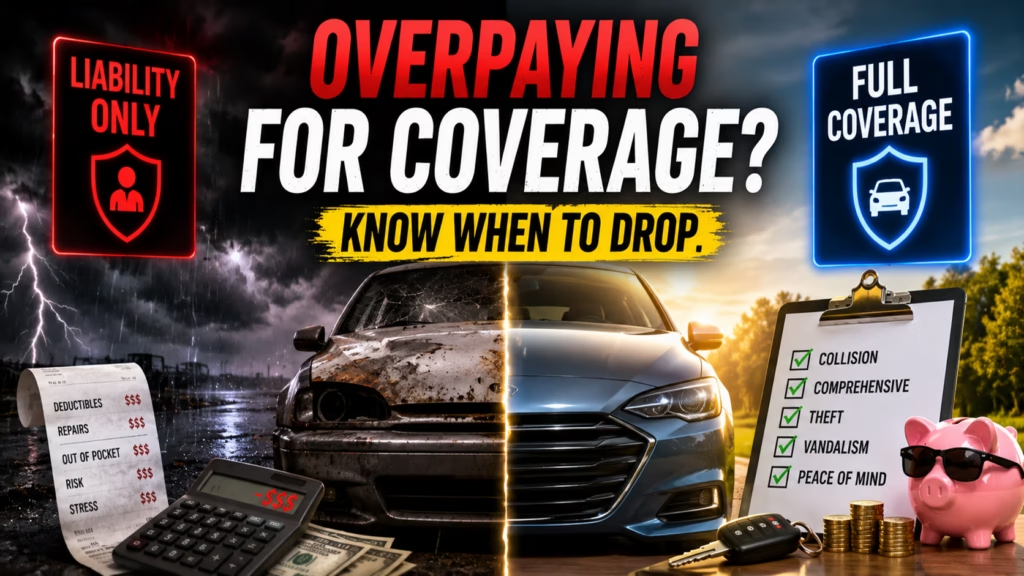
One of the most expensive mistakes you can make in 2026 is paying for “full coverage” on a car that isn’t worth it. Conversely, dropping the wrong coverage on a newer car can bankrupt you if you get into an at-fault accident.
Quick Answer: “Full coverage” is not a real insurance term—it simply means your state-required Liability PLUS Comprehensive and Collision coverage. On average, adding comp/coll increases your premium by 40% to 80%. You should drop full coverage when your car’s actual cash value drops below $4,000 to $5,000, OR when your annual premium for comp/coll exceeds 25% of your car’s total value.
This guide cuts through the insurance jargon. We will show you exactly what each part covers, what it costs, and give you the mathematical formula to decide if you are overpaying.
What Liability Insurance Actually Covers (The Legal Minimum)
Liability insurance pays for damage you cause to other people and their property. It does absolutely nothing to fix your own car or pay your own medical bills. It consists of two parts:
- Bodily Injury (BI): Pays for the other driver’s hospital bills, rehab, and lost wages if you are at fault.
- Property Damage (PD): Pays to repair or replace the other person’s car, fence, or mailbox that you hit.
The “State Minimum” Trap
Most states require something like 25/50/25 limits ($25k per person, $50k per accident, $25k property). Do not rely on these minimums. If you T-bone a new SUV in 2026, the other car alone could be worth $45,000. If their medical bills hit $60,000, your insurance stops paying at $50,000, and you are personally sued for the remaining $10,000+. Financial experts strongly recommend carrying at least 100/300/100 limits.
What “Full Coverage” Actually Adds
To protect your own vehicle, you must add two separate coverages to your liability policy:
- Collision: Pays to fix your car if you hit another car, a tree, or a guardrail—regardless of who is at fault. You will pay a deductible (usually $500 or $1,000) out of pocket.
- Comprehensive: Pays to fix your car for things that aren’t collisions. This includes theft, hail damage, flood, fire, vandalism, and hitting a deer.
2026 Cost Breakdown: Liability vs. Full Coverage
Adding comprehensive and collision is where your bill spikes. Here are average monthly estimates for a 35-year-old driver with a clean record:
- Liability Only (100/300/100 limits): $70 – $120 / month
- Full Coverage (Liability + Comp/Coll $500 ded): $130 – $220 / month
*Note: If you drive a luxury vehicle or a sports car, full coverage can easily push $300+ per month.
👉 See your exact numbers. Use our 30-second estimate tool to see the exact price difference between liability and full coverage in your ZIP code.
The Mathematical Formula: When to Drop Full Coverage
Insurance agents won’t tell you this, but there is a mathematical breaking point where full coverage becomes a bad financial investment. Use these two rules:
- The 25% Rule: Take your annual cost for comp/coll. If it is more than 25% of your car’s actual cash value (ACV), drop the coverage.
- Example: Your car is worth $4,000. 25% of $4,000 is $1,000. If your comp/coll premium is $1,200 a year, drop it. You are overpaying.
- The Savings Account Test: If your car is totaled tomorrow, can you comfortably write a check for $4,000 to buy a replacement? If yes, drop full coverage. If no, keep it.
Real-World Scenarios
Scenario A (Keep Full Coverage): You drive a 2022 Toyota RAV4 worth $24,000. Your comp/coll costs $800/year. If you total it, insurance pays out ~$23,500. Paying $800 to protect a $24,000 asset is a no-brainer. (Also, if you have a car loan, your lender legally forces you to keep full coverage).
Scenario B (Drop Full Coverage): You drive a 2013 Honda Civic worth $3,800. Your comp/coll costs $900/year. If you total it, you get $3,300 (minus deductible). But over 4 years, you paid $3,600 in premiums. You are losing money. Drop the coverage, put that $900/year into a high-yield savings account, and “self-insure.”
The One Coverage You Should NEVER Drop
Even if you drop comp/coll because your car is old, never drop your liability limits to the state minimum, and never skip Uninsured Motorist (UM) coverage. In 2026, roughly 1 in 8 drivers on the road is completely uninsured. If an uninsured driver hits you and you don’t have UM coverage, you have to sue them personally to pay for your medical bills—and most uninsured drivers don’t have assets to sue for.
Frequently Asked Questions
Is it illegal to drive with only liability insurance?
No. As long as you carry your state’s minimum required liability limits, you are legally allowed to drive. You are only legally required to carry full coverage (comp/coll) if you are leasing the car or have an active auto loan.
If I only have liability and someone hits me, does their insurance pay for my car?
Yes, if they are at fault and if they actually have insurance. Their liability coverage pays for your car. But if they are uninsured, or if you are the one who caused the accident (like sliding on ice into a tree), liability insurance pays $0 for your car.
Does full coverage mean I am 100% protected from everything?
No. “Full coverage” is a marketing term. Even with it, you still have to pay your deductible. Furthermore, standard full coverage does not cover roadside assistance, mechanical breakdowns, or rental car fees after an accident—those require small add-ons.
Stop Overpaying for Depreciating Assets
Cars lose value every single day. Paying top dollar to insure a $3,000 vehicle is throwing money down the drain. Enter your ZIP code below to instantly see what your baseline liability rate should be in 2026.
Sources: Insurance Information Institute (III), National Association of Insurance Commissioners (NAIC), Quadrant Information Services (2026 Rate Data).