
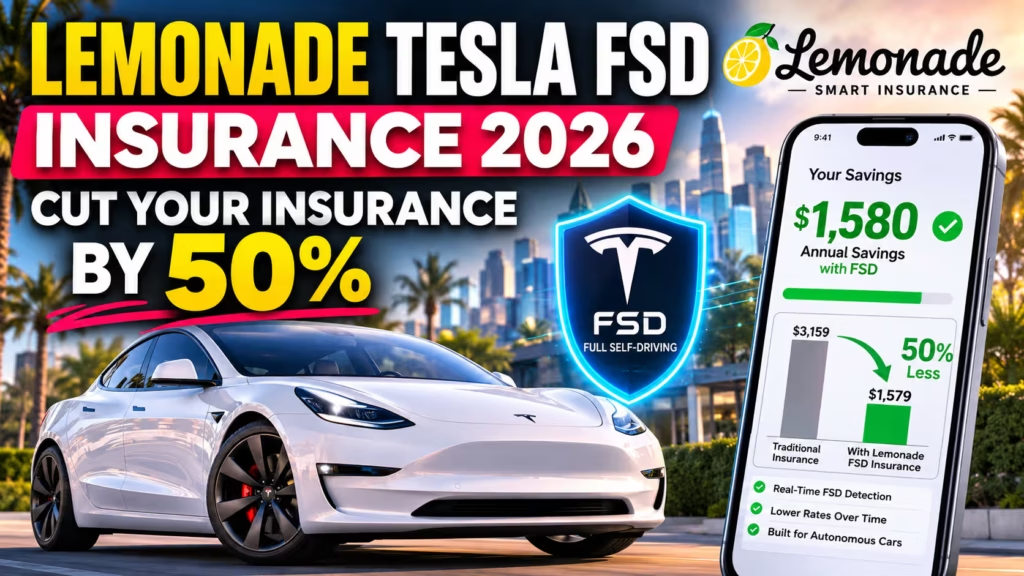
For years, the promise of self-driving cars has been just that — a promise. But in 2026, that promise is finally hitting your wallet in a positive way. Insurance disruptor Lemonade has launched the first-ever Autonomous Car Insurance policy built specifically for Tesla drivers who use Full Self-Driving (FSD) technology. The headline number? A 50% rate cut for every mile driven in autonomous mode.
Quick Answer: Lemonade’s autonomous car insurance policy offers Tesla FSD drivers a 50% per-mile discount when Full Self-Driving is engaged. For the average Tesla owner paying $3,159 annually, regular FSD usage can slash premiums by over $1,500 per year. The policy is currently available in Arizona and Oregon, with more states rolling out in 2026. You do not need to use FSD full-time to save — every autonomous mile counts.
This is not a marketing gimmick. It is the first major signal that the auto insurance industry is finally pricing risk for the autonomous era — and early adopters stand to save thousands. Below, we break down exactly how Lemonade’s Tesla FSD insurance works, who qualifies, how it compares to Tesla’s own insurance product, and what this means for every driver in America.
📑 Navigate This Guide:
- What Is Autonomous Car Insurance?
- How Lemonade’s Tesla FSD Insurance Works
- How Much Can You Save? Real 2026 Numbers
- Who Qualifies & Where Is It Available?
- Lemonade vs Tesla Insurance: Side-by-Side
- Liability, Data Privacy & Safety Concerns
- The Future: Cybercab & Fully Autonomous Fleets
- Your 3-Step Action Plan
- Frequently Asked Questions
What Is Autonomous Car Insurance?
Autonomous car insurance is a new class of auto policy that distinguishes between human-driven miles and autonomous-driven miles. Traditional auto insurance assumes a human is always behind the wheel, making every decision, and prices risk accordingly. But when Tesla’s FSD system is actively navigating traffic, changing lanes, and responding to signals, the risk profile changes dramatically.
Lemonade’s policy leverages this shift. By accessing real-time Tesla vehicle data — a data stream previously unavailable to third-party insurers — Lemonade can verify exactly when FSD is engaged and when the human driver is in control. This allows the company to apply a dynamic per-mile rate: standard pricing for human-driven miles, and a 50% discounted rate for FSD-engaged miles.
According to the Insurance Information Institute (III), autonomous vehicles have the potential to reduce accident frequency by up to 90% once the technology matures. While we are not there yet, FSD-engaged driving in 2026 already shows measurably lower collision rates in highway and suburban environments — the exact scenarios where Lemonade is applying its discount.
How Lemonade’s Tesla FSD Insurance Works
The mechanics are straightforward but technologically sophisticated. When you enroll in Lemonade’s autonomous policy, you authorize a secure data connection between your Tesla and Lemonade’s underwriting platform. This is not a generic telematics app — it is a direct vehicle-to-insurer data feed that reads FSD status in real time.
Data privacy note: Lemonade’s data use is limited to risk pricing and claims verification. The company does not sell driving data to third parties, and under California’s CCPA and similar state privacy frameworks, you retain the right to request deletion of your data at any time. The connection is encrypted end-to-end, and you can disconnect it if you switch insurers.
How Much Can You Save? Real 2026 Numbers
Let’s talk dollars. The average Tesla owner in the United States pays approximately $3,159 per year for comprehensive auto insurance — roughly 25-30% more than the national average for internal-combustion vehicles, according to 2026 rate data. This premium reflects higher repair costs, specialized parts, and the advanced technology packed into every Tesla.
Lemonade’s 50% FSD discount changes the math entirely. Here is how the savings break down based on typical FSD usage patterns:
These figures assume the full $3,159 average premium is mileage-weighted. In practice, Lemonade applies the discount to the per-mile rate during FSD operation, so your exact savings depend on how many miles you drive and what percentage of those miles use FSD. A remote worker in suburban Phoenix who commutes 25 miles daily on FSD could realistically save $800–$1,200 per year.
Get Your 2026 Car Insurance Quotes
Compare Lemonade’s autonomous FSD policy against Tesla Insurance and traditional carriers in your state. See your exact savings in under 2 minutes.
GET YOUR 2026 CAR INSURANCE QUOTESWho Qualifies & Where Is It Available?
As of mid-2026, Lemonade’s autonomous car insurance is not available nationwide. The company is using a state-by-state rollout to satisfy regulatory requirements and build actuarial confidence in its FSD risk models.
Who qualifies: You must own or lease a Tesla vehicle with Full Self-Driving (FSD) capability — either purchased outright or subscribed to via Tesla’s monthly FSD subscription. The vehicle must be registered in Arizona or Oregon. You must also have a clean driving record (no at-fault accidents or DUI convictions in the past 3 years) and maintain minimum state liability coverage.
Expansion roadmap: Industry analysts at McKinsey predict Lemonade will expand to California, Nevada, Texas, and Florida by Q4 2026, assuming early loss ratios remain favorable. If you live outside the current launch states, join Lemonade’s waitlist and set a calendar reminder to check back quarterly.
Lemonade vs Tesla Insurance: Side-by-Side Comparison
Tesla owners naturally assume Tesla Insurance is their best option. In some cases, it is. But when it comes to FSD-specific pricing, Lemonade’s offering is dramatically more aggressive. Here is the head-to-head breakdown:
🍋 Lemonade Autonomous Policy
- FSD Discount: 50% per-mile rate cut when FSD is engaged
- Data Source: Direct Tesla vehicle data feed
- FSD Requirement: No minimum usage; intermittent use qualifies
- Mixed Vehicles: Covers Teslas + non-Tesla cars under one policy
- Future Pricing: Rates designed to decrease as FSD improves
- Availability: Arizona, Oregon (expanding)
⚡ Tesla Insurance
- FSD Discount: Maximum 10% on select coverages only
- Data Source: Tesla Safety Score (broader behavior tracking)
- FSD Requirement: Multiple stipulations and safety score thresholds
- Mixed Vehicles: Tesla vehicles only
- Future Pricing: Tied to Safety Score; volatile month-to-month
- Availability: Arizona, California, Colorado, Illinois, Ohio, Oregon, Texas, Virginia, Washington
Verdict: If you are a frequent FSD user, Lemonade wins on price by a wide margin. If you rarely use FSD, live in a state where Lemonade is not yet available, or prefer to keep all your vehicle data within the Tesla ecosystem, Tesla Insurance may still be the better choice. The only way to know for certain is to get quotes from both.
Liability, Data Privacy & Safety: What the Experts Say
The biggest question surrounding autonomous insurance is not pricing — it is liability. When a car drives itself and crashes, who is at fault? The driver? The manufacturer? The software developer?
In 2026, this remains a legal gray area. The National Association of Insurance Commissioners (NAIC) has published model legislation urging states to clarify manufacturer liability for Level 3 autonomous accidents, but only a handful of states — notably Nevada, Arizona, and Michigan — have enacted specific statutes. In most jurisdictions, if FSD malfunctions and causes a collision, you may face a protracted legal battle to prove manufacturer fault while your insurer decides whether to cover the claim.
Lemonade’s policy is designed to close this gap. Because the policy is built for autonomous operation, there is no ambiguity about coverage during FSD-engaged miles. The insurer has already priced for that risk and accepted it. This alone makes the policy valuable even before considering the 50% discount.
On data privacy: Sharing real-time vehicle data with an insurer makes some drivers uncomfortable. This is a valid concern. However, in 2026, the regulatory landscape has shifted. Under the California Consumer Privacy Act (CCPA), Colorado Privacy Act, and Virginia Consumer Data Protection Act, insurers must disclose exactly what data is collected, how it is used, and provide a one-click opt-out. Lemonade’s autonomous policy complies with all three frameworks, even in states where they are not yet legally required.
The Future: Cybercab & Fully Autonomous Fleets
Lemonade’s Tesla FSD policy is just the beginning. Tesla has announced the Cybercab — a purpose-built autonomous robotaxi with no steering wheel or pedals — for production in 2027. When fully autonomous vehicles (SAE Level 4 and 5) hit public roads, the entire insurance model will flip from driver-centric to product liability-centric.
In a Level 5 world, you are no longer the driver. You are a passenger. The vehicle manufacturer and the software provider bear responsibility for safe operation. Insurance will shift from personal auto policies to product liability coverage bundled into the vehicle purchase or ride-hail fee — similar to how commercial airline insurance works today.
Lemonade’s current FSD policy is essentially a bridge product: it prices the transition period where human and machine share driving responsibility. By building actuarial expertise now, Lemonade positions itself to underwrite the Cybercab and other autonomous fleets when they arrive. For early adopters, this means today’s 50% discount is a preview of the dramatically lower insurance costs that await fully autonomous mobility.
Your 3-Step Action Plan to Lock In FSD Savings
- Verify your FSD status and state eligibility. Open your Tesla app, navigate to Software > Additional Vehicle Information, and confirm FSD is active. Check that your vehicle is registered in Arizona or Oregon. If you are outside these states, join the waitlist and mark your calendar to recheck in 90 days.
- Get parallel quotes from Lemonade, Tesla Insurance, and one traditional carrier. Do not rely on a single quote. Request identical coverage limits from all three so you are comparing apples to apples. Factor in your estimated annual mileage and your typical FSD usage percentage. If you drive 60%+ of miles with FSD engaged, Lemonade will almost always be the cheapest.
- Confirm autonomous coverage in writing before you bind. Whether you choose Lemonade or stay with your current carrier, get explicit written confirmation that your policy covers accidents occurring during autonomous operation. A 30-second email today can prevent a six-figure coverage dispute tomorrow.
Frequently Asked Questions About Lemonade Tesla FSD Insurance
What is Lemonade’s Tesla FSD insurance discount?
Lemonade’s autonomous car insurance policy offers Tesla drivers a 50% per-mile rate reduction for miles driven with Full Self-Driving (FSD) engaged. The policy uses a direct data connection to your Tesla to verify when FSD is active versus when you are manually driving. For a Tesla owner paying the average EV insurance rate of $3,159 per year, consistent FSD usage can produce savings exceeding $1,500 annually.
How does autonomous car insurance work?
Autonomous car insurance distinguishes between human-driven and autonomous-driven miles through real-time vehicle data. When your Tesla’s FSD system is engaged, the insurer receives confirmation and applies a discounted per-mile rate. Human-driven miles are priced at standard rates. You do not need to use FSD full-time — every autonomous mile receives the discount independently.
Where is Lemonade’s Tesla FSD insurance available?
As of mid-2026, the policy is available in Arizona (launched January 26, 2026) and Oregon (launched February 2026). Expansion to California, Nevada, Texas, and Florida is expected by late 2026, pending regulatory approval and favorable early loss data.
Does my standard auto insurance cover Tesla FSD accidents?
Not necessarily. Many standard personal auto policies in 2026 contain ambiguous language or exclusions regarding autonomous-mode accidents. If FSD malfunctions and causes a crash, your standard insurer may deny coverage or argue that manufacturer liability applies. Drivers with FSD-equipped vehicles should verify autonomous coverage in writing with their current carrier or switch to a purpose-built policy like Lemonade’s.
Is Lemonade’s Tesla FSD insurance cheaper than Tesla Insurance?
For drivers who use FSD regularly, yes — significantly. Tesla Insurance offers a maximum 10% discount on certain coverages for FSD usage, subject to strict Safety Score requirements. Lemonade’s 50% per-mile rate cut is far more aggressive and applies regardless of your Safety Score. However, Tesla Insurance may still be competitive for drivers who rarely use FSD or live in states where Lemonade has not yet launched.
Will my insurance rates keep dropping as FSD improves?
Lemonade has stated that as FSD becomes safer through over-the-air updates and accumulated real-world data, the insurance price will continue to decrease. This creates a unique dynamic where your premium can fall over time without you changing anything — simply because the underlying technology becomes less risky to insure.
What happens when the Tesla Cybercab launches?
The Cybercab and other Level 4/5 autonomous vehicles will likely shift insurance from personal auto policies to product liability coverage bundled with the vehicle or ride service. Lemonade’s current FSD policy is a transitional product that builds the actuarial expertise needed to underwrite fully autonomous fleets. Early adopters of today’s FSD policy are effectively beta-testing the pricing models that will govern tomorrow’s robotaxi insurance.
The Autonomous Insurance Era Starts Now
Lemonade’s 50% Tesla FSD discount is more than a headline — it is a declaration that the insurance industry is finally ready to price autonomous risk accurately. For Tesla owners in Arizona and Oregon, this is an immediate, actionable opportunity to cut premiums by hundreds or thousands of dollars per year. For every other driver in America, it is a signal of what is coming: a world where safer, self-driving technology translates directly into cheaper insurance.
The drivers who act now — verifying coverage, getting quotes, and switching to behavior-based autonomous policies — will lock in rates before legacy carriers catch up. The drivers who wait will keep paying premiums built for human error in a world where machines increasingly do the driving.
Take the three-step action plan above. It costs nothing but 20 minutes. The return could be $1,500 this year — and the peace of mind that your policy actually covers you when FSD is behind the wheel.