
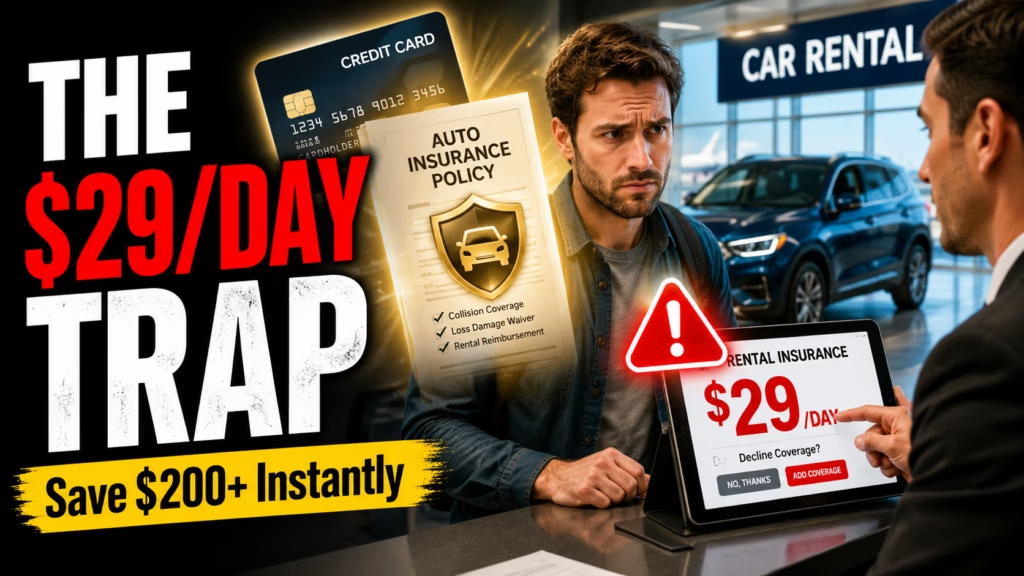
You step up to the rental counter, tired from your flight, and the agent slides a tablet toward you with a single question: “Would you like our Collision Damage Waiver? It’s only $29 per day.” That innocent upsell adds $203 to a weekly rental — often doubling the base cost of the car. You wonder: if I say no, am I risking a $30,000 repair bill? If I say yes, am I flushing money away for coverage I already have? In 2026, with rental prices soaring and credit card benefits shifting, the wrong choice costs you hundreds — or thousands.
Quick Answer: If you have comprehensive and collision coverage on your personal auto policy with a deductible you can afford, and liability limits of at least 100/300/100, you can safely decline the rental company’s Collision Damage Waiver (CDW) and Supplemental Liability Protection (SLP) for domestic rentals. Pay with a credit card that offers primary rental coverage, and you are triple-protected — at no daily fee. You only need to buy the counter’s coverage if you lack personal auto insurance, carry a high deductible you cannot stomach, are renting a luxury vehicle, or are driving outside the U.S. and Canada.
Here is the 2026 guide to slicing through the rental insurance confusion, including exactly what your existing policies cover, the credit cards that protect you best, the hidden “loss of use” trap, and a decision checklist that takes ten seconds to run through at the counter.
The 4 Layers of Protection You Already Have (But May Not Know About)
Before you ever hand a credit card to a rental agent, you are likely sitting on multiple forms of coverage that duplicate — or exceed — what the counter sells. Understanding these layers is the key to confidently saying “no.”
1. Your Personal Auto Insurance Policy
If you carry comprehensive and collision on your own vehicle, those coverages typically extend to a rental car anywhere in the United States, Canada, and sometimes Mexico. Your liability limits also transfer. However, the extension comes with critical fine print:
- Your deductible applies. If you have a $1,000 collision deductible, you will pay the first $1,000 of any rental car damage before your insurer steps in.
- Loss of use is rarely covered. When a rental car sits in a repair shop, the rental company loses revenue — sometimes $100 to $500 per day — and they will bill you for it. Most personal auto policies exclude this charge entirely.
- Diminished value claims can slip through the cracks. After a crash, the rental car’s resale value drops. Your personal policy may or may not cover this, depending on state law and policy language.
- Vehicle type restrictions apply. If you rent a high-value luxury SUV, a large cargo van, or a vehicle with a gross vehicle weight rating above certain thresholds, your personal policy might cap coverage or exclude it altogether.
Verdict: Personal auto insurance is the foundation of rental protection, but it leaves you exposed to out-of-pocket deductible costs and potentially thousands in loss-of-use fees.
2. Credit Card Rental Car Benefits
Many travel rewards cards include an auto rental collision damage waiver when you pay for the entire rental with that card and decline the rental company’s CDW. In 2026, the distinction between primary and secondary coverage is everything:
- Primary coverage pays before your personal auto insurance, meaning you never involve your own insurer, pay no deductible, and avoid a claim on your record. Cards like the Chase Sapphire Reserve and American Express Platinum (with enrolled Premium Car Rental Protection) offer this.
- Secondary coverage only kicks in after your personal policy pays. It may reimburse your deductible, but you still file a claim and risk a premium increase.
- Coverage limits typically range from $50,000 to $75,000 for theft and damage. Liability insurance — bodily injury or property damage you cause to others — is not included on any major credit card. You must have liability coverage elsewhere.
- Excluded vehicles include exotic cars, trucks, certain SUVs, cargo vans, and rentals exceeding 15 to 30 days. Always read your card’s most current guide to benefits before assuming coverage.
Verdict: A card with primary coverage is the single best free shield against rental car damage. But you still need liability coverage from your personal auto policy or the rental company.
3. Non-Owner Auto Insurance Policies
If you live in a city, do not own a car, and rent or borrow vehicles occasionally, a non-owner policy from a major insurer provides continuous liability coverage. Priced between $200 and $500 per year, it protects you every time you get behind the wheel of a rental or borrowed car — far cheaper than buying SLP at the counter for $15 per day.
4. Employer Commercial Coverage (Business Rentals)
When you rent for work, your employer’s commercial auto policy may cover both liability and physical damage. Never assume — verify with HR or your travel desk. Many small and mid-sized businesses do not extend coverage to rental cars, leaving employees personally liable in a crash.
What the Rental Counter Sells — And What You Are Actually Buying
The four products pushed at the counter often have confusing names. Here is a no-spin breakdown of each, with cost estimates based on 2026 major U.S. airport locations:
| Coverage Sold | What It Actually Covers | Typical Daily Cost | Buy If… | Skip If… |
|---|---|---|---|---|
| Collision Damage Waiver (CDW) / Loss Damage Waiver (LDW) | Damage to or theft of the rental car itself. Waives your financial responsibility. | $20–$40 | You have no personal comp/collision, a very high deductible, or are renting internationally. | Your personal auto policy covers rentals and you can afford your deductible; or your credit card provides primary coverage. |
| Supplemental Liability Protection (SLP) | Liability for injury or property damage you cause to others. Typically increases state minimums to $1 million. | $10–$20 | You lack personal auto insurance or carry only state minimum limits. | Your personal liability limits are 100/300/100 or higher. |
| Personal Accident Insurance (PAI) | Medical bills for you and your passengers. | $5–$10 | You have no health insurance or MedPay/PIP. | You have health insurance, MedPay, or PIP on your auto policy. |
| Personal Effects Coverage (PEC) | Theft of personal belongings from the rental car. | $5–$10 | You carry no homeowners or renters insurance. | Your renters or homeowners policy covers off-premises personal property (subject to deductible). |
5 Scenarios Where You Should Actually Buy the Counter’s Coverage
There are real situations where saying “yes” is the financially smarter move. Here is when to pull the trigger:
- You have no personal auto insurance at all. Without a non-owner policy, you need both CDW and SLP from the rental company. Driving without liability coverage is illegal and financially catastrophic.
- Your deductible exceeds your comfort zone. If you carry a $2,000 collision deductible and a crash would wreck your emergency savings, the CDW eliminates that out-of-pocket risk entirely — it carries no deductible.
- You cannot afford loss-of-use charges. This is the most overlooked gap. Your personal policy typically excludes loss of use, and most credit cards do as well. The rental company can bill you $100–$500 per day while the car is out of service. The CDW covers this.
- You are renting a luxury or specialty vehicle. Personal policies often cap coverage based on vehicle value. A $100,000 Mercedes rental may only be covered up to $50,000 by your insurer — leaving a massive gap.
- You are driving outside the U.S. or Canada. Your personal auto policy almost never covers rentals in Mexico, Europe, Asia, or South America. You must buy local coverage or a travel insurance package that includes rental vehicle protection.
The Hidden Costs Your Personal Policy Will Not Cover
Understanding these three gaps saves you from a surprise bill after an accident:
- Loss of use: As described above, the rental company’s lost revenue during repairs. This can equal or exceed the actual repair cost in some cases.
- Diminished value: After a significant repair, the rental vehicle is worth less. Rental companies increasingly pursue renters for this difference, which can run into the thousands.
- Administrative fees: Towing, storage, appraisal, and claims handling fees often appear as separate line items on the bill you receive weeks after the rental. CDW typically waives these; personal policies may not.
International Rentals: A Completely Different Rulebook
Your U.S.-based personal auto policy is essentially worthless once you cross into Europe, Asia, Africa, or South America. Even Canada and Mexico have restrictions. For international rentals in 2026:
- Purchase full coverage (CDW + liability) from the rental company or from a reputable third-party provider like Allianz or AXA that specializes in international car rental protection.
- In Mexico specifically, U.S. liability coverage is not recognized. You must buy a Mexican liability policy through a provider like Baja Bound or Mexican Insurance Store. Driving without one can land you in jail after an accident.
- Check if your travel insurance includes rental car damage. Policies from World Nomads, SafetyWing, and Allianz often include rental vehicle coverage as an add-on, sometimes at rates lower than the rental counter.
Third-Party Rental Insurance: Cheaper Than the Counter, But Watch the Gaps
Online platforms like Bonzah, RentalCover.com, and Sure offer primary rental car damage coverage for as little as $7–$15 per day or $50–$100 per week. They often cover loss of use and diminished value, matching or exceeding the CDW. However, they rarely include liability coverage. You would still need personal auto insurance or the rental company’s SLP. Read the policy wording carefully before purchasing, and verify it is accepted at your rental location.
The 10-Second Counter Checklist
When the agent asks if you want coverage, mentally run through these five questions. If you answer “yes” to all, decline everything with confidence:
- Do I have comprehensive and collision on my personal auto policy? (Yes)
- Is my auto deductible an amount I can comfortably pay today if I crash? (Yes)
- Do I carry at least 100/300/100 liability limits? (Yes)
- Did I pay for the rental with a credit card that provides primary damage coverage? (Yes, ideally)
- Am I renting within the U.S. or Canada and not a luxury/exotic vehicle? (Yes)
If any answer is “no,” buy the specific coverage that fills that gap — and nothing more.
Frequently Asked Questions
Does my credit card cover liability insurance on a rental car?
No. No major U.S. credit card provides third-party liability coverage for rental cars. Your personal auto policy or the rental company’s Supplemental Liability Protection must fill that role.
What happens if I damage a rental car and have no coverage at all?
You are personally responsible for the full repair cost, loss-of-use charges, diminished value, and any liability claims from injured parties. This can easily exceed $30,000. The rental company can pursue collections and legal action to recover these amounts.
Can I buy rental car insurance after I pick up the car?
No. The rental company sells CDW and other protections only at the time of rental. If you drive off the lot without it and later change your mind, you cannot add it retroactively. Third-party policies from Bonzah or similar can sometimes be purchased before you pick up the car, but not after a loss occurs.
Does rental car insurance cover tire and windshield damage?
It depends. CDW typically covers tires and glass if damaged in a collision, but not mechanical tire failure or a simple flat. Credit card coverage varies — many exclude tire damage unless part of a broader collision. Always check the specific policy wording.
The Smartest Move Is a 30-Second Check Before You Travel
You cannot make the right decision at the counter if you do not know what your personal policy already covers. Checking your deductibles, liability limits, and credit card benefits takes less than a minute — and can save you $200 or more on a single trip. The average American who buys CDW unnecessarily spends over $300 per year on duplicate coverage. That is money you could keep in your pocket for the rental car upgrade you actually want.
Enter your ZIP code below to instantly see your current coverage profile, compare what you are paying against baseline rates in your area, and spot gaps before you ever step up to the counter.
Sources: Insurance Information Institute (III) Rental Car Coverage Guidelines, Consumer Financial Protection Bureau (CFPB) Auto Insurance Advisory, Chase Sapphire Reserve & American Express Platinum 2026 Guide to Benefits, Quadrant Information Services Premium Analytics, RentalCover.com and Bonzah policy specimens, National Association of Insurance Commissioners (NAIC) International Auto Insurance Report.
👉 Are you overpaying because of your credit? Use our 30-second estimate tool to compare baseline rates in your ZIP code and see where you stand.