
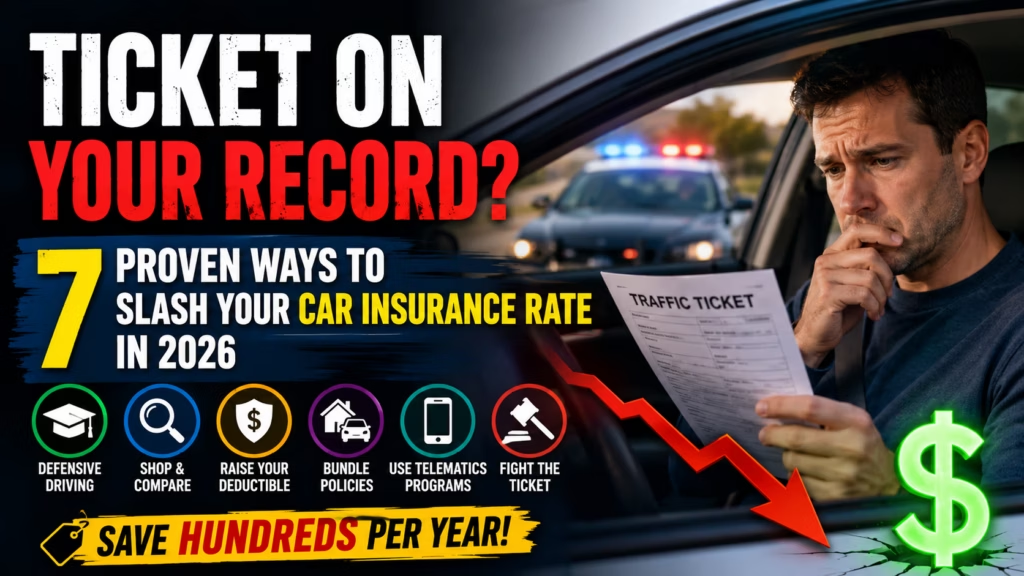
That sinking feeling when you see the flashing lights in your rearview mirror is bad enough. But the real pain starts weeks later, when your insurance renewal arrives with a surcharge that can inflate your premium by 20% to 40% — and stick around for three to five years. In 2026, with auto insurance costs already at historic highs, a single speeding ticket can cost you more than the fine itself. The good news: you are not powerless. There are immediate, proven tactics to soften the blow — or even erase it entirely.
Quick Answer: You can lower your premium after a ticket by taking a state-approved defensive driving course (removes points, reduces surcharge), shopping your policy across at least five insurers, raising your deductible, bundling policies, enrolling in a telematics program, or — if you act fast — fighting the ticket in court. The most effective combination: take the course, then switch to a carrier that penalizes tickets less severely. Many drivers who do both save $400 or more per year compared to simply renewing with their current insurer.
Here is the step-by-step playbook to stop a moving violation from wrecking your budget, including exact rate hike data, state loopholes, and the one mistake that locks you into overpaying for years.
How Much a Ticket Actually Adds to Your Premium in 2026
Insurers pull your Motor Vehicle Report (MVR) at renewal. A single violation triggers a surcharge schedule that varies by company, state, and violation severity. Based on 2026 rate filings analyzed by Quadrant Information Services, here is the typical annual increase for a 40-year-old driver with full coverage (100/300/100, $500 deductible) and a previously clean record:
- Minor speeding (1–15 mph over): +20% to +30% — roughly $300–$500 per year
- Moderate speeding (16–25 mph over): +30% to +45% — $500–$800 per year
- Reckless driving / excessive speed: +50% to +100% — $800–$1,800 per year
- Running a red light or stop sign: +25% to +40% — $400–$700 per year
- At-fault accident with citation: +40% to +60% — $700–$1,200 per year
- DUI/DWI (first offense): +80% to +150% — typically requires an SR-22 or FR-44 filing
These surcharges compound. Two minor speeding tickets can cost more than one reckless driving citation. The key is to act before your policy renews, because once the surcharge is applied, it is locked in for the entire term.
7 Proven Strategies to Reduce Your Rate After a Ticket
1. Take a Defensive Driving Course Immediately
This is the single most effective move, and it works before your insurer even sees the ticket. In most states, completing a state-approved 4- to 6-hour online course (typically $25–$50) can:
- Remove up to 3 or 4 points from your license before they hit your MVR.
- Trigger a mandatory 10%–15% premium discount for three years.
- Prevent the surcharge entirely if completed before renewal, as many insurers treat a point-free MVR as if the ticket never happened.
Crucially, in states like New York, Florida, Texas, and California, this is a formal administrative right — you can take the course, submit the certificate, and watch the points vanish. Check with your state’s DMV and your insurer’s approved provider list (National Safety Council, AAA, and iDriveSafely are widely accepted).
2. Shop Your Policy Across at Least 5 Carriers
Your current insurer may be the worst offender. Some companies penalize tickets far more heavily than others. Data from multiple rate studies shows that a driver with one minor speeding ticket who switches insurers saves an average of $400 per year compared to staying put. GEICO and Progressive tend to surcharge aggressively for any violation; State Farm and regional carriers like Erie or Auto-Owners often apply smaller surcharges, especially if you have loyalty history. Use an online comparison tool to quote your exact ZIP code and the violation — you will see dramatically different numbers for the same coverage.
3. Ask for a One-Time Forgiveness Exception
Accident forgiveness is a well-known perk, but many insurers also offer informal “minor violation forgiveness” for long-term customers. If you have been claim-free for five years and this is your first ticket, call your agent and simply ask: “Is there any way to waive the surcharge as a courtesy?” Some companies (State Farm, Allstate, and occasionally Progressive) will grant it. You have nothing to lose by asking, and the worst they can say is no.
4. Raise Your Collision and Comprehensive Deductibles
After a ticket, your premium spikes. To offset it immediately, increase your deductible from $500 to $1,000 (if you have the emergency savings to cover it). This alone can reduce your annual premium by 10%–15%, effectively canceling out a minor speeding surcharge. Just ensure you maintain the higher deductible in a separate savings account in case you need to file a claim later.
5. Bundle Renters, Home, or Life Insurance
Multi-policy discounts range from 5% to 25%, and they are applied even when a ticket is on your record. If you have been insuring your car with one company and your apartment or home with another, now is the time to consolidate. Even adding a small renters policy for $15/month can trigger a larger auto discount that reduces your net cost after the ticket.
6. Enroll in a Telematics (Usage-Based) Program
Programs like Progressive Snapshot, State Farm Drive Safe & Save, and Allstate Drivewise track your actual driving behavior — speed, braking, mileage, time of day. If you drive safely for 30–90 days, you can earn a discount of 10%–40%, regardless of the ticket on your MVR. Many insurers offer a “first-ticket amnesty” if you enroll in their telematics program within 30 days of the violation. This signals to the underwriter that you are a low-mileage, cautious driver despite the slip-up.
7. Fight the Ticket in Court (or Hire a Traffic Attorney)
If you have not yet paid the fine, you can challenge the citation. A traffic attorney (cost: $100–$300) can often get the ticket reduced to a non-moving violation like “defective equipment” — which does not appear on your MVR and therefore never triggers a surcharge. Even if you pay the attorney fee, the long-term insurance savings can reach thousands of dollars. This is especially worth pursuing for speeds 15+ mph over the limit or charges like reckless driving.
How Long a Ticket Haunts Your Premium
For insurance rating purposes, most moving violations affect your premium for three to five years, depending on state law and the insurer’s internal guidelines. Major violations like DUI or hit-and-run can remain for five to ten years. After that period, the violation drops off your MVR. However, your insurer will not automatically reduce your rate — you must ask for a policy review or switch to a new carrier that sees a clean record.
State-Specific Loopholes That Can Save You
- California (Prop 103): Insurers cannot raise your rates for a single minor speeding ticket if you have been licensed and accident-free for three years prior. You must invoke this right.
- Florida: Traffic school removes points every 12 months. Points from speeding drop off after three years.
- New York: The Point & Insurance Reduction Program (PIRP) lets you remove up to four points every 18 months.
- Texas: A defensive driving course can dismiss one ticket per year and keep it off your record entirely.
- Massachusetts: The Safe Driver Insurance Plan (SDIP) allows you to appeal surcharges and present evidence of a clean record.
What Never to Do After a Ticket
- Do not hide the ticket from your insurer. They will discover it at renewal via your MVR. Nondisclosure can lead to policy cancellation or denial of a future claim.
- Do not drop full coverage out of panic. If you have a loan or lease, you are contractually required to maintain it. Even without a loan, dropping collision and comprehensive after a ticket leaves you exposed to a total loss.
- Do not automatically renew without comparing quotes. The carrier that was cheapest before the ticket may now be the most expensive. A new customer with the same violation often pays less than a renewing customer.
Frequently Asked Questions
Will my insurer automatically find out about my ticket?
Yes. At renewal, insurers order your Motor Vehicle Report (MVR) from the state DMV. Any conviction that appears will be factored into your new premium. Even if you pay the fine without contesting it, the conviction still hits your record.
Does a defensive driving course remove the ticket from my record?
In many states, yes — the points are removed, and the violation itself may be masked from your MVR. In other states, the violation remains but the points are waived, which still prevents a surcharge. Always verify with your DMV and insurer.
Which insurance companies penalize tickets the least?
State Farm, USAA, and regional carriers like Erie and Auto-Owners tend to apply smaller surcharges for a first minor violation, especially if you have been claim-free. GEICO and Progressive often impose steeper hikes, but they may still be the cheapest overall if you shop after completing defensive driving. There is no universal answer; your ZIP code and credit profile heavily influence the outcome.
Can I lower my rate if the ticket was a mistake and I was found not guilty?
If you were acquitted or the ticket was dismissed, it should not appear on your MVR at all. Verify with your state DMV that the record is clean, then provide the acquittal documentation to your insurer to remove any erroneous surcharge.
Act Now — The Clock Is Ticking
A single ticket does not define your driving future. By combining a defensive driving course, aggressive quote comparison, and a strategic deductible adjustment, you can come out of this with a rate that is lower than what you were paying before the violation. The worst thing you can do is ignore it and let the surcharge automatically renew.
Enter your ZIP code below to instantly see how much you could save — even with a ticket on your record. The comparison tool pulls live quotes from top insurers that compete for your specific profile. It takes 30 seconds and costs nothing.
Sources: Quadrant Information Services 2026 Premium Analytics, Insurance Information Institute (III) Traffic Violation Surcharge Report, National Highway Traffic Safety Administration (NHTSA) Driver Behavior Data, State DMV Point System Regulations, J.D. Power 2025–2026 Auto Insurance Study.
👉 Are you overpaying because of your credit? Use our 30-second estimate tool to compare baseline rates in your ZIP code and see where you stand.