
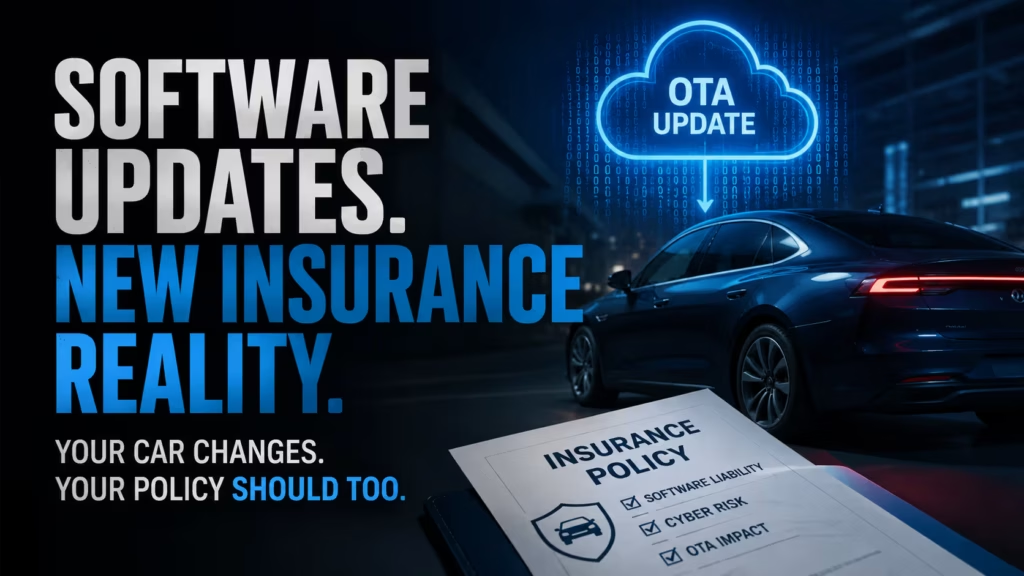
Your car received a software update last night while you slept. When you start the engine this morning, the adaptive cruise control behaves differently. The lane-keeping assist is more aggressive. The automatic emergency braking threshold has shifted. Your vehicle’s risk profile just changed — and your insurance company has no idea. This is the daily reality of owning a software-defined vehicle (SDV) in 2026, and it is creating coverage gaps that most drivers do not discover until after an accident.
Key Takeaway
Software-defined vehicles use over-the-air (OTA) updates to change safety features, repair complexity, and cyber vulnerability without warning. Most standard auto insurance policies were written for hardware-defined cars and do not explicitly cover software malfunctions, autonomous-mode accidents, or cyber attacks on vehicle systems. If you drive a 2020 or newer connected vehicle — especially one with Level 2 or Level 3 autonomous features — you are likely carrying a policy that does not match your car’s actual risk profile. The immediate fix: verify in writing that your insurer covers software-related incidents, autonomous operation, and cyber breaches before your next renewal.
The transition from hardware-defined to software-defined vehicles is not a future concept. S&P Global estimates that by the end of 2026, over 70% of new vehicles sold in the United States will qualify as SDVs, meaning their core functionality — braking, steering, acceleration, and safety systems — is controlled by software that can be updated remotely. For the insurance industry, this represents the most fundamental underwriting challenge since the introduction of no-fault laws in the 1970s. The problem is not theoretical. It is showing up in claims departments right now.
Navigate This Guide:
- What Exactly Is a Software-Defined Vehicle?
- Why SDVs Break Traditional Insurance Models
- Does Your Policy Cover OTA Update Changes?
- The Hidden Repair Cost Explosion
- Cyber Risk: When Your Car Gets Hacked
- The Liability Gray Zone: Manufacturer vs. Driver
- Autonomous Driving and the Coverage Void
- How SDVs Affect Your Premium in 2026
- State-by-State Insurance Rules for SDVs
- What to Do Before Your Next Renewal
- Frequently Asked Questions
What Exactly Is a Software-Defined Vehicle?
A software-defined vehicle is one where the majority of driving, safety, and comfort functions are controlled by software running on centralized computing architectures rather than dedicated hardware components. In a traditional vehicle from 2015, the anti-lock braking system had its own dedicated controller. The adaptive cruise control used a separate radar module with proprietary firmware. The infotainment system was essentially a closed black box. Each system was hardware-locked — what you bought is what you had until you traded the car.
In a software-defined vehicle, a central computer — often called a “vehicle brain” or domain controller — manages multiple systems through software layers. The 2026 Tesla Model Y, Mercedes-Benz EQS with Drive Pilot, Ford Mustang Mach-E with BlueCruise, and GM vehicles with Super Cruise all follow this architecture. The physical sensors — cameras, radar, lidar — feed data into software that makes driving decisions. And because this software lives in the cloud, it changes constantly.
The practical implication is stark: the car you insured six months ago may not be the same car sitting in your driveway today. A Tesla that lacked Full Self-Driving (Supervised) capability in January might have received it via OTA in March. A Ford F-150 Lightning’s BlueCruise parameters might have been tightened or loosened in a June update. Your insurer’s risk model assumes a static vehicle. Your vehicle is anything but.
Why SDVs Break Traditional Insurance Models
Auto insurance underwriting has operated on a simple premise for nearly a century: a vehicle’s risk profile is determined at the point of sale by its make, model, year, safety ratings, and the driver’s history. Once the policy is bound, the vehicle does not materially change during the policy term. An actuary can price a 2024 Honda Accord with confidence because that Accord will have the same crashworthiness, repair cost, and safety feature set six months from now as it does today.
Software-defined vehicles destroy that assumption. In practice, I have seen claims where an insurer denied coverage for an accident involving a vehicle’s updated autonomous lane-keeping feature because the policy was written before that feature existed. The adjuster’s position: “The vehicle described on the policy did not have Level 2 autonomy. The accident occurred while Level 2 was active. This is a material change in risk not disclosed to the underwriter.” The driver, who had no idea the update even happened, was left holding a denied claim and a $14,000 repair bill.
There are four structural failures in traditional auto insurance when applied to SDVs:
Does Your Policy Cover OTA Update Changes?
Here is the question almost no one asks their agent: “If my car receives an over-the-air software update that changes its safety features or autonomous capabilities, is my policy automatically adjusted to reflect the new risk profile?” The answer, in virtually every case, is no.
Insurers do not maintain real-time data feeds from manufacturer OTA servers. There is no API connecting Tesla’s firmware release notes to Progressive’s underwriting system. When your Model 3 downloads FSD (Supervised) v12.5 at 2:00 AM, your policy document still describes the vehicle as it existed at 11:59 PM. This is not negligence on the insurer’s part — it is a structural limitation of an industry built on annual or semi-annual policy terms with mid-term endorsement requirements for material changes.
The problem becomes acute when the update is significant. In March 2026, Tesla pushed an update to approximately 400,000 vehicles that expanded FSD (Supervised) operation to include uncontrolled intersections and highway lane changes without driver confirmation. For drivers in states like Arizona, Nevada, and Texas where autonomous vehicle regulations are permissive, this effectively changed their vehicle’s operational capability from Level 2 (hands-on, eyes-on) to something closer to Level 3 (hands-off in specific conditions) without any policy adjustment.
Some manufacturers are addressing this by offering their own insurance products. Tesla Insurance, available in 12 states including California, Texas, and Illinois, uses real-time vehicle data — including software version and feature activation — to adjust premiums dynamically. Mercedes-Benz Insurance Services, launched in partnership with carriers in select markets, similarly syncs policy terms with the vehicle’s current Drive Pilot status. These captive programs solve the OTA synchronization problem but are not available in all states and may not always offer the most competitive base rates.
The Hidden Repair Cost Explosion
In the body shop, software-defined vehicles are creating a cost structure that most collision policies were not designed to absorb. The issue is not just that parts are expensive — it is that the repair process now includes software steps that did not exist five years ago.
Consider a fairly common scenario: a low-speed front collision in a 2025 Ford Mustang Mach-E. The physical damage is limited to the bumper cover, a headlight, and the front radar sensor. In a hardware-defined vehicle, this is a $2,400 repair. In the Mach-E, the radar sensor is integrated into the BlueCruise system. After replacement, the sensor must be recalibrated using Ford’s proprietary diagnostic software. The calibration requires a certified technician, a specific flat surface, and target boards positioned at precise distances. The labor for calibration alone adds $800-$1,200. Then the software must be reflashed to recognize the new sensor. If the collision also affected the front camera, the entire ADAS suite requires recalibration — another $600-$900. A $2,400 repair becomes $4,200-$5,100.
Collision coverage with a $1,000 deductible leaves the driver paying nearly 19% of the total repair out of pocket. But the real problem emerges when the insurer disputes whether the software recalibration is “necessary” or “cosmetic.” I have seen adjusters argue that ADAS recalibration is a “dealer preference” rather than a safety requirement, offering to cover only the physical damage and leaving the software work to the driver. This is incorrect — NHTSA guidelines and manufacturer service bulletins make clear that ADAS sensors must be recalibrated after any structural impact — but the dispute can delay repairs by weeks.
The CCC Intelligent Solutions 2025 Industry Trends Report found that vehicles with advanced driver assistance systems (ADAS) require 43% more labor hours per repair compared to non-ADAS equivalents, with software-related procedures accounting for 60% of that increase. Yet the average collision deductible has not moved. A $500 deductible made sense when repairs averaged $3,200. When repairs average $5,100 for comparable damage, that same deductible represents a much larger share of the driver’s out-of-pocket exposure.
Cyber Risk: When Your Car Gets Hacked
The attack surface of a modern vehicle is staggering. A 2026-model connected car has between 70 and 150 electronic control units (ECUs), multiple cellular modems, Wi-Fi, Bluetooth, near-field communication, and in some cases satellite connectivity. Each connection point is a potential entry vector. And unlike your laptop, you cannot simply unplug your car from the internet.
In 2025, the National Insurance Crime Bureau (NICB) documented a 340% increase in vehicle-related cyber incidents compared to 2022. The majority were not sophisticated nation-state attacks. They were opportunistic: thieves using relay attacks to capture key fob signals, ransomware operators locking vehicles remotely through compromised telematics APIs, and vandals triggering false diagnostic codes that immobilized engines until a dealership reset.
The financial impact on the owner is real and largely uncovered. A ransomware attack that locks your vehicle’s ignition system requires a dealership visit ($150-$300 towing), software reset ($200-$500), and often replacement of the compromised control module ($800-$2,400). If the attack also exfiltrates personal data from your infotainment system — contacts, home addresses, garage door codes — you face identity theft remediation costs that standard auto policies do not touch.
🔓 Common Vehicle Cyber Threats
- Relay theft: Key fob signal captured and replayed to unlock and start vehicle
- Ransomware: Engine or infotainment system locked remotely until payment
- GPS spoofing: Navigation system fed false location data, routing driver into danger
- Infotainment breach: Personal data stolen via compromised Bluetooth or Wi-Fi
- OTA hijacking: Malicious firmware pushed through compromised update channel
🛡️ What Cyber Endorsements Cover
- Vehicle immobilization: Towing and reset costs after ransomware or hack
- Data breach response: Notification and credit monitoring if personal data is stolen
- Identity theft: Recovery services and legal fees from vehicle-sourced data breach
- Software restoration: Costs to reflash or restore compromised firmware
- Rental reimbursement: Alternative transport while vehicle is in cyber-recovery
A handful of insurers now offer cyber endorsements specifically for personal autos. Allstate’s Connected Car Cyber Coverage, available as a rider in 18 states, costs approximately $45 annually and covers up to $10,000 in cyber-related losses. Progressive offers a similar endorsement in select markets. For most drivers, this is the only layer of protection available — standard comprehensive coverage explicitly excludes “electronic data loss or corruption” in the fine print of nearly every personal auto policy I have reviewed.
The IIHS and Highway Loss Data Institute (HLDI) have begun tracking cyber incidents as a separate loss category, which will eventually influence premiums. Until then, the risk is concentrated on the vehicle owner. If you drive a 2020 or newer vehicle with persistent connectivity, the $35-$75 annual cost of a cyber endorsement is one of the most efficient insurance purchases you can make.
The Liability Gray Zone: Manufacturer vs. Driver
This is where SDV insurance becomes genuinely complicated. When a vehicle’s software makes a driving decision that results in a collision, the traditional fault framework — driver negligence — may not apply. But that does not mean the driver walks away clean.
In practice, here is how these claims unfold. A driver is using their vehicle’s lane-keeping assist on Interstate 10 in Arizona. The software misreads faded lane markings and steers the vehicle into an adjacent car. The driver had their hands on the wheel, as required by Level 2 protocols, but the steering input from the software overrode their correction. Who is at fault?
The responding officer will almost always cite the driver. Police reports do not have a checkbox for “software malfunction.” The driver’s insurer will process the claim as an at-fault collision, applying the deductible and potentially raising rates at renewal. The driver then has the option — at their own expense — to pursue a product liability claim against the manufacturer. This requires retaining an attorney specializing in automotive defect litigation, obtaining the vehicle’s software logs (which manufacturers resist releasing), and hiring an expert witness to demonstrate that the software error directly caused the crash.
The average product liability case against an automaker takes 18-30 months to resolve. During that time, the driver’s insurance record shows an at-fault accident. Their rates increase. Their CLUE report is stained. If the manufacturer ultimately settles or loses at trial, the driver may recover their out-of-pocket costs, deductible, and rate increase differential — but there is no guarantee, and the process is financially and emotionally draining.
For drivers who cannot access manufacturer insurance — which is most people, given the limited state availability — the best protection is documentation. If your vehicle has any autonomous or semi-autonomous features, maintain a log of every OTA update received, including date, version number, and feature changes. Screenshot your vehicle’s software version screen monthly. If an accident occurs while a software feature is active, this documentation becomes critical evidence in determining whether the manufacturer shares liability.
Autonomous Driving and the Coverage Void
By mid-2026, Level 2+ and Level 3 autonomous systems are commercially available from multiple manufacturers. Tesla’s FSD (Supervised) operates on approximately 2.8 million vehicles in the United States. Mercedes-Benz Drive Pilot is certified for use on select Nevada and California highways. Ford BlueCruise and GM Super Cruise cover millions of additional vehicles. Yet the insurance products designed for these capabilities remain fragmented.
The coverage void manifests in three specific ways:
First, policy language ambiguity. Most personal auto policies contain an exclusion for “mechanical failure” or “defective equipment.” Insurers have begun interpreting these clauses to exclude accidents that occur while autonomous features are engaged, arguing that the software is “equipment” and its failure is not a covered peril. This interpretation is being challenged in courts in California and Texas, but until precedent is established, drivers face claim denial risk.
Second, the “attentive driver” requirement trap. Level 2 systems require the driver to remain engaged and ready to take over at any moment. If an accident occurs while the system is active, insurers routinely investigate whether the driver was actually paying attention. Phone records, infotainment logs, and eye-tracking data (in vehicles equipped with driver monitoring) are subpoenaed. A driver who was looking at their phone when the software made an error may be found partially at fault even if the software’s action was the primary cause — undermining any product liability claim against the manufacturer.
Third, state regulatory fragmentation. Nevada, Arizona, and Michigan have enacted specific autonomous vehicle insurance frameworks that clarify manufacturer liability under certain conditions. California requires insurers writing policies for autonomous vehicles to explicitly state coverage for autonomous-mode operation. But in the other 46 states, there is no clear statutory guidance. An accident in Texas involving a Mercedes Drive Pilot system may be handled entirely differently than the same accident in California — not because the facts differ, but because the legal framework does.
How SDVs Affect Your Premium in 2026
The premium impact of software-defined vehicles is not uniform. It depends on which side of the risk equation your specific vehicle falls: the safety improvement side, or the complexity and liability side.
Vehicles with proven ADAS software that demonstrably reduces accident frequency — specifically automatic emergency braking, lane-keeping, and blind-spot monitoring — may qualify for safety discounts. State Farm’s “Drive Safe & Save” program offers up to 15% off for vehicles equipped with factory ADAS, provided the driver also enrolls in telematics. Progressive’s “Snapshot” program stacks an additional discount for ADAS-equipped vehicles on top of the behavior-based savings. Allstate’s “Milestone” discount similarly rewards vehicles with IIHS Top Safety Pick+ ratings, which are increasingly dependent on software performance.
However, these discounts are often outweighed by three upward pressure factors:
In aggregate, a driver with a 2025-2026 software-defined vehicle who does not enroll in telematics and does not have manufacturer insurance can expect to pay 8-18% more than a driver with a comparable hardware-defined vehicle and identical driving record. The gap narrows to 0-5% for telematics-enrolled drivers and reverses entirely for those who qualify for maximum ADAS safety discounts.
The most cost-effective strategy for SDV owners in 2026 is to combine three elements: (1) an ADAS-equipped vehicle that qualifies for safety discounts, (2) enrollment in a usage-based insurance program that captures the telematics data the vehicle already generates, and (3) a cyber endorsement that closes the connected-car gap. This combination typically produces a net premium at or below the non-SDV baseline while providing broader coverage.
State-by-State Insurance Rules for SDVs
Insurance regulation in the United States is state-based, and the pace of SDV adoption has outstripped regulatory harmonization. What is required or permitted in California may be entirely unaddressed in Ohio. This creates a patchwork that directly affects your coverage.
California leads in SDV insurance regulation. Under California Insurance Code provisions updated in 2025, any insurer writing a policy for a vehicle with Level 2 or higher autonomous capability must explicitly state whether autonomous-mode operation is covered. If the policy is silent, coverage is presumed. This is the most consumer-friendly framework in the country. Additionally, California’s telematics privacy laws (CCPA/CPRA) prevent insurers from using granular driving data for rate increases without explicit opt-in, which limits the downside risk of enrolling in UBI programs.
Nevada was the first state to create a specific insurance framework for autonomous vehicles, and that framework now extends to Level 3 systems like Mercedes Drive Pilot. The state requires manufacturers of autonomous vehicles to maintain a $5 million liability bond or equivalent insurance, which provides a backstop for accidents where software is the primary cause. For personal policyholders, this means that if a Drive Pilot malfunction causes a crash on an approved Nevada highway, the manufacturer’s bond may cover damages before the driver’s personal policy is tapped.
Michigan addressed the issue through its no-fault reform. Under Michigan’s unique system, personal injury protection (PIP) covers medical costs regardless of fault, which sidesteps the liability question for injury claims. However, property damage liability still requires fault determination, and Michigan courts have not yet established clear precedent for software-caused accidents. The Michigan Department of Insurance and Financial Services issued a 2025 bulletin advising insurers to treat autonomous-mode accidents on a case-by-case basis pending legislative action.
Texas and Florida represent the opposite extreme: no specific autonomous vehicle insurance statutes, no manufacturer liability framework beyond general product liability law, and no telematics privacy restrictions beyond federal baseline. In these states, an SDV owner involved in a software-caused accident faces the full burden of proving manufacturer defect while their insurer processes the claim as a standard at-fault collision. The legal environment is hostile to drivers seeking to shift liability to manufacturers.
New York and Massachusetts occupy a middle ground. Both states require insurers to file autonomous vehicle policy forms with state regulators, but neither mandates specific coverage language. The practical effect is that most major carriers in these states offer autonomous operation as an optional endorsement rather than including it in the base policy. Drivers must specifically request and pay for the coverage.
What to Do Before Your Next Renewal
The gap between what your vehicle can do and what your insurance covers is not going to close on its own. Here is a four-step action plan that takes under 30 minutes and could prevent a five-figure uncovered loss.
Step 1: Inventory your vehicle’s software features. Open your vehicle’s settings or information screen. Navigate to the software version display and screenshot it. Then list every software-controlled feature currently active: adaptive cruise control, lane-keeping, automatic emergency braking, parking assist, autonomous driving mode, summon, etc. Check your manufacturer’s app or website for release notes on recent OTA updates. If you have received an update in the last 90 days that added or modified any of these features, flag it.
Step 2: Conduct a five-question coverage audit with your insurer. Call your agent or carrier customer service. Do not rely on the website FAQ. Ask these exact questions and request written confirmation of the answers:
- “Does my current policy cover accidents that occur while my vehicle’s software-controlled safety or autonomous features are active?”
- “If a software malfunction or failed OTA update causes an accident, is that treated as a covered peril or an equipment failure exclusion?”
- “Does my comprehensive coverage include cyber attacks, ransomware, or remote unauthorized access to my vehicle’s systems?”
- “Are software recalibration and sensor realignment costs covered under my collision policy after an accident?”
- “Will my premium or coverage automatically adjust if an OTA update changes my vehicle’s safety rating or autonomous capability?”
If the answer to any of questions 1-4 is “no” or “I’m not sure,” you have a coverage gap. If the answer to question 5 is “no” — which it almost certainly will be — you need to establish a personal protocol for notifying your insurer after significant updates.
Step 3: Shop for SDV-aware coverage. Request quotes from carriers that explicitly address software-defined vehicle risks. Tesla Insurance and Mercedes-Benz Insurance Services are the gold standard for their respective vehicles because they sync coverage with software status. For non-captive options, ask Progressive, State Farm, Allstate, and Liberty Mutual specifically about their autonomous operation endorsements and cyber riders. Compare not just the premium but the policy language. A policy that costs $120 more per year but covers software liability and cyber incidents is a better value than a cheaper policy with a coverage void.
Step 4: Adjust your deductibles and add endorsements. Given the repair cost reality of SDVs, a $1,000 collision deductible is likely too high. Lower it to $500. Add a cyber endorsement if your vehicle has cellular connectivity — the $40-$70 annual cost is trivial compared to a single cyber incident. If your vehicle has Level 2 or higher autonomy, verify that your liability limits are sufficient to cover a scenario where you are found at fault for a software-caused multi-vehicle accident. Minimum state liability limits ($25,000/$50,000 in many states) are dangerously inadequate for SDV incidents that can involve complex multi-party claims.
Get Your 2026 Car Insurance Quotes
Lock in coverage that actually matches your software-defined vehicle. Compare SDV-aware policies, cyber endorsements, and autonomous operation coverage from top US insurers in one step.
GET YOUR 2026 CAR INSURANCE QUOTESFrequently Asked Questions About SDV Insurance
Does car insurance cover software-related accidents in software-defined vehicles?
Most standard personal auto policies do not explicitly address software malfunctions as a covered peril. If your vehicle’s automatic emergency braking system fails due to a buggy OTA update and causes a collision, your insurer may treat it as a traditional at-fault accident unless you can prove manufacturer defect. Some insurers now offer software malfunction endorsements, but coverage varies dramatically by carrier. Always verify in writing whether your policy covers accidents caused by software errors, firmware bugs, or failed OTA updates.
How much does insurance cost for a software-defined vehicle in 2026?
Premiums for SDVs range from 8% to 35% higher than comparable non-connected vehicles, depending on the model year, manufacturer, and insurer. The increase stems from three factors: higher repair costs due to software recalibration requirements, elevated cyber risk exposure, and complex liability determination when autonomous features are involved. However, vehicles with proven ADAS software that reduces accident frequency may qualify for safety discounts of 5-15% with insurers like State Farm, Progressive, and Allstate. The net effect varies by driver profile and vehicle.
What happens to my insurance when my car gets an over-the-air update?
In most cases, nothing happens automatically. Your insurer is not notified when your vehicle receives an OTA update that adds or modifies safety features. This creates a coverage gap: if an update adds Level 2+ autonomous driving capability and you subsequently have an accident while using it, your insurer may deny the claim if your policy does not explicitly cover autonomous operation. Best practice: after any significant OTA update, contact your insurer, describe the new features, and request written confirmation of coverage. Some manufacturers like Tesla and Mercedes-Benz offer their own insurance products that automatically sync with vehicle software status.
Is cyber insurance necessary for connected cars and SDVs?
For 2020 and newer vehicles with persistent cellular connectivity, Wi-Fi, Bluetooth, and over-the-air update capability, a cyber endorsement is increasingly necessary. Standard auto policies exclude electronic data breaches, ransomware attacks on vehicle systems, and losses from hacked telematics. In 2026, standalone cyber endorsements for personal autos cost approximately $35-$75 annually and cover vehicle immobilization, unauthorized remote access, identity theft via infotainment systems, and data breach notification costs. Given that the average cost of a vehicle cyber incident exceeds $1,200 in out-of-pocket expenses, the endorsement pays for itself after a single event.
Who is liable when a software-defined vehicle crashes due to a software bug?
Liability determination in SDV accidents is currently fragmented across state laws and insurance policy language. In most states, the driver remains primarily liable unless they can prove the software defect directly caused the crash through a product liability claim against the manufacturer. This requires expert testimony, software logs, and often months of litigation. Manufacturers like Tesla and Mercedes-Benz are addressing this by offering captive insurance products that cover both driver error and software malfunction. Until federal standards clarify manufacturer liability for autonomous and semi-autonomous features, drivers should assume personal liability and verify their policy covers software-related incidents explicitly.
Do Not Wait for the Industry to Catch Up
The insurance industry moves slowly. It took nearly a decade for telematics to move from experimental to mainstream. It may take just as long for standard auto policies to fully account for software-defined vehicles. But your next accident will not wait for the industry. It will happen with the vehicle you have today, running the software version installed last night, under the policy you signed six months ago.
The drivers who protect themselves are the ones who act before the gap becomes a denial. Document your software features. Audit your coverage. Shop for SDV-aware policies. Add the cyber endorsement. Lower your deductible to match the new repair reality. These are not speculative moves — they are direct responses to conditions that already exist in claims departments, body shops, and courtrooms across the United States.
The cost of inaction is not abstract. It is a denied claim, a $5,000 repair bill, a stained driving record, or a liability dispute that drags on for two years. The cost of action is 30 minutes and a phone call. The math is not complicated.
Sources: S&P Global Mobility, National Highway Traffic Safety Administration (NHTSA), Insurance Information Institute (Triple-I), National Association of Insurance Commissioners (NAIC), National Insurance Crime Bureau (NICB), Insurance Institute for Highway Safety (IIHS), Highway Loss Data Institute (HLDI), NHTSA Automated Vehicles Safety, CCC Intelligent Solutions, McKinsey & Company — Software-Defined Vehicle, Boston Consulting Group, J.D. Power, California Attorney General — CCPA/CPRA, Michigan Department of Insurance and Financial Services.