
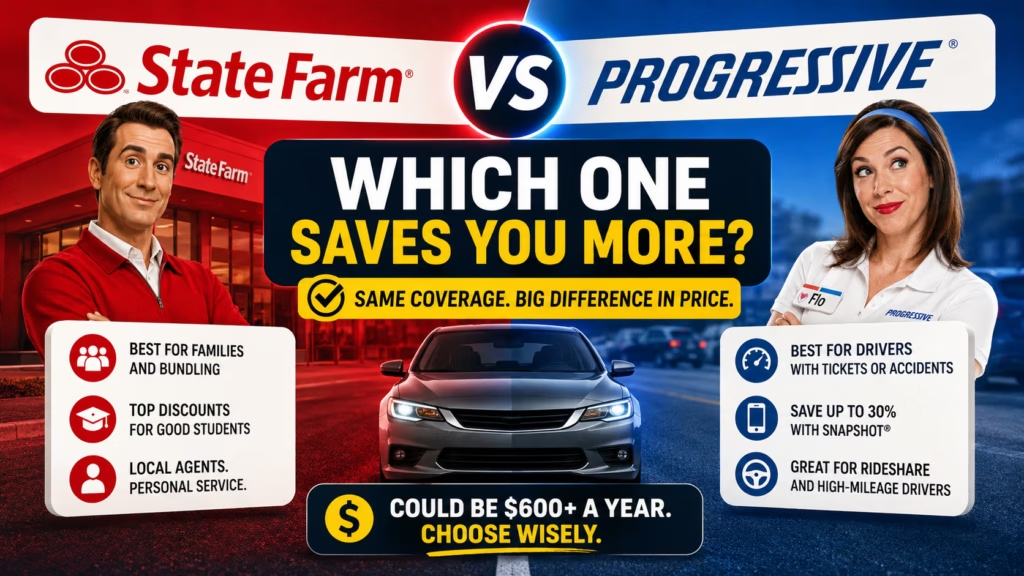
You have narrowed your search to two names that dominate every “top ten” list. State Farm, the largest auto insurer in the country with an agent on every corner, promising warm handshakes and bundling magic. Progressive, the data-driven disruptor with its Snapshot app and a reputation for accepting drivers other carriers reject. For a driver with a spotless record, their quotes can land within $5 of each other. But the moment you add a teenager, a speeding ticket, or a rideshare job to the equation, the price gap explodes to $600 or more. Choosing wrong because both quotes “look about the same” is a mistake that costs you real money every single renewal. This comparison surgically dissects their pricing models, discount architectures, and claims realities to reveal who is actually cheaper for the life you live.
Quick Answer: For a driver with a clean record, State Farm and Progressive are nearly identical on base price, averaging $1,650–$1,950/year for full coverage. The tiebreaker is your risk profile. State Farm is cheaper for families bundling home or renters insurance, teens with good grades, and anyone who wants a local agent. Progressive is cheaper for drivers with tickets, accidents, or DUIs, rideshare drivers, and safe drivers willing to enroll in the Snapshot telematics program for a discount of up to 30%.
We analyze the 2026 rate data, unpack the discount fine print, and tell you exactly which company to pick based on your driving record, household composition, and coverage needs.
Head-to-Head Premium Analysis for 2026
Based on aggregated rate filings for a 40-year-old driver with full coverage (100/300/100 liability, comprehensive and collision with a $500 deductible), the national averages create an illusion of a dead heat.
- State Farm Average Annual Premium: $1,650–$1,950
- Progressive Average Annual Premium: $1,650–$1,950
On pure sticker price, neither company has a decisive edge for the median clean-record driver. However, State Farm’s rates drop dramatically faster as you approach the “preferred risk” tier—excellent credit, multiple policies, and long tenure. Progressive’s algorithm is flatter, spreading its cost evenly across risk pools, which punishes the perfect driver slightly less but rewards the imperfect driver significantly more. If you are an ideal risk, State Farm wins by a narrow margin. If you carry any blemish, Progressive pulls ahead decisively.
Discount Stacking: The Real Decider of Your Final Bill
Base rates are a mirage. The discounts you stack determine whether you pay $1,400 or $2,200. State Farm and Progressive take diametrically opposed approaches to discounting.
State Farm Discounts (Generous for Families and Loyalists)
State Farm rewards household consolidation and traditional risk mitigation. If you are insuring a family, a house, and a couple of cars, the discounts compound aggressively.
- Good Student: Up to 25% for full-time students with a B average or higher—the most aggressive student discount in the industry.
- Multi-Vehicle: Up to 20% when you insure more than one car.
- Bundling (Home/Renters/Life): Up to 25% combined savings across all policies.
- Drive Safe & Save Telematics: Up to 30% discount for safe driving monitored via app or OnStar.
- Accident Forgiveness and Loyalty Perks: Available after years of clean driving, preventing rate hikes after a first accident.
Progressive Discounts (Generous for Tech Users and Non-Standard Risks)
Progressive ties its deepest savings to telematics and financial behavior, making it the better choice for solo drivers and tech-savvy users.
- Snapshot Telematics: Up to 30% average savings for safe driving. Unlike State Farm, this is often the primary way to achieve the lowest possible rate.
- Paid-in-Full: Up to 10% for paying your entire term upfront.
- Continuous Insurance: 5–10% for maintaining coverage without a lapse.
- Multi-Vehicle: Up to 12%—noticeably smaller than State Farm’s cap.
- Rideshare Endorsement: Not a discount, but a $15–$30/month add-on that prevents a catastrophic coverage gap.
Verdict: If you have a teenager, a house, and multiple cars, State Farm’s discount ceiling is mathematically higher. If you are a single driver willing to let Snapshot track your driving, Progressive’s upfront telematics discount is the quickest path to a sub-$1,500 premium.
The High-Risk Divide: Why Progressive Dominates Non-Standard Drivers
This is the single most important distinction between the two companies. State Farm operates as a preferred-risk mutual company with a conservative underwriting appetite. Progressive built its modern identity on the “Name Your Price” tool and a willingness to accept non-standard risks.
- One at-fault accident: State Farm may apply a surcharge of 40–60% or choose not to renew if the loss ratio is unfavorable. Progressive accepts these drivers routinely and its rate increase typically averages 35–50%.
- DUI or SR-22/FR-44: Progressive is one of the largest SR-22 carriers in the country and will often insure DUI offenders immediately. State Farm frequently declines to write new policies for drivers with a recent DUI, referring them to a high-risk subsidiary or the non-standard market.
- Young drivers (under 25): Progressive consistently beats State Farm on premiums for solo young drivers, especially males under 25, by $200–$500 annually.
If your driving record contains any violations, Progressive is not just cheaper—it is often the only viable option between the two.
Customer Service and Claims: Agents vs. Algorithms
The purchasing and claims experience differs fundamentally. State Farm relies on its captive agent network—over 19,000 strong—to serve as a local intermediary. Progressive relies on its app, website, and call centers to deliver a direct-to-consumer experience.
- J.D. Power Overall Satisfaction (2025): State Farm scored 884 out of 1,000, ranking among the industry leaders. Progressive scored 862, above average but trailing by a significant gap in customer interaction.
- NAIC Complaint Index: State Farm records a remarkably low 0.68 complaint ratio. Progressive sits at 1.05, slightly worse than the industry average of 1.0.
- Claims Speed: State Farm agents can handhold you through a complex claim. Progressive’s digital-first claims tool can deliver faster turnaround on simple fender-benders but may feel impersonal during a severe accident.
If you value a personal relationship and want a human to call when something goes wrong, State Farm is the superior service provider. If you prefer to handle everything via an app and never speak to an agent, Progressive’s digital infrastructure is faster.
Definitive Buyer’s Guide: Who Chooses Which in 2026
Find your profile and make the call.
Choose State Farm If…
- Your driving record is clean and your credit score is excellent.
- You have a teen driver who can earn the 25% good student discount.
- You own a home or rent and plan to bundle your policies for maximum savings.
- You want a local agent you can visit face-to-face.
- You prefer high-touch customer service and faster claims settlements.
Choose Progressive If…
- You have a speeding ticket, accident, DUI, or need an SR-22 filing.
- You are a single driver under 25.
- You drive for Uber, Lyft, DoorDash, or Instacart.
- You are a low-mileage, safe driver willing to enroll in Snapshot to maximize your discount.
- You prefer managing your policy entirely online without agent interaction.
The 10-Minute Rule That Saves You Hundreds
In the time it takes to brew a pot of coffee, you can stop guessing. State Farm and Progressive both deliver bindable quotes online in under ten minutes. Because their pricing models serve entirely different risk appetites, the gap between their quotes for your specific profile will reveal exactly who wins. Do not assume the jingle you remember means the cheapest premium. Run the numbers. Stack the discounts. Keep the money.
👉 Are you overpaying because of your credit? Use our 30-second estimate tool to compare baseline rates in your ZIP code and see where you stand.
Sources: State Farm and Progressive rate filings (2026), Quadrant Information Services, J.D. Power 2025 U.S. Auto Insurance Study, NAIC Complaint Index, company underwriting guidelines.