
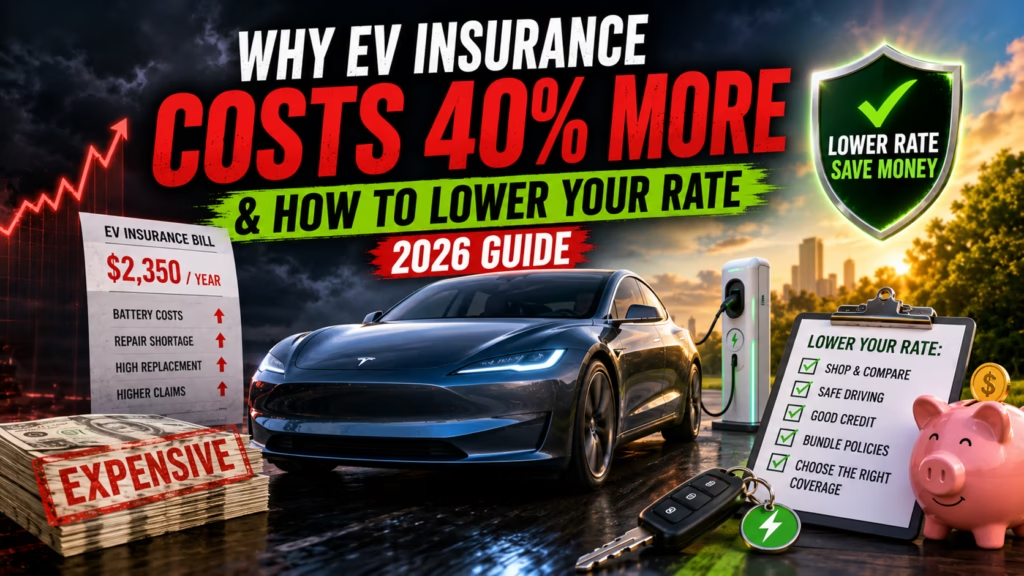
Buying an electric vehicle was supposed to save you money on gas. But when your first insurance bill arrives, that financial victory often turns into sticker shock. In 2026, insuring an electric vehicle costs an average of 30% to 40% more than insuring a similar gas-powered car.
Quick Answer: EV insurance is more expensive primarily because of battery replacement costs (often $10,000+) and a shortage of certified repair shops, which makes minor accidents more likely to result in a total loss. On average, a Tesla Model 3 costs $2,350/year to insure, compared to $1,550 for a gas-powered Honda Accord. The cheapest way to insure a Tesla is usually through Tesla Insurance (where available), while GEICO and Progressive tend to be best for non-Tesla EVs.
If you own a Tesla, Ford Mustang Mach-E, Hyundai Ioniq, or Rivian, you are being overcharged if you don’t understand the specific quirks of EV insurance. Here is exactly why your rates are high and how to fight back.
The 3 Reasons EV Insurance Is So Expensive
It’s not price gouging by insurers—it’s cold, hard math. EVs fundamentally change the risk profile of a vehicle:
- The “Total Loss” Battery Problem: In a gas car, if you hit the rear bumper at 15 mph, a body shop replaces the plastic and paints it. In many EVs, the high-voltage battery pack sits low in the chassis. Even a minor impact can crack the battery casing. Because batteries cannot be safely repaired, the entire $15,000+ pack must be replaced. If the car is 3 years old, replacing the battery often costs more than the car is worth, forcing the insurer to “total” the car.
- The Certified Repair Shop Shortage: There are tens of thousands of standard mechanic shops in the US, but only a fraction are certified to handle high-voltage EV systems. Fewer shops mean longer repair times, higher labor rates, and massive rental car bills that insurers have to pay out.
- The Acceleration Factor: EVs have instant torque. A Tesla Model 3 can hit 60 mph in under 4 seconds. Unfortunately, this leads to a higher frequency of at-fault accidents among everyday drivers who aren’t used to that kind of power.
2026 EV Insurance Cost Comparison (Real Data)
Based on a 40-year-old driver with a clean record carrying full coverage, here is what you can expect to pay annually for popular EVs compared to a gas equivalent:
- Tesla Model 3: $2,350 / year
- Tesla Model Y: $2,450 / year
- Rivian R1T (Truck): $2,800 / year (High replacement cost + truck liability)
- Ford Mustang Mach-E: $2,100 / year
- Hyundai Ioniq 5: $1,950 / year
- Chevrolet Bolt EV: $1,850 / year
- For Context — Honda Accord (Gas): $1,550 / year
*Source: Quadrant Information Services, 2026 projections. Rates will vary by ZIP code.
👉 Stop overpaying for your EV. Use our 30-second estimate tool to see exactly what drivers in your ZIP code are paying for your specific EV model.
The “Tesla Insurance” Loophole
If you drive a Tesla, this is the most important section. Tesla launched its own insurance company, and in the states where it operates (CA, TX, IL, AZ, CO, MD, OH, VA, etc.), it is usually 20% to 30% cheaper than Geico, State Farm, or Progressive.
Why is it cheaper? Because Tesla has direct access to your car’s computer. Instead of guessing your risk based on your credit score and age, Tesla uses your real-time Safety Score (measuring hard braking, aggressive turning, and following distance). If you drive safely, you are rewarded instantly. If you drive aggressively, your rate goes up.
Note: If you have a poor Safety Score or a history of speeding tickets, Tesla Insurance might actually quote you *higher* than traditional insurers.
Hidden EV Insurance Traps You Must Ask About
When getting quotes, do not assume the agent understands EVs. Specifically ask about these three things:
- OEM vs. Aftermarket Parts: Some insurers will try to use aftermarket parts to repair your EV. Demand an “OEM Parts Endorsement” to ensure only factory Tesla/Ford/Hyundai parts are used, which is critical for maintaining your battery warranty and safety ratings.
- Does Homeowners Cover My Charging Station? If you have a Level 2 charger hardwired to your house, it is usually covered under your home insurance, not your auto insurance. However, portable chargers kept in your trunk are covered by your auto policy. Verify this with your home insurer.
- EV Roadside Assistance: Running out of battery (vs. running out of gas) requires a flatbed tow truck, not a simple gas can. Standard roadside assistance might not cover the $200+ flatbed fee required to tow an EV safely without damaging the battery. Ensure your policy includes EV-specific towing.
5 Ways to Lower Your EV Insurance Premium
- Optimize Your Telematics: Whether it’s Tesla Insurance’s Safety Score or Progressive’s Snapshot, drive smoothly for 30 days before your policy renews to lock in a discount.
- Drop Collision on Older EVs: If you drive a 2017 Chevy Bolt worth $8,000, dropping collision coverage can save you $600/year. Apply the standard “25% rule” (if comp/coll costs more than 25% of the car’s value, drop it).
- Garage Your EV: Insurers give significant discounts for vehicles kept in a locked garage, especially in areas prone to hail or theft (Teslas are highly targeted for catalytic converter and battery component theft).
- Join an EV Club/Association: Some regional EV clubs offer discounted group insurance rates through specific brokers.
- Shop Every 6 Months: The EV insurance market is evolving faster than gas cars. A company that overcharged you in 2025 might have adjusted their algorithms for 2026.
Frequently Asked Questions
Do I need special insurance to charge my EV at public stations?
No. Your standard liability insurance covers you if you damage someone else’s property or vehicle while plugged into a public charger. However, if your car is vandalized or the charging cable is stolen while plugged in, that falls under your comprehensive coverage.
Does car insurance cover battery degradation?
No. Battery degradation (losing range over 5 years due to normal use) is considered normal wear and tear, just like brake pads on a gas car. Insurance only covers sudden, accidental battery damage (like a crash or a power surge).
Is Gap Insurance necessary for an EV?
Absolutely yes. EVs depreciate incredibly fast in their first 3 years. If you take out a $45,000 loan for a Tesla Model Y, and it’s totaled in year two when it’s only worth $30,000, you will owe the bank $15,000 out of your own pocket without Gap Insurance. It usually only costs $20-$40 a year and is mandatory if you are leasing.
Stop Paying Gas-Car Rates for an EV Risk
The auto insurance industry is still playing catch-up to the EV revolution. Some companies will overcharge you because their algorithms don’t know how to handle your car’s data yet. Don’t let them. Enter your ZIP code and EV model below to force insurers to compete for your business in real-time, completely anonymously.
Sources: Quadrant Information Services (2026 Data), Tesla Insurance Rate Filings, Insurance Information Institute (III), National Automobile Dealers Association (NADA) EV Depreciation Guide.