
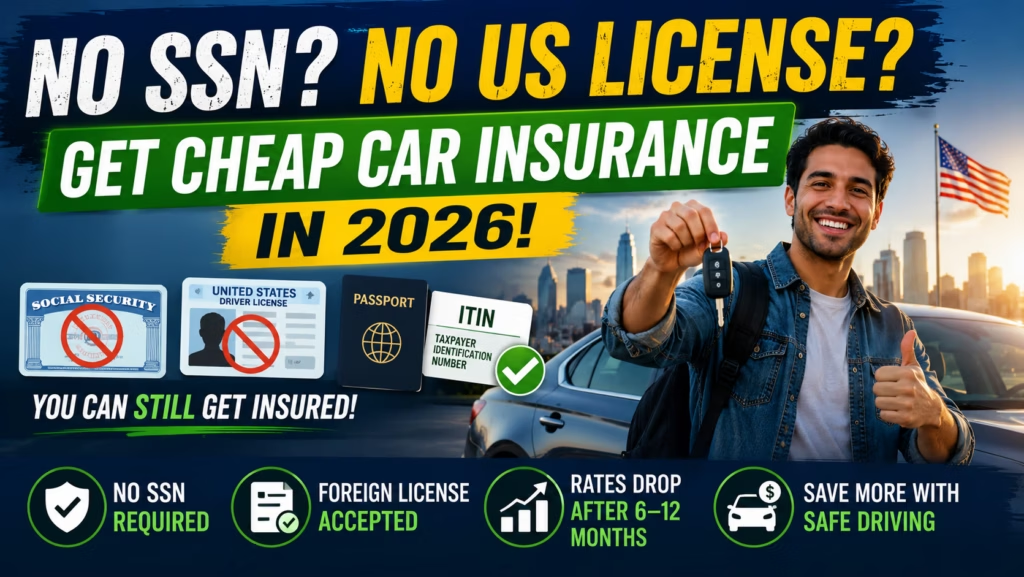
You just arrived in the United States. You found an apartment, started a job, and now you need a car. But every insurance quote form demands a Social Security Number and a U.S. driver’s license—two things you do not have yet. Right then, the doubt hits: Can I even get insured? The answer is a definitive yes. Thousands of immigrants secure affordable car insurance every single day without an SSN or a U.S. driving history. You simply need to know which companies to call, which documents to have ready, and how to avoid the biggest pricing traps.
Quick Answer: Yes, you can buy car insurance as a new immigrant without a Social Security Number or a U.S. driver’s license. Most major insurers accept an Individual Taxpayer Identification Number (ITIN) and a valid foreign driver’s license (with a certified translation) to issue a policy. Expect to pay 15–30% more for the first 6–12 months because you lack a U.S. credit and driving record. After that, your rates drop significantly—especially if you use telematics to prove you are a safe driver.
This guide removes the confusion. We will show you exactly which carriers welcome immigrants, how to get a quote without an SSN, why your foreign driving history matters, and the fastest paths to lower premiums in 2026.
Do You Need a U.S. Driver’s License Right Away?
Many insurers will write a policy using a valid foreign driver’s license for the first 30 to 90 days after your arrival. However, state laws require you to obtain a local license from the Department of Motor Vehicles (DMV) within a set timeframe after establishing residency—typically 30 to 60 days. Driving without a valid license beyond that window can result in fines and invalidated insurance.
Action plan: Start the DMV process immediately. A U.S. license not only satisfies the law but also unlocks lower rates and more carrier options. While waiting, keep your foreign license, passport, and I-94 arrival record with you at all times.
Social Security Number vs. ITIN: What Insurers Actually Need
You do not need a Social Security Number (SSN) to get car insurance. If you do not yet have an SSN, you can use an Individual Taxpayer Identification Number (ITIN), which the IRS issues for tax purposes. Many standard and non-standard insurers treat the ITIN the same way they treat an SSN for identity verification.
If you have neither an SSN nor an ITIN, several carriers—including The General, Direct Auto, and some Progressive underwriters—will still bind coverage using your passport number, visa type, and foreign license. When speaking with an agent, ask directly for “no SSN required” quotes. You may pay a small premium surcharge initially, but after six months of continuous coverage you can reshop and eliminate it.
Why New Immigrants Pay Higher Rates (And How to Fix It Fast)
Insurance companies price risk based on data. Without a U.S. driving record or credit file, you are a statistical unknown. The industry calls this a “thin file” or “no-hit” consumer. Consequently, carriers apply a surcharge of 15–30% above what a comparable U.S.-born driver with a clean record would pay. The good news is that this surcharge is temporary—and you can accelerate its removal.
Here are the most effective ways to slash your rates within 6 to 12 months:
- Never let your coverage lapse. Even a one-day gap resets your “prior insurance” history and sends you back to high-risk pricing.
- Enroll in a telematics program. Usage-based insurance like Progressive Snapshot or State Farm Drive Safe & Save tracks your driving through a mobile app. Prove you brake gently, avoid late-night trips, and stay off your phone, and you can earn a 10–30% discount after just six months—regardless of credit history.
- Bundle with renters insurance. Adding a renters policy (often $15–$25 per month) lowers your auto premium by 5–15% through multi-policy loyalty discounts.
- Take a state-approved defensive driving course. Many online courses cost $25 or less and yield an immediate 5–10% discount on liability and collision premiums.
- Pay your premium in full. Carriers frequently offer 5–10% off if you pay the entire 6-month term upfront instead of monthly.
Best Car Insurance Companies for Immigrants Without U.S. History
Not all insurers are immigrant-friendly. These six companies consistently accept ITINs, foreign licenses, and thin credit files while offering competitive rates in 2026:
- Progressive: Accepts foreign licenses and ITINs; online quote tool works without an SSN in many states. Strong telematics discount with Snapshot.
- GEICO: Immigrant-friendly underwriting. If the online form requires an SSN, call their phone agents directly—they often bypass the field using a passport number.
- State Farm: Local agents frequently have the flexibility to bind policies using alternative ID. Visit an agent in person with your passport, visa, and proof of address for the smoothest experience.
- The General: Specializes in non-standard, high-risk drivers, including new immigrants. No SSN required and offers bilingual agents.
- Direct Auto Insurance: Explicitly markets to immigrant communities, accepts ITINs, and provides Spanish-language service. Good option for those with a foreign license only.
- Infinity Insurance: A strong option in California, Florida, and Texas for drivers without credit history; accepts ITINs and offers low down-payment plans.
How to Get a Quote Without a U.S. License or SSN
Follow this step-by-step process to secure coverage smoothly:
- Gather the required documents: Passport, valid visa (or I-94), foreign driver’s license with a certified English translation, and proof of U.S. address (lease agreement, utility bill, or bank statement).
- Call insurers directly—do not rely only on online forms. Many websites are hard-coded to demand an SSN or U.S. license number. Phone agents can override these fields.
- Visit an independent insurance agent. Find one via TrustedChoice.com who represents multiple carriers. They know exactly which companies accept ITINs and foreign documents.
- Consider a non-owner auto policy if you do not yet own a vehicle but occasionally drive a friend’s car. This builds continuous coverage and protects you from liability gaps.
Can Your Foreign Driving Record Help You?
Yes—if you come from a country with a reciprocal agreement or a recognized licensing system. Progressive and GEICO accept driving records from Canada, the United Kingdom, Germany, South Korea, and Japan, and they may use that history to offer a better rate. For other countries, a letter of experience from your previous foreign insurer (translated into English) can serve as proof of accident-free driving. While not all carriers honor it, the letter adds credibility during underwriting and can sometimes tip a quoted rate downward.
If your foreign record is not accepted, you will start with a clean U.S. slate—but that blank slate is far better than a record with accidents. Focus on building that positive history quickly.
Special Situations: Students, Work Visas, and Tourists
If you are in the U.S. on a temporary visa, insurance options still exist:
- F-1 and J-1 international students: Many universities partner with insurers to offer discounted car insurance. Check with your international student office. You can also be added as a rated driver to a host family’s policy if you drive their car.
- H-1B and L-1 workers: Your valid SSN or ITIN, plus a U.S. license (which you should obtain immediately), will qualify you for standard market rates after just six months of history.
- Tourists and short-term visitors: If you plan to drive a rental car, purchase the rental company’s liability and damage waivers—they do not require a U.S. policy. For long-term stays, you must buy a standard policy from a U.S. carrier.
State Laws That Work in Your Favor
Credit-based pricing is a major obstacle for immigrants who have no U.S. credit history. Several states have banned or restricted the use of credit scores in auto insurance rating, which directly benefits newcomers:
- California – Prohibits credit scoring entirely (Proposition 103). A huge advantage.
- Hawaii – Complete ban on credit-based insurance scores.
- Massachusetts – Credit cannot be used for rating.
- Michigan – Banned as a primary rating factor.
- Washington – Recently enacted strict limitations.
If you live in one of these states, your lack of credit will not penalize you at all. In all other states, insurers can—and will—use your thin credit file to charge higher rates initially.
Don’t Wait—Get Insured Today and Reap Lower Rates Tomorrow
Driving without insurance is illegal in nearly every state and can lead to license suspension, fines, and even deportation risks in extreme cases. Do not let confusion about SSNs or licenses stop you. Call Progressive, GEICO, or an independent agent this week with your passport, visa, and proof of address. Accept that you will pay a little more for the first six months—and then aggressively shop for new quotes once you have built continuous coverage and telematics proof of safe driving.
👉 Are you overpaying because of your credit? Use our 30-second estimate tool to compare baseline rates in your ZIP code and see where you stand.
Sources: U.S. Citizenship and Immigration Services (USCIS), Insurance Information Institute (III) 2026 Auto Insurance Report, state DMV handbooks for immigrants, Progressive Insurance Underwriting Guidelines, GEICO Non-Standard Auto Filings, Consumer Financial Protection Bureau (CFPB) analysis of credit-based insurance scoring.