
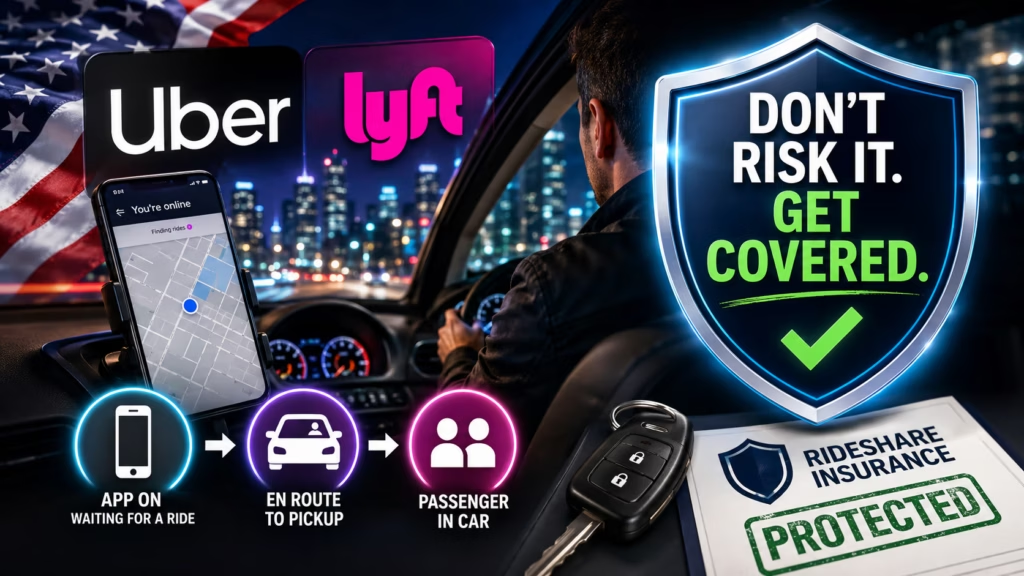
If you drive for Uber or Lyft, turning on the app instantly creates a dangerous legal gray area. The moment you accept a ride request, your personal auto insurance company can legally deny any claim—even if the accident wasn’t your fault.
Quick Answer: Standard personal auto policies exclude “livery” (driving for profit). To be properly covered, you must buy a Rideshare Endorsement from your insurer (which costs an extra $15–$30/month) to fill the coverage gap while you are waiting for a passenger. Relying solely on Uber or Lyft’s insurance leaves you exposed to massive out-of-pocket costs for car repairs.
According to the Insurance Information Institute, nearly 40% of gig drivers are dangerously underinsured because they don’t understand how the coverage phases work. Here is exactly how to protect yourself and your car in 2026.
The “Livery Exclusion”: Why Personal Insurance Fails
Read the fine print of your personal auto policy, and you will likely find a “livery exclusion.” This clause states that if you use your vehicle to transport people or goods for money, your policy is voided.
If you get into an accident with the Uber app on and try to file a claim with Geico, State Farm, or Allstate, they will investigate, see you were ridesharing, deny the claim, and likely cancel your policy. That leaves you 100% personally liable for medical bills and car repairs.
The 3 Phases of Rideshare Coverage (Where the Gap Lives)
Insurance for Uber and Lyft isn’t a single blanket. It is broken into three distinct phases. Understanding this is the key to not getting ripped off:
- Phase 1: App is OFF (You are a normal driver)
Your standard personal auto insurance covers you fully here. You are just driving to the grocery store. - Phase 2: App is ON, Waiting for a Match (THE DANGER ZONE)
You are driving around waiting for a ping. Uber/Lyft provide a very basic liability limit (usually $50,000/$100,000/$25,000) if you hit someone else. However, they provide $0 for damage to YOUR car. If you hit a pothole or another driver backs into you, you pay for your own repairs entirely out of pocket. - Phase 3: En Route to Pickup / Passenger in Car (The Safe Zone)
Once you accept a ride and are driving to get the passenger (and while they are in the car), Uber/Lyft provide up to $1 million in liability coverage. They also provide contingent collision coverage for your car, but it comes with a massive $2,500 deductible that comes out of your pocket.
The Best Fix: A Rideshare Endorsement
You don’t need an expensive commercial trucking policy. You just need a “Rideshare Endorsement” (sometimes called TNC coverage) added to your existing personal policy.
For an extra $15 to $30 a month, this endorsement “drops down” your personal comprehensive and collision coverage into Phase 2. If someone hits your car while you’re waiting for a ride request, your personal insurer pays to fix your car, just as if you were driving to work.
Top Insurers Offering Rideshare Endorsements (2026):
- Progressive: One of the most widely available rideshare endorsements in the country.
- State Farm: Offers a rideshare add-on in most states, known for excellent customer service during claims.
- Allstate: Offers rideshare coverage, but availability varies by region.
- Farmers & USAA: Great options if you already have a policy with them (USAA is for military families).
- Geico: Offers rideshare insurance, but notoriously strict about underwriting—call them directly to verify you qualify.
What About Full Commercial Insurance?
If you drive 40+ hours a week and treat ridesharing as your full-time job, a commercial auto policy might make sense. It covers you 100% of the time, regardless of whether the app is on or off. However, it is significantly more expensive—usually $300 to $600 per month. For 90% of part-time drivers, the Rideshare Endorsement is the smarter financial move.
Estimated Rideshare Insurance Costs (2026)
- Standard Personal Policy: $150 – $250 / month
- Personal Policy + Rideshare Endorsement: $170 – $280 / month (+$15 to $30)
- Dedicated Commercial Policy: $300 – $600 / month
*Rates depend heavily on your driving record, vehicle type, and ZIP code.
👉 Don’t guess your rate. Use our 30-second estimate tool to see your base rate, then call that insurer to ask how much their rideshare endorsement costs on top of it.
Frequently Asked Questions
What happens if I lie to my insurance company about driving for Uber?
This is considered material misrepresentation. If you get into an accident and the adjuster finds the Uber app was on your phone (they almost always check phone records during investigations), they will deny the claim, cancel your policy, and you could be sued personally for tens of thousands of dollars. It is never worth the risk.
If I get into an accident in Phase 2, do I have to pay the $2,500 Uber deductible?
If you ONLY have Uber’s insurance, yes. In Phase 2 (waiting for a ride), Uber does not cover your car’s physical damage at all. The $2,500 deductible only applies in Phase 3 (when you have a passenger). This is exactly why you need a Rideshare Endorsement from your personal insurer to cover your car in Phase 2.
Do I need to tell my insurer if I only drive 5 hours a week?
Yes. The moment you turn the app on to accept a fare, you are operating as a business. There is no “part-time exception” in insurance contracts. If you are in an accident during those 5 hours, you will be treated exactly the same as a full-time driver who didn’t disclose their job.
Bottom Line: Protect Your Asset
Your car is your money-maker as a rideshare driver. Driving without a rideshare endorsement is like running a restaurant without fire insurance—it’s fine until a single bad day bankrupts you. Call your insurer today, add the endorsement, and drive with peace of mind. Enter your ZIP code below to benchmark your current base rate against competitors in seconds.
Sources: Insurance Information Institute (III), Uber Insurance Coverage Guidelines, Lyft Insurance Policy, Quadrant Information Services (2026 projections).