
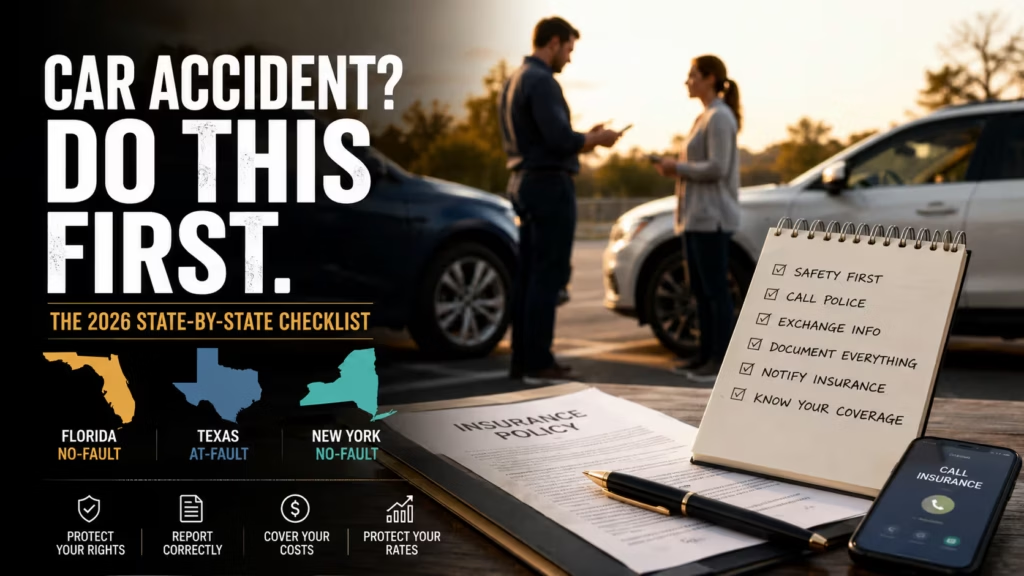
The first ninety seconds after a collision decide more about your claim than anything an adjuster does weeks later. Call 911 if anyone is hurt, move to safety if the vehicles still drive, and exchange information with every driver involved — but never say “I’m sorry” or guess at fault while you’re still standing on the shoulder. What happens after that depends heavily on where the crash occurred. Florida and New York route bodily injury claims through no-fault Personal Injury Protection first. Texas assigns the bill directly to whichever driver caused the wreck. The police-report thresholds, minimum coverage limits, and the deadline to notify your own carrier are all different in each state, and getting one of them wrong can cost you the claim entirely.
Key Takeaway: After a car accident in Florida, Texas, or New York, stop the vehicle, call 911 for any injury, and request police response once property damage crosses each state’s reporting line — $500 in Florida (rising to $2,000 on October 1, 2026), and $1,000 in both Texas and New York. Florida and New York are no-fault states, so your own Personal Injury Protection pays medical bills first regardless of fault. Texas is an at-fault state, so the driver who caused the crash — and their liability coverage — pays. In every state, document the scene, avoid admitting fault, and notify your insurer within 24 to 48 hours.
There is no version of this process that fully removes the stress of a car accident. But the size of the financial fallout — whether a fender-bender stays a $600 repair or turns into a six-month coverage dispute — is something you control. In practice, the drivers who lose ground on a claim rarely lose it because fault was unclear. They lose it because they skipped the police report on a “minor” crash, waited too long to see a doctor, or said the wrong thing at the scene. This guide walks through the sequence that protects a claim in all three states, then breaks down exactly how Florida, Texas, and New York differ once the tow trucks leave.
Navigate This Guide:
- What to Do Immediately After a Car Accident
- Do You Have to Call the Police After a Car Accident?
- Is Florida a No-Fault Car Insurance State?
- Is Texas an At-Fault Car Accident State?
- What Are New York’s No-Fault Car Accident Rules?
- What If the Other Driver Doesn’t Have Insurance?
- Should You File a Claim or Pay Out of Pocket?
- How Much Will an Accident Raise Your Insurance Rates?
- What Mistakes Cost Drivers Their Claim?
- Frequently Asked Questions
What to Do Immediately After a Car Accident, Step by Step
Every state handles fault differently, but the first several minutes after a crash follow the same sequence everywhere: safety, medical assessment, documentation, then notification. Skipping steps — even out of shock — can undercut a claim that would otherwise have been straightforward.
- Stop and stay at the scene. Leaving before exchanging information and, where required, waiting for police is a hit-and-run in all three states — a third-degree felony in Florida when there’s injury, a state-jail felony in Texas involving injury, and a Class E felony in New York when injury or death occurs.
- Call 911 for any injury. Even a driver who feels fine can have a soft-tissue injury that surfaces 24 to 72 hours later. An EMS or police record timestamps the connection between the crash and the injury, which matters enormously if a PIP or bodily injury claim gets disputed down the line.
- Move to safety if the vehicle is drivable and blocking traffic. Pull onto the shoulder or into a nearby lot and turn on your hazard lights. Staying in a live traffic lane to “preserve the scene” causes more secondary collisions than it prevents disputes.
- Request police response based on your state’s threshold. Covered in detail in the next section — when in doubt, call, since the report costs nothing and protects you either way.
- Exchange information with every driver, not just the one you believe is at fault. Get full name, phone number, insurer, policy number, driver’s license number, and license plate from each vehicle involved.
- Photograph everything before vehicles move. Wide shots of the full scene, close-ups of damage and plates, road markings, skid marks, traffic signals, and weather conditions all matter later.
- Collect witness contact information on the spot. Witnesses leave within minutes, and a name and phone number gathered at the scene can resolve a disputed-fault claim that would otherwise come down to two conflicting accounts.
- Say only what is necessary. “I’m sorry” or “I didn’t see you” gets logged in the police report and cited by an adjuster as an admission, even when the full picture shows shared or zero fault on your part.
- Notify your own insurer within 24 to 48 hours — even if you believe the other driver was entirely at fault. Most policies contain a prompt-notice clause, and a late report can give the carrier grounds to deny coverage on a technicality that has nothing to do with who caused the crash.
None of these nine steps requires legal training. They require discipline in a moment when adrenaline is working against you. In practice, the accidents that turn into prolonged insurance disputes are rarely the ones with unclear fault — they’re the ones where someone skipped step six or step nine.
- PIP (Personal Injury Protection)
- First-party medical and wage-loss coverage that pays regardless of fault, required in no-fault states such as Florida and New York.
- PDL (Property Damage Liability)
- Coverage that pays for damage you cause to someone else’s vehicle or property.
- UM/UIM (Uninsured/Underinsured Motorist)
- Coverage that pays you when the at-fault driver has no insurance, or not enough insurance, to cover your losses.
- Modified Comparative Negligence
- A fault rule, used in both Florida and Texas, that bars recovery entirely once a claimant is found 51% or more at fault for the crash.
- Serious Injury Threshold
- The legal bar an injury must clear — a fracture, permanent injury, or similar — before a driver in a no-fault state can sue the at-fault party.
Do You Have to Call the Police After a Car Accident?
Yes, in Florida, Texas, and New York, once the crash involves injury, death, or property damage that crosses the state’s reporting threshold — but that dollar line is different in each state, and missing it can turn a simple claim into a coverage fight.
(rising to $2,000 on Oct. 1, 2026)
Transportation Code §550.026
Vehicle & Traffic Law §605
Florida Statute §316.065 requires immediate notification to police once apparent damage reaches $500 or an injury occurs — a lower bar than most states, since modern bumpers hide sensors and brackets that push repair costs past $500 faster than the damage looks at the scene. That threshold is changing: Senate Bill 488 (Chapter 2026-39) raises it to $2,000 for crashes occurring on or after October 1, 2026. The rule that applies is the one in effect on the date of the crash, not the date you file the claim, so it’s worth knowing which side of that date your accident falls on.
Texas Transportation Code §550.026 sets a flat $1,000 threshold for property-damage-only crashes. A cracked parking-assist sensor alone can price out at $600 to $900 installed, so that number is easier to reach than most drivers expect. Failing to report a qualifying crash is a Class C misdemeanor, and just as importantly, it strips you of the CR-3 crash report that adjusters rely on to establish fault.
New York layers two separate obligations. If police don’t respond to a property-damage-only crash, Vehicle and Traffic Law §605 still requires the driver to file Form MV-104 with the DMV within 10 days once damage to any one person’s property — including your own car — exceeds $1,000. A police report at the scene does not excuse this filing; failing to submit the MV-104 can trigger a license suspension even when the crash was not your fault.
What if I’m not sure the damage crosses the threshold?
Call anyway. Requesting police response costs nothing and creates a record if the damage later turns out to exceed the threshold once a shop opens up the bumper. Waiting to find out after the fact means driving back to the scene or filing a self-report from memory — both worse options than a five-minute police visit while the vehicles are still there.
Is Florida a No-Fault Car Insurance State?
Yes. Florida requires every driver to carry $10,000 in Personal Injury Protection (PIP), which pays your own medical bills and lost wages after a crash regardless of who caused it — a structure very different from the at-fault system used in neighboring Georgia and Alabama.
The detail most Florida drivers miss is that bodily injury liability isn’t mandatory. A driver can be fully compliant with state law and still carry zero coverage for the medical bills they cause someone else. That’s the entire reason uninsured/underinsured motorist coverage matters so much in Florida — more on that in the next section.
Is Texas an At-Fault Car Accident State?
Yes. Texas follows the traditional tort system: the driver who caused the crash — or, more precisely, their liability insurer — pays for the other party’s medical bills, lost wages, and vehicle damage. There’s no PIP-first buffer like the one in Florida or New York.
During a claim analysis on a Texas at-fault crash, the first document an adjuster pulls is the CR-3. It anchors the liability determination, and everything else — medical bills, repair estimates, lost-wage documentation — gets measured against that fault finding.
What Are New York’s No-Fault Car Accident Rules?
New York is a no-fault state with the highest PIP minimum of the three — $50,000, five times Florida’s requirement — which changes how quickly medical bills get paid and how hard it is to sue the other driver.
A very common scenario in New York claims: a rear-end collision with $3,000 in vehicle damage and a driver who feels stiff for two weeks. No-fault pays the medical bills through PIP. But without a fracture, surgery, or a documented 90/180-day impairment, that driver has no separate bodily injury claim against the at-fault driver — the injury simply doesn’t clear the statutory bar, even though the accident was clearly someone else’s fault.
See What Your Policy Would Actually Pay
Coverage minimums are only the floor. Compare 2026 rates and real limits from top-rated carriers in Florida, Texas, and New York before your next renewal.
GET YOUR 2026 CAR INSURANCE QUOTESWhat If the Other Driver Doesn’t Have Insurance?
Uninsured/underinsured motorist (UM/UIM) coverage is the only real protection in this scenario, and the three states treat it very differently — Florida makes it optional, Texas requires insurers to offer it, and New York makes it mandatory.
Reviewing every available policy — yours, a resident relative’s, and the at-fault driver’s — is one of the first things an experienced claims professional checks when the at-fault driver’s coverage looks thin. If your own UM/UIM limits are set at the state minimum, they may not cover a serious injury any better than the at-fault driver’s inadequate policy would have.
Should You File an Insurance Claim or Pay Out of Pocket?
For damage under roughly $1,000 to $1,500, paying out of pocket sometimes avoids a rate increase — but only if you still report the accident to your insurer, because failing to report at all can violate your policy regardless of who pays for the repair.
Ask your agent for a same-day repair estimate before deciding. Many carriers will run a preliminary damage assessment without opening a full claim file, which gives you a real number instead of a guess.
Does reporting a minor accident to my insurer always raise my rate?
Not necessarily. A single not-at-fault report, especially one supported by a police report clearing you of fault, often has no rate impact at most carriers. Rate increases are driven primarily by at-fault claims and by a pattern of multiple claims within a short window, not by a single, well-documented report.
How Much Will an Accident Raise Your Insurance Rates?
An at-fault accident typically raises premiums by 20% to 50% nationally, though the exact number depends on the carrier, your prior claims history, and — in no-fault states — whether the claim was a PIP-only medical claim or a liability claim with fault clearly assigned.
In Florida and New York, even a not-at-fault crash can nudge your premium slightly at renewal, because filing any claim adds a data point to your loss history that some carriers weight regardless of fault. In Texas, a not-at-fault crash backed by a clear CR-3 report typically has no rate impact at all, since fault is directly documented in the officer’s findings.
What Mistakes Cost Drivers Their Claim?
Most denied or reduced claims trace back to one of a handful of avoidable errors made in the hours and days after the crash, not to genuinely disputed facts about who caused it.
- Admitting fault at the scene. “I didn’t see the light change” or “I’m sorry” gets logged in the police report and cited by the adjuster as an admission, even if the full picture shows shared or zero fault.
- Skipping the police report on a “minor” crash. Damage estimates at the scene are unreliable. A bumper that looks like $400 in cosmetic damage regularly turns into $1,200 to $2,000 once a shop removes the fascia and finds a cracked sensor bracket.
- Waiting to see a doctor. In Florida, waiting past the 14-day window forfeits PIP medical benefits entirely. In New York, a documentation gap weakens the case for meeting the serious injury threshold. In Texas, delayed treatment gives the at-fault driver’s insurer an argument that the injury wasn’t crash-related.
- Posting about the accident on social media. Adjusters and defense attorneys routinely review public posts. A photo of you at the gym two days after reporting a back injury can undercut an otherwise legitimate claim.
- Accepting a settlement offer before treatment is complete. Once you sign a release, the claim is closed, even if symptoms worsen or a new injury surfaces weeks later.
Frequently Asked Questions About Car Accidents in Florida, Texas & New York
Do I have to call the police after a car accident in Florida, Texas, or New York?
Yes, in all three states once the crash involves injury, death, or property damage above the state’s threshold. Florida’s threshold is $500, rising to $2,000 for crashes on or after October 1, 2026. Texas and New York both use a $1,000 threshold, with New York requiring an MV-104 filing within 10 days when police don’t respond to a qualifying crash.
Is Florida a no-fault state for car accidents?
Yes. Florida requires $10,000 in PIP coverage that pays your medical bills and lost wages regardless of fault. Florida does not require bodily injury liability, and you can only sue the at-fault driver if your injury meets the state’s serious injury threshold.
Is Texas an at-fault or no-fault state?
Texas is an at-fault (tort) state. The driver who caused the crash pays through their liability insurance, subject to Texas’s minimum coverage of $30,000 per person, $60,000 per accident, and $25,000 for property damage.
How long do I have to report a car accident to my insurance company?
Most policies require prompt notice, generally interpreted as 24 to 48 hours. There’s no single statewide deadline, but a delayed report can give an insurer grounds to dispute or deny coverage under the policy’s notice provision, separate from any state reporting requirement.
What happens if the other driver doesn’t have insurance in Texas?
Your uninsured/underinsured motorist coverage becomes the primary source of recovery. Texas insurers must offer UM/UIM, and you can only decline it in writing, so most policies carry at least some level of this protection unless a driver actively opted out.
Can I be denied a claim for not calling the police?
Failing to file a required police or DMV report doesn’t automatically void your insurance coverage, but it removes the official documentation adjusters rely on to establish fault and damage, which weakens your position significantly in any disputed claim.
How much does car insurance go up after an accident in a no-fault state?
A not-at-fault claim in Florida or New York often has minimal or no rate impact, but it can still show up in your loss history and affect pricing at some carriers upon renewal. An at-fault claim, by contrast, typically raises premiums 20% to 50% regardless of state.
The States Are Different. The Discipline Isn’t.
Whether you drive in Miami, Houston, or Buffalo, the accidents that turn into prolonged disputes almost never come down to unclear fault. They come down to a skipped police report, a delayed doctor’s visit, or a rushed comment made while still standing at the scene. Florida’s no-fault PIP, Texas’s at-fault liability system, and New York’s higher-limit no-fault structure each demand a slightly different next step, but the habits that protect you — document everything, say little, report promptly — are identical across all three.
Your coverage is the part of this equation you can actually control before anything happens. If it’s been more than a year since you compared rates, or if your policy still reflects decisions you made when you first got your license, a quick comparison against current 2026 market pricing is worth the ten minutes it takes.
Sources: National Highway Traffic Safety Administration (NHTSA), Insurance Information Institute (Triple-I), National Association of Insurance Commissioners (NAIC), National Insurance Crime Bureau (NICB), Florida Statutes §§316.065, 316.066, 627.736 (Florida Senate), Florida Senate Bill 488 / Chapter 2026-39, Texas Transportation Code §550.026 and §601.072, Texas Civil Practice & Remedies Code Chapter 33, New York Vehicle and Traffic Law §605, New York Insurance Law §5102(d), New York State Department of Financial Services minimum auto insurance requirements, New York DMV Form MV-104 instructions.