
Every figure in this article is attributed to the sources listed under Sources, and figures we calculated ourselves are labeled as calculations. Estimates are not quotes. Instant Car Insure is a comparison and estimation tool, not an insurance company.
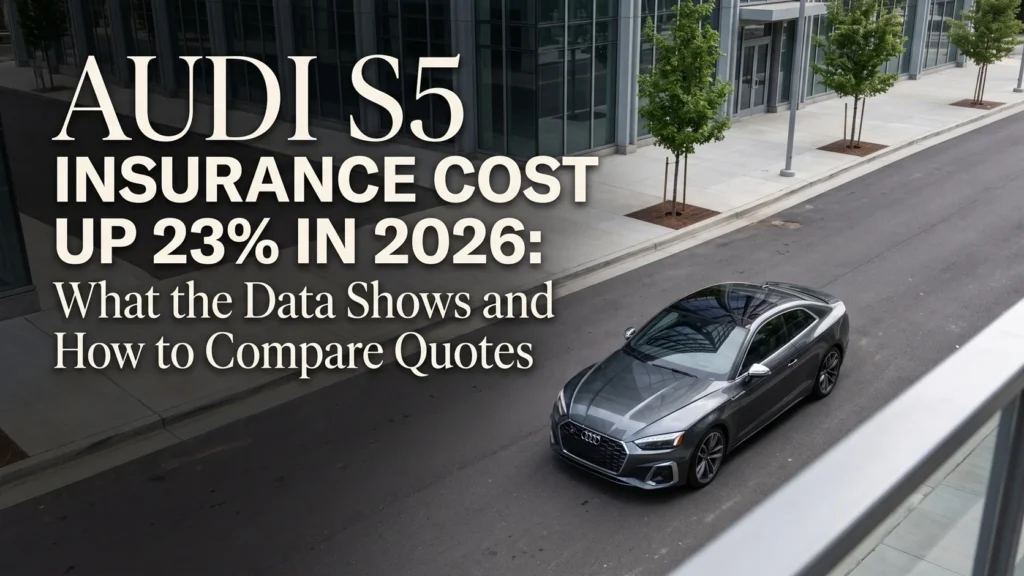
Audi S5 insurance premiums rose 23% year-over-year in 2026, the largest increase in Compare.com’s published ranking of 2025–2026 models. The average annual full-coverage premium now sits at $4,937, roughly $939 more than the prior year, according to a Compare.com study published in August 2026.
Key Findings
- Largest spike tracked. The S5’s 23% increase is the biggest year-over-year increase in Compare.com’s published ranking of 2025–2026 model-year vehicles (cargo vehicles are excluded from that ranking).
- The cause is not confirmed. Compare.com points to the S5’s changing model lineup, which may make insurers’ loss estimates less stable from year to year. Separate HLDI data, reported by ForCar, puts S5 collision losses at an index of 167, where 100 is the average vehicle, but it covers earlier model years (2022–2024).
- Estimates vary widely by source. Compare.com puts the S5 at $4,937 per year and The Zebra puts the 2025 model year at $4,067; ForCar, applying HLDI data for earlier model years to a 2023 national average premium, estimates $1,905. Differences in methodology, model year, and data period likely explain much of the gap.
Navigate This Guide
How Much Is Audi S5 Insurance in 2026?
The central figure for the 2025–2026 Audi S5 is $4,937 per year for full coverage, according to Compare.com’s August 2026 study, which AutoGuide also reported. That translates to a monthly equivalent of about $411 per month ($4,937 ÷ 12). This is a calculated monthly equivalent, not a billed monthly amount; the source provides an annual figure. Compare.com’s figure is built from two-year rolling medians of quotes for drivers aged 20 to 70, with $1,000 comprehensive and collision deductibles.
That puts the S5 at the top of Compare.com’s table of average premiums for 2025–2026 models. For a 2025 or 2026 model-year car, the average full-coverage premium is $2,879 per year, Compare.com reports. The S5’s premium is about 71% higher than that benchmark, or roughly $2,058 more per year (our calculation from Compare.com’s figures).
Other estimates vary, and the variation itself is informative. The Zebra lists the 2025 S5 at $4,067 per year ($339 per month) for a 30-year-old male driver with no violations, and its model-year averages for the S5 run from $2,243 (2011) to $4,067 (2025). MoneyGeek reports S5 full-coverage premiums averaging $205 per month (roughly $2,460 annually) across S5 model years for a 40-year-old unmarried male driver with a clean record, and $275 per month (about $3,300 annualized) for the 2025 model year, based on 100/300/100 liability limits and $1,000 deductibles. ForCar estimates the S5 at $1,905 per year — about 32% more than the $1,438 national average premium (NAIC, 2023) it uses as a base. That estimate applies HLDI loss data for model years 2022–2024 to the national average and is not a quote.
The gap between $1,905 and $4,937 is large. Differences in methodology, model year, data source, and timing likely explain much of it, rather than one number being “wrong.” Compare.com’s figure comes from quotes on 2025–2026 model-year vehicles (applications dated January 2025 to May 2026), while ForCar’s figure scales loss data from earlier model years by a 2023 national average premium. When sources disagree this widely, the safest reading is a range, with the newest model years at the high end.
Why Did Audi S5 Insurance Go Up 23% in 2026?
None of the sources reviewed for this article confirms a single cause for the S5’s 23% increase. Compare.com, which produced the figure, points to the S5’s changing model lineup. According to Compare.com, Audi began reshuffling its lineup in 2024, and the A4 and A5 merged into one vehicle, the A5. Consumer Guide reports that the S5 was redesigned for the 2025 model year and now comes only as a four-door sedan, with the coupe and convertible dropped after 2024. Compare.com’s view is that this kind of change may make insurers’ loss estimates for the S5 less stable from one year to the next.
Repair costs are part of the broader picture, but the evidence is indirect. HLDI loss data, reported by ForCar, puts the S5’s collision loss index at 167, where 100 is the average vehicle, meaning collision losses per insured vehicle run well above average. That index reflects model years 2022–2024, the generation before the 2025 redesign, so it suggests the S5 was already costly to insure for collisions before this year’s jump rather than explaining the jump.
Compare.com also notes more generally that an insurer pays more to repair a 2025 luxury model loaded with driver-assistance technology than an older car with simpler technology and more aftermarket parts available. That helps explain why new luxury models carry high premiums, though it does not isolate the S5’s year-over-year change.
The broader 2026 insurance environment also matters. Insurify projects the national average full-coverage premium will rise about 1% in 2026, to roughly $2,242 by year-end, after a 6% decline in 2025. That average hides large differences by model: in Compare.com’s data, the S5 rose 23% while the Audi A3 fell 16%, to $3,700.
What May Be Pushing S5 Premiums Up
- Changing model lineup — Compare.com says the S5’s changing model lineup may make insurers’ loss estimates less stable.
- High collision losses — HLDI collision index of 167 for model years 2022–2024.
- Repair complexity — newer luxury models with advanced driver-assistance systems cost insurers more to repair, per Compare.com.
What Could Bring Premiums Down
- More claims history — Compare.com suggests the Audi A3’s 16% drop may reflect insurers gaining several years of claims history after its redesign.
- Insurer differences — The Zebra’s 2025 S5 averages range from $2,508 to $6,459 a year depending on the insurer (30-year-old male driver, no violations), so comparing can matter more than waiting.
- Usage-based programs — MoneyGeek lists usage-based programs among ways to lower an S5 premium; results depend on your driving habits and insurer.
See How Your S5 Premium Compares
Get personalized estimates from multiple insurers in minutes. No pressure, no obligation.
GET YOUR CAR INSURANCE QUOTESWhat Drivers Should Do Now
If you own a 2025 or 2026 Audi S5, or you are considering buying one, Compare.com’s data shows the average S5 premium rose sharply in a single year. The average $939 increase works out to about $78 more per month (a calculated figure, not a billed amount).
Frequently Asked Questions About Audi S5 Insurance
Why did Audi S5 insurance go up 23% in 2026?
None of the sources reviewed for this article publishes a single confirmed cause. Compare.com, which produced the 23% figure, notes that Audi reshuffled its lineup and merged the A4 and A5 lines, and suggests the S5’s changing model lineup may make insurers’ loss estimates less stable from year to year. Separate loss data from HLDI, reported by ForCar, shows S5 collision losses at 167 where 100 is the average vehicle, but that data covers model years 2022–2024 and cannot by itself explain a 2025–2026 change.
Is the $4,937 average premium a quote for my S5?
No. It is Compare.com’s average full-coverage premium for 2025–2026 S5 quotes, calculated from two-year rolling medians for drivers aged 20 to 70. Your actual premium depends on your state, ZIP code, driving record, credit-based insurance score where applicable, coverage limits, deductible, and vehicle trim. Get a personalized quote from your insurer.
The Bottom Line
The Audi S5’s 23% insurance increase in 2026 is the largest in Compare.com’s published ranking of 2025–2026 models. Compare.com points to the S5’s changing model lineup as a possible reason, while separate loss data shows collision losses well above average (an index of 167 for earlier model years). For owners and shoppers, the average increase in Compare.com’s data is roughly $939 more per year — a material addition to the cost of ownership that should be factored into any purchase or renewal decision. Get a personalized quote before you commit, and review your deductible and coverage limits to make sure you are not paying for protection you do not need or carrying risk you cannot afford.
Instant Car Insure is an insurance comparison and estimation tool. We are not an insurance company, and we do not issue policies. The estimates in this article are for informational purposes only and do not constitute a personalized quote.
How We Verified This
On October 15, 2026, we opened the Compare.com study (published August 19, 2026) and checked the $4,937 average, the 23% (+$939) change, the $2,879 benchmark for 2025–2026 vehicles, the Audi A3 comparison, the lineup comments, and the methodology (two-year rolling medians, drivers aged 20 to 70, $1,000 deductibles, applications dated January 2025 to May 2026). We also opened the AutoGuide report, The Zebra, MoneyGeek, ForCar, Insurify (updated August 11, 2026) and Consumer Guide pages and checked each figure attributed to them.
What we could not confirm: the collision index of 167 is ForCar’s use of HLDI data, and we could not open HLDI’s model-level data directly. None of the sources reviewed publishes a confirmed cause of the 23% increase. All dollar figures are estimates or averages, not quotes.
Sources
- Compare.com, Buyers Guide: The 2025/2026 Vehicles With the Biggest Drops in Insurance Costs, August 19, 2026.
- AutoGuide, The Five Cars With The Biggest Insurance Spikes, August 19, 2026.
- ForCar, How Much Is Insurance for a Audi S5? (2026), updated October 2026.
- MoneyGeek, Audi S5 Insurance Cost and Cheap Rates (2026), July 27, 2026.
- The Zebra, Audi S5 Insurance: by Model Year & Company, accessed October 15, 2026.
- Insurify, Car Insurance Costs Climb in the First Half of 2026: Insurify Projects Increases in 32 States by Year’s End, updated August 11, 2026.
- Consumer Guide, 2025 Audi S5: Review, Prices, and Specs, October 13, 2025.
Last updated: