
Full Coverage vs. Liability Only: The 2026 Cost Verdict
Full coverage costs 40-80% more than liability only. See real 2026 monthly rates, state minimums, and the exact math for deciding which one to drop.
Read more →Fast. Easy. Free. See real quotes from 30 leading insurers side-by-side. No email required. No phone calls. No SSN. Just your rate, instantly.

COMPARE CAR INSURANCE QUOTES FROM THE TOP 30 US INSURANCE COMPANIES
Click on any insurance company to get your actual quote. The prices are smart, personalized estimates based on your profile.
YOUR INFORMATION IS SECURE AND NEVER SHARED
Unlock hidden discounts, insider tips, and proven strategies to save money on your car insurance—without compromising your coverage.
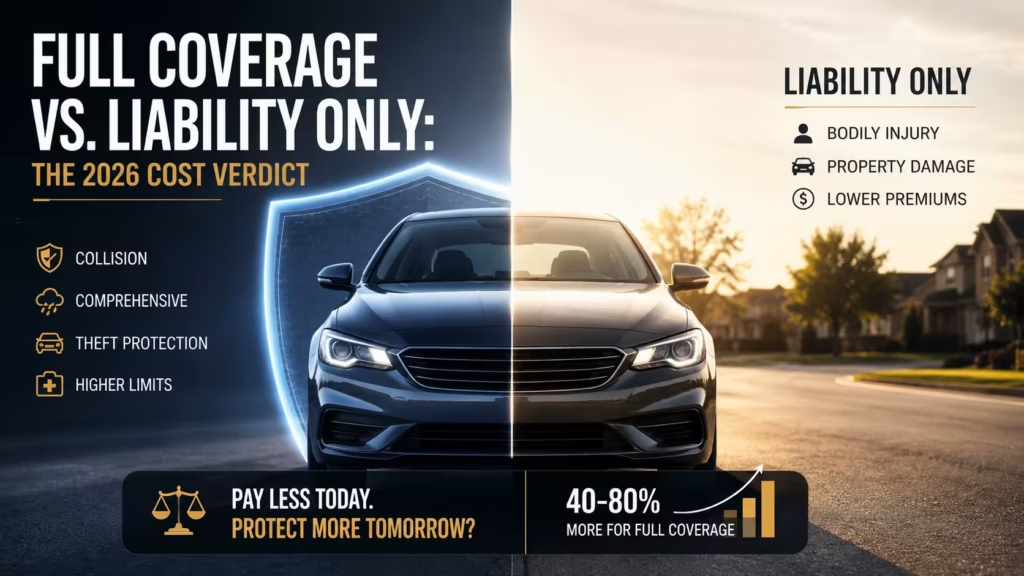
Full coverage costs 40-80% more than liability only. See real 2026 monthly rates, state minimums, and the exact math for deciding which one to drop.
Read more →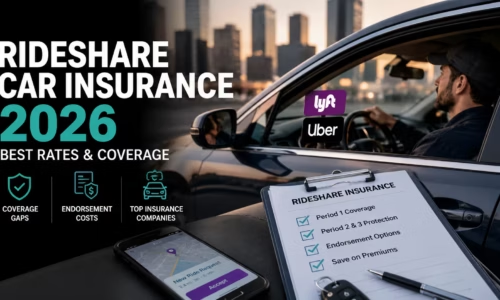
Driving for Uber or Lyft? Discover average 2026 rideshare endorsement costs, Period 1 coverage gaps, top insurance carriers,...
Read more →
See real 2026 Ford F-150 insurance rates by trim, age, state, and driving record, plus the cheapest insurers...
Read more →
A 25-year insurance pro breaks down real 2026 Hyundai Palisade Hybrid Calligraphy premiums, cheapest carriers, hybrid repair costs,...
Read more →
See real 2027 Kia Seltos insurance rates by age, state, and trim, why this redesigned compact SUV beats...
Read more →
Need an SR-22? See real 2026 monthly premiums by violation type, which states require it, and how to...
Read more →Real savings from real people who used our tool to find better rates.
"I was paying around $212/month, which is about the Texas average. After using this tool, I switched to Travelers and now pay $162/month. That's $600 saved per year!"

"No phone calls, no spam, just instant numbers. I compared 5 quotes in under 2 minutes and found a policy $42 cheaper per month. Highly recommend!"

"As a new driver, I was terrified of insurance costs. This tool showed me other quotes averaging over $300/month, then found USAA at $183/month. Best decision ever."

Get expert answers to the most searched car insurance questions, uncover hidden savings opportunities, and make smarter insurance decisions.
The average cost of car insurance in 2026 is approximately $210 per month for full coverage. The national average reaches $2,520 per year. However, your actual rate depends heavily on your state, age, driving record, credit score, and vehicle type. Drivers in Vermont pay around $116/mo, while drivers in Louisiana pay about $328/mo.
Nationally, Country Financial offers the cheapest full coverage at approximately $135/month ($1,620/year), though it's only sold in 19 states. Among carriers available almost everywhere, Travelers is the cheapest at $153/month, followed by Progressive at $155/month and GEICO at $160/month. For military families, USAA is consistently the cheapest at around $124/month ($1,489/year). The cheapest company varies by state and driver profile — use the calculator above to compare all 30.
Rates rose due to: 1) Higher vehicle repair costs (sensors, cameras); 2) Increased medical costs; 3) Record payouts from severe weather; 4) Rising used car values; 5) Inflation. The national average reached $2,520/yr — an increase of 15-25% from 2023 in many states.
Liability only covers damages you cause to others. Full coverage includes liability PLUS Collision (your own car damage) and Comprehensive (theft, weather, vandalism). Minimum liability averages $804/year vs. $2,520/year for full coverage. If you have a newer vehicle or loan, full coverage is recommended.
1) Shop around — compare 3-5 quotes; 2) Raise deductible from $500 to $1,000 (save about 13%); 3) Bundle auto and home (save 10-18%); 4) Drive under 5,000 miles/year for low-mileage discounts (save up to 18%); 5) Drop unnecessary coverages if you already have AAA.
Yes, in most states. Drivers with poor credit can pay 60% to 85% more than those with excellent credit, depending on the insurer. States that fully banned this practice for auto insurance: California, Hawaii, Massachusetts, and Michigan. Oregon and Utah restrict how credit can be used (e.g., for renewals) but don't ban it outright at initial pricing. Improving your credit score by 50-100 points can save hundreds per year.
Vermont is the cheapest at $1,392/year ($116/month). Other cheap states: Maine ($1,584), New Hampshire ($1,596), Idaho ($1,620), and Ohio ($1,632). These states benefit from low population density, fewer accidents, and less severe weather. Nevada is the most expensive at $4,092/yr — nearly 3x more than Vermont.
Yes. EV insurance averages 10% to 18% more than gas cars due to expensive battery packs ($10,000+ to replace), fewer certified repair shops, and specialized parts. Some insurers offer "EV discounts" if you charge at home or have a safe driving record. Look for companies specializing in electric vehicles.
A single speeding ticket raises rates by 20% to 30% on average. If your baseline is $2,520/year (the national average), a ticket could add roughly $500-$600 annually. The increase lasts 3 to 5 years. Some insurers (Progressive, Root) are more forgiving. Consider taking a defensive driving course — some states dismiss the ticket or reduce the impact.
Generally no — if your car is worth less than 10x your annual premium for collision + comprehensive, it's not worth it. Most experts recommend dropping full coverage when your vehicle is 8-10 years old or worth less than $4,000. However, if you have a car loan, your lender will require full coverage regardless of age.